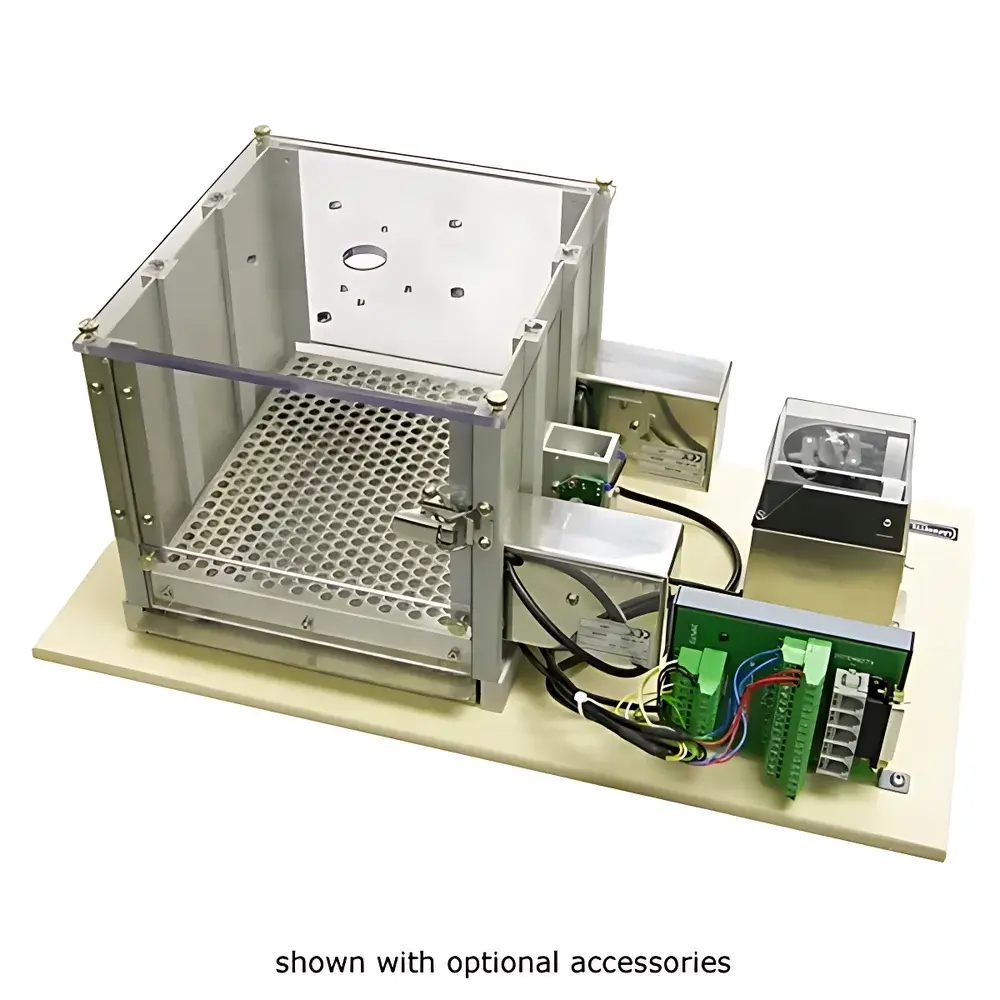
RWD Standard Skinner Box
| Brand | RWD |
|---|---|
| Origin | USA |
| Manufacturer Type | Manufacturer |
| Origin Category | Imported |
| Model | Skinner Box |
| Price Range | USD 1,400 – 7,000 (approx.) |
| Animal Compatibility | Rat & Mouse |
| Enclosure Dimensions | 30.5 × 26.0 × 20.0 cm (L×W×H) |
| Observation Window | 26 cm W × 20 cm H |
| Grid Floor | Stainless Steel, Bar Diameter 4.775 mm, Center Hole Ø15.494 mm, Pitch 10.72 mm |
| Sound-Attenuating Chamber | 64.5 × 44.2 cm, 25 dB attenuation at 3 m |
| LED Illumination | 1" diffused white light, ≥1000 h lifetime |
| Reward Delivery | Pellet dispenser (45 mg / 20 mg), peristaltic liquid pump (0.025–0.20 mL/sec, 57 rpm) |
| Input/Output Module | 8 digital inputs / 15 digital outputs, 0–5 V TTL synchronization |
| Stimulus Control | 7-frequency tone generator (1–16 kHz, 90 dB SPL), RGB nose-poke LED (Ø2.30 cm × 2.29 cm depth), adjustable lever force (rat: 0–25 g |
| mouse | 0–3 g), foot shock (0–5.10 mA, 0.02 mA resolution) |
| Software | Modular behavioral programming suite with task scripting, real-time event logging, timestamped data export (CSV, HDF5), GLP-compliant audit trail, and third-party device synchronization (e.g., electrophysiology, optogenetics, video tracking) |
Overview
The RWD Standard Skinner Box is a rigorously engineered operant conditioning chamber designed for reproducible, ethologically grounded behavioral assays in rodent models. Based on the foundational principles of instrumental learning—where subjects acquire associations between voluntary actions and contingent outcomes—the system implements precise, temporally resolved stimulus-response paradigms under controlled environmental conditions. Its core architecture supports both classical and operant conditioning protocols, including fixed-ratio (FR), variable-interval (VI), progressive-ratio (PR), and second-order schedules. The chamber operates within an acoustically isolated environment (25 dB attenuation at 3 m), minimizing external interference while enabling high-fidelity measurement of latency, response rate, omission errors, and reinforcement efficacy. Designed to meet the operational requirements of preclinical neuroscience, psychopharmacology, and addiction research laboratories, the system complies with NIH Guide for the Care and Use of Laboratory Animals standards and supports alignment with OECD Test Guidelines 426 (Neurotoxicity Study) and FDA-recommended behavioral assay validation frameworks.
Key Features
- Fully modular chassis: Interchangeable front panels accommodate levers (rat/mouse-specific geometry and force calibration), nose-poke apertures (RGB-lit, depth-sensing), liquid/pellet dispensers, and stimulus emitters without mechanical reconfiguration.
- Electromechanically calibrated actuation: Rat lever (3.8 cm wide, 0.3175 cm travel, 0–25 g force threshold); mouse lever (16 mm wide, 0–3 g threshold); nose-poke sensor with tactile feedback and programmable illumination (red/green/yellow).
- Multi-modal stimulus delivery: Seven discrete pure-tone frequencies (1–16 kHz, ±2 dB accuracy at 90 dB SPL), intensity-tunable white light (1″ diffused LED, ≥1000 h lifetime), and precisely controllable foot shock (0–5.10 mA, 0.02 mA resolution).
- High-resolution reward control: Dual pellet dispensers (20 mg and 45 mg options); peristaltic liquid pump (0.025–0.20 mL/sec, 57 rpm motor, flow stability ±3% over 24 h).
- Synchronization-ready I/O architecture: 8 digital inputs / 15 digital outputs, 0–5 V TTL-compatible, enabling hardware-level time-locking with electrophysiology amplifiers, calcium imaging systems, or high-speed video acquisition platforms.
- Acoustic isolation chamber: Double-door polycarbonate enclosure (64.5 × 44.2 cm footprint) with acoustic foam lining, integrated ventilation fan, and ambient light shielding—validated to ISO 3744 sound power standards.
Sample Compatibility & Compliance
The RWD Standard Skinner Box is validated for use with Sprague-Dawley and Wistar rats (200–500 g) and C57BL/6, BALB/c, and CD-1 mice (18–35 g). All contact surfaces—including stainless-steel grid floor (bar diameter 4.775 mm, pitch 10.72 mm)—are autoclavable and compliant with ASTM F2100 Level 3 biocompatibility requirements. The system supports full traceability per 21 CFR Part 11 through software-enforced user authentication, electronic signatures, and immutable audit logs for all protocol modifications, session executions, and data exports. It meets GLP Annex 11 (EU) and ISO/IEC 17025:2017 clause 7.7 requirements for measurement uncertainty documentation in behavioral endpoints. Electrical safety conforms to UL 61010-1 and IEC 61000-6-3 EMC emission limits.
Software & Data Management
RWD’s proprietary behavioral programming suite provides a hierarchical, script-based interface for defining experimental logic: from basic FR-1 schedules to multi-stage discrimination tasks with conditional branching. Each session generates timestamped, millisecond-precision event logs (e.g., “nose-poke-enter”, “lever-press”, “reward-deliver”, “shock-onset”) stored in HDF5 format for MATLAB/Python interoperability. The software includes built-in statistical modules for calculating response rates, breakpoint analysis (for PR schedules), extinction curves, and Pavlovian-to-instrumental transfer indices. All data files are digitally signed and version-stamped; raw logs retain provenance metadata (operator ID, hardware serial number, firmware revision, calibration date). Export options include CSV (for SPSS/GraphPad), JSON (for LIMS integration), and direct SQL push to institutional research databases.
Applications
- Psychostimulant and opioid self-administration: Programmable IVSA protocols with dose escalation, timeout enforcement, and extinction/reinstatement phases.
- Cognitive flexibility testing: Attentional set-shifting via compound discrimination reversal and intra-/extra-dimensional shift paradigms.
- Neuropharmacological screening: Dose-response assessment of dopaminergic, serotonergic, and GABAergic agents on motivation, impulsivity, and compulsive responding.
- Optogenetic-behavioral interfacing: TTL-synchronized laser pulse delivery during lever press or nose-poke events for causal circuit interrogation.
- Developmental neurotoxicity assessment: Longitudinal operant performance tracking across adolescence into adulthood following prenatal or early-life exposure.
- Translational biomarker validation: Correlation of operant metrics (e.g., breakpoint, latency variability) with ex vivo tissue assays (dopamine transporter binding, dendritic spine density).
FAQ
Is the Skinner Box compatible with third-party electrophysiology or imaging systems?
Yes—the 0–5 V TTL I/O module enables hardware-level synchronization with commercial patch-clamp amplifiers, fiber photometry systems, and high-speed cameras via NIDAQ or BNC-triggered interfaces.
Can the software generate FDA-submission-ready audit trails?
Yes—it maintains immutable, time-stamped records of all user actions, parameter changes, and data exports, fulfilling 21 CFR Part 11 requirements for electronic records and signatures.
What maintenance is required for the foot shock module?
The constant-current circuit requires no recalibration; periodic verification using a calibrated load resistor (included) is recommended every 6 months per ISO/IEC 17025 preventive maintenance guidelines.
Does the system support automated cleaning cycles between subjects?
While not fully automated, the stainless-steel grid floor and removable polycarbonate panels allow rapid disinfection with 70% ethanol or approved veterinary-grade sporicides; airflow rate in the isolation chamber is configurable to achieve ≥15 air exchanges/hour.
Are firmware updates provided post-purchase?
Yes—RWD offers free firmware and software updates for the duration of the standard 2-year warranty, including new stimulus paradigms, expanded I/O mapping, and enhanced data export formats.