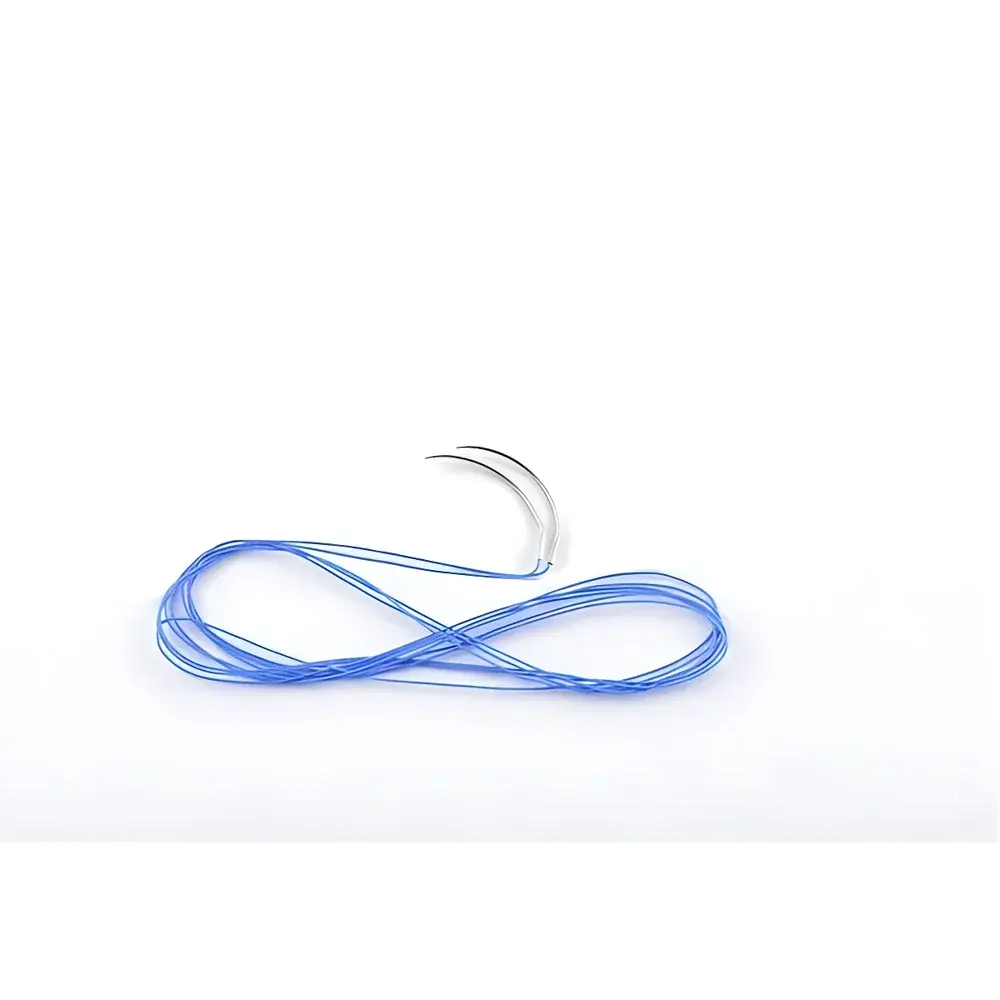
RWD Suture Needles with Attached Sutures
| Brand | RWD |
|---|---|
| Origin | Shenzhen, China |
| Manufacturer Type | Manufacturer |
| Product Origin | Domestic (China) |
| Model | RWD |
| Pricing | Upon Request |
Overview
RWD Suture Needles with Attached Sutures are precision-engineered surgical sutures designed for consistent handling, reliable tissue penetration, and optimal wound approximation in preclinical research, veterinary procedures, and laboratory-based surgical training. These sterile, single-use sutures integrate high-tensile synthetic filaments—polyester, nylon, and polyglycolic acid (PGA)—with precisely ground, stainless steel needles featuring standardized geometries (e.g., 1/2-circle, 3/8-circle, triangular, and spatula/“铲” [spatulate] configurations). Each suture is manufactured under controlled cleanroom conditions compliant with ISO 13485 quality management requirements for medical devices, ensuring dimensional accuracy, needle sharpness reproducibility, and filament integrity. The system operates on mechanical principles of tensile strength transfer and controlled tissue drag—critical for minimizing trauma during passage and maximizing knot security in soft-tissue models.
Key Features
- Multi-material filament portfolio: Non-absorbable polyester (high strength, low tissue reactivity), non-absorbable nylon (excellent elasticity and smooth passage), and absorbable PGA (hydrolytic degradation profile suitable for short-term wound support, typically 2–3 weeks in vivo)
- Needle geometry variants: 1/2-circle and 3/8-circle curved needles for general soft-tissue approximation; triangular (cutting) needles for dense or fibrous tissues (e.g., skin, tendon); spatulate (铲) needles optimized for delicate ophthalmic or microvascular applications
- Precise metric sizing: Filament diameters conform to USP/ISO suture size standards (e.g., 12-0 to 1#, corresponding to ~0.015–0.40 mm), with needle dimensions (length × chord width, e.g., 2×5 mm) specified per USP-defined curvature and cross-section tolerances
- Consistent packaging configuration: Dual-length (90 cm) configurations for general surgery; single-length (30 cm or 90 cm) options for microsurgery or specialized protocols; all supplied in EO-sterilized peel-open pouches with lot traceability
- Traceable manufacturing: Full batch documentation, including raw material certifications (ASTM F1871 for polyester, ASTM D4067 for nylon, ISO 10993-1 biocompatibility summary), and process validation records available upon request for GLP-compliant study reporting
Sample Compatibility & Compliance
These sutures are validated for use across rodent, rabbit, porcine, and canine surgical models in academic, contract research organization (CRO), and pharmaceutical preclinical settings. Polyester and nylon variants meet ISO 9001 and ISO 13485 requirements for Class I/IIa medical devices. PGA sutures comply with ISO 10993-1 (biological evaluation) and USP particulate matter testing. All products are manufactured without animal-derived components and are free from latex, DEHP, and heavy metals. Packaging adheres to ISO 11607-1 for sterile barrier systems. Documentation supports FDA 21 CFR Part 58 (GLP) and ICH S5(R3) reproductive toxicity study compliance when used as procedural tools.
Software & Data Management
While the sutures themselves are passive medical devices requiring no embedded electronics or software, RWD provides comprehensive digital traceability via batch-specific Certificates of Analysis (CoA) and Certificates of Conformance (CoC). These documents—delivered in PDF format with digital signatures—are structured to integrate into electronic lab notebook (ELN) systems such as LabArchives or Benchling. Each CoA includes filament tensile strength (per ASTM D2256), needle sharpness (measured per ASTM F2182), sterility assurance level (SAL 10⁻⁶, verified by ISO 11135), and endotoxin levels (<0.5 EU/mL, tested per USP ). Audit trails and revision-controlled documentation are maintained for ≥10 years post-manufacture to support regulatory inspections.
Applications
- Preclinical wound healing studies: Standardized closure of incisional or excisional defects in murine dorsal skin models using 5-0 to 6-0 PGA or nylon
- Cardiovascular surgery training: Anastomosis simulation using 7-0 or 8-0 nylon with 3/8-circle spatulate needles on silicone or ex vivo porcine aorta
- Ophthalmic microsurgery practice: Corneal suture placement with 10-0 or 11-0 nylon and ultra-fine 3/8-circle round needles (0.6×4 mm)
- Tendon repair modeling: High-tension approximation of rat Achilles tendon using 3-0 polyester with 1/2-circle cutting needles (5×12 mm)
- Toxicology endpoint assessment: Suture site histopathology scoring (e.g., inflammation, fibrosis, granuloma formation) in repeat-dose studies per OECD 407 guidelines
FAQ
Are these sutures suitable for GLP-regulated toxicology studies?
Yes—full CoA and CoC documentation, sterilization validation reports, and raw material traceability are provided to satisfy OECD GLP Principles and FDA 21 CFR Part 58 requirements.
What is the shelf life and recommended storage condition?
Sterile shelf life is 5 years when stored unopened at 15–30°C and ≤60% relative humidity; avoid direct sunlight and repeated temperature cycling.
Can custom needle-suture combinations be supplied for specialized protocols?
RWD offers OEM/ODM services—including non-standard needle curvatures, custom filament coatings (e.g., silicone-lubricated nylon), and alternate packaging formats—subject to minimum order quantities and design verification timelines.
Do you provide ISO 10993 biocompatibility data for PGA sutures?
Yes—a full ISO 10993-1 summary report covering cytotoxicity (ISO 10993-5), sensitization (ISO 10993-10), and intramuscular implantation (ISO 10993-6) is available upon request for each PGA lot.
How is needle sharpness quantified and controlled during production?
Sharpness is measured per ASTM F2182 using a calibrated force-displacement sensor; mean penetration force is maintained within ±15% of target values across production lots, with statistical process control (SPC) charts retained for audit.