
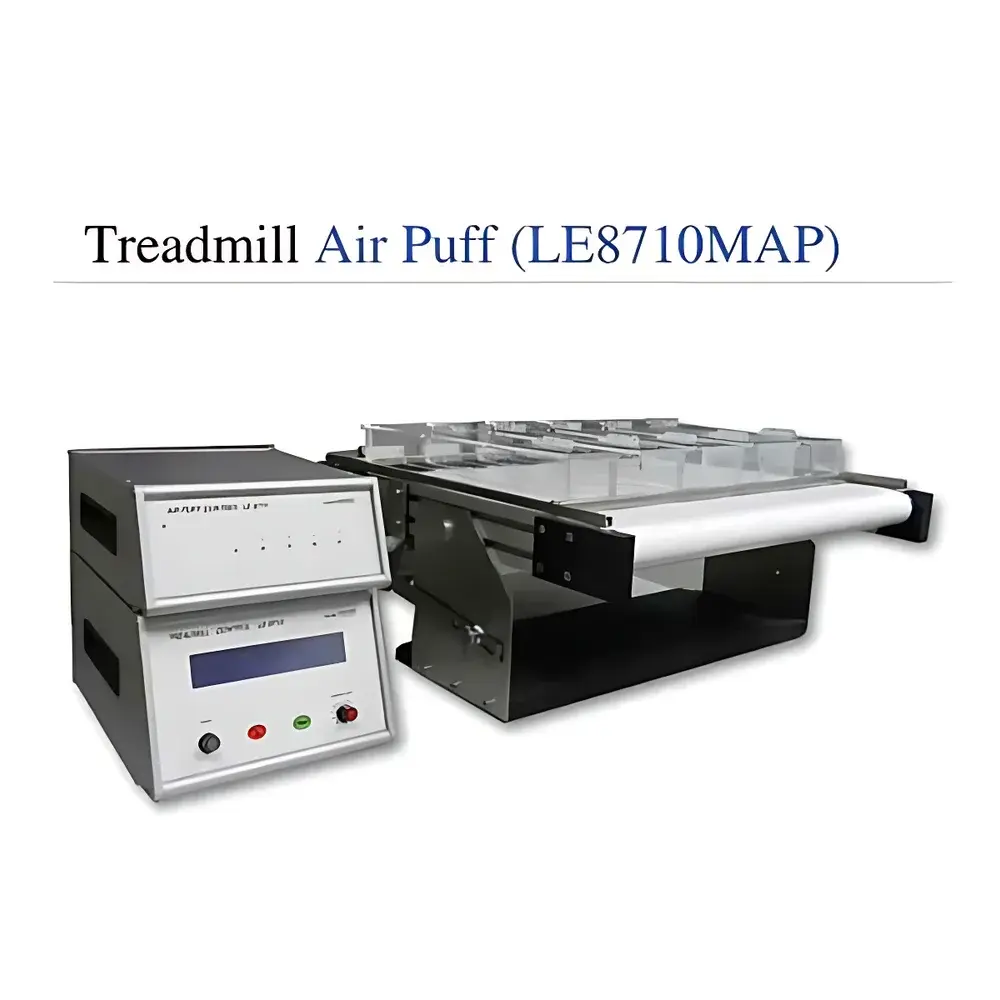
Panlab LE8700TS Series Touchscreen Treadmill System for Rodent Forced Exercise and Fatigue Testing
| Brand | RWD |
|---|---|
| Origin | Spain |
| Manufacturer Type | Original Equipment Manufacturer (OEM) |
| Origin Category | Imported Instrument |
| Model | Panlab LE8700TS Series |
| Price | USD 13,500 (approx.) |
Overview
The Panlab LE8700TS Series Touchscreen Treadmill System is a rigorously engineered platform designed for standardized forced exercise protocols and objective fatigue assessment in preclinical rodent models. Based on the biomechanical principle of controlled locomotor load imposition, the system applies quantifiable mechanical or aversive stimuli to elicit voluntary running behavior under precisely regulated kinematic conditions. Its core architecture integrates motorized belt propulsion, programmable incline adjustment, and stimulus delivery modules—enabling reproducible induction of physiological stress responses relevant to cardiovascular endurance, neuromuscular fatigue, metabolic adaptation, and behavioral phenotyping studies. Validated for use in ISO 17025-accredited laboratories and compliant with NIH and EU Directive 2010/63/EU requirements for humane animal experimentation, the treadmill supports both acute challenge paradigms and longitudinal training regimens across murine and rat strains.
Key Features
- Integrated touchscreen control unit with real-time graphical interface for speed (0–150 cm/s), incline (±25°), stimulation intensity, and session timing
- Modular runway configuration: single- to five-lane models available for mice (LE8708TS/LE8709TS/LE8710MTS) and rats (LE8700TS/LE8706TS/LE8710RTS); dedicated single-lane rabbit model (LE8715TS)
- Dual-stimulus compatibility: adjustable foot-shock grid (0–2 mA DC) and optional pneumatic air-puff module (interchangeable via standardized mounting interface)
- Independent lane control: individual start/stop, stimulus activation, and data logging per channel without cross-interference
- High-durability polyurethane-coated belt with low-friction surface optimized for repeated high-speed operation and easy decontamination
- Optional indirect calorimetry integration: LE8700TSC and LE8708TS models feature gas-tight chamber design compatible with OxyletPro respiratory monitoring systems
Sample Compatibility & Compliance
The system accommodates standard laboratory rodents including C57BL/6, BALB/c, Sprague-Dawley, and Wistar strains. Runway dimensions and grid spacing are calibrated per species-specific gait dynamics and paw morphology—ensuring consistent stimulus contact and minimizing unintended stress artifacts. All hardware components meet IEC 61000-4 electromagnetic compatibility standards and carry CE marking for in vitro diagnostic and research instrumentation. The platform supports GLP-compliant experimental workflows through audit-trail-capable software logging (via SEDACOM v2.0), traceable calibration records, and user-access-level authentication. Protocols align with ASTM E2917-22 (Standard Practice for Preclinical Exercise Testing) and NIH Guide for the Care and Use of Laboratory Animals (8th Edition).
Software & Data Management
SEDACOM v2.0 serves as the native data acquisition and analysis suite, communicating via USB 2.0 with full timestamp synchronization. It captures time-stamped parameters including total distance, cumulative running time, latency to first shock, number of shocks received, and velocity-incline profiles. Export formats include CSV, MATLAB (.mat), and HDF5 for downstream statistical modeling (e.g., R, Python SciPy, GraphPad Prism). For metabolic studies, METABOLISM v3.0 and METAOXY modules integrate seamlessly with LE4002FL airflow controllers and LE405 O2/CO2 analyzers, enabling VO2, VCO2, RER, and energy expenditure calculations per lane. All software modules comply with FDA 21 CFR Part 11 requirements for electronic records and signatures when configured with password-protected user roles and immutable audit logs.
Applications
- Evaluation of exercise tolerance and exhaustion thresholds in models of heart failure, muscular dystrophy, or mitochondrial myopathy
- Pharmacodynamic assessment of ergogenic compounds, anti-fatigue agents, or neuroprotective therapeutics
- Behavioral phenotyping in depression/anxiety models using forced swim–treadmill cross-validation
- Respiratory metabolism profiling during graded exercise via indirect calorimetry-coupled configurations
- Neuromuscular coordination analysis through gait parameter extraction (step frequency, stride length variability) using synchronized video tracking add-ons
- Training protocol standardization for transplantation or surgical recovery studies requiring preoperative conditioning
FAQ
Is the treadmill compatible with third-party video tracking systems?
Yes—the system provides TTL pulse output synchronized with belt motion and stimulus events, enabling precise frame-locked integration with EthoVision XT, Noldus, or custom OpenCV-based tracking pipelines.
Can incline and speed be changed dynamically during a single run?
Yes—protocols support up to 10 programmable phase transitions per session, allowing ramped or stepwise adjustments in real time without interrupting data acquisition.
What maintenance is required for long-term reliability?
Belt tension verification every 200 hours; quarterly cleaning of shock grid contacts with 70% ethanol; annual calibration of speed/incline actuators using certified reference encoders.
Does the system support automated session termination upon fatigue detection?
Yes—customizable criteria include consecutive immobility >3 s, failure to cross designated zones, or cumulative shock count exceeding threshold; all trigger immediate lane stop and event logging.
Are replacement parts and service contracts available globally?
RWD maintains authorized service centers in North America, EMEA, and APAC regions; all consumables (belts, grids, covers) carry 24-month shelf-life certification and ship with lot-specific QC documentation.
Related Products





