
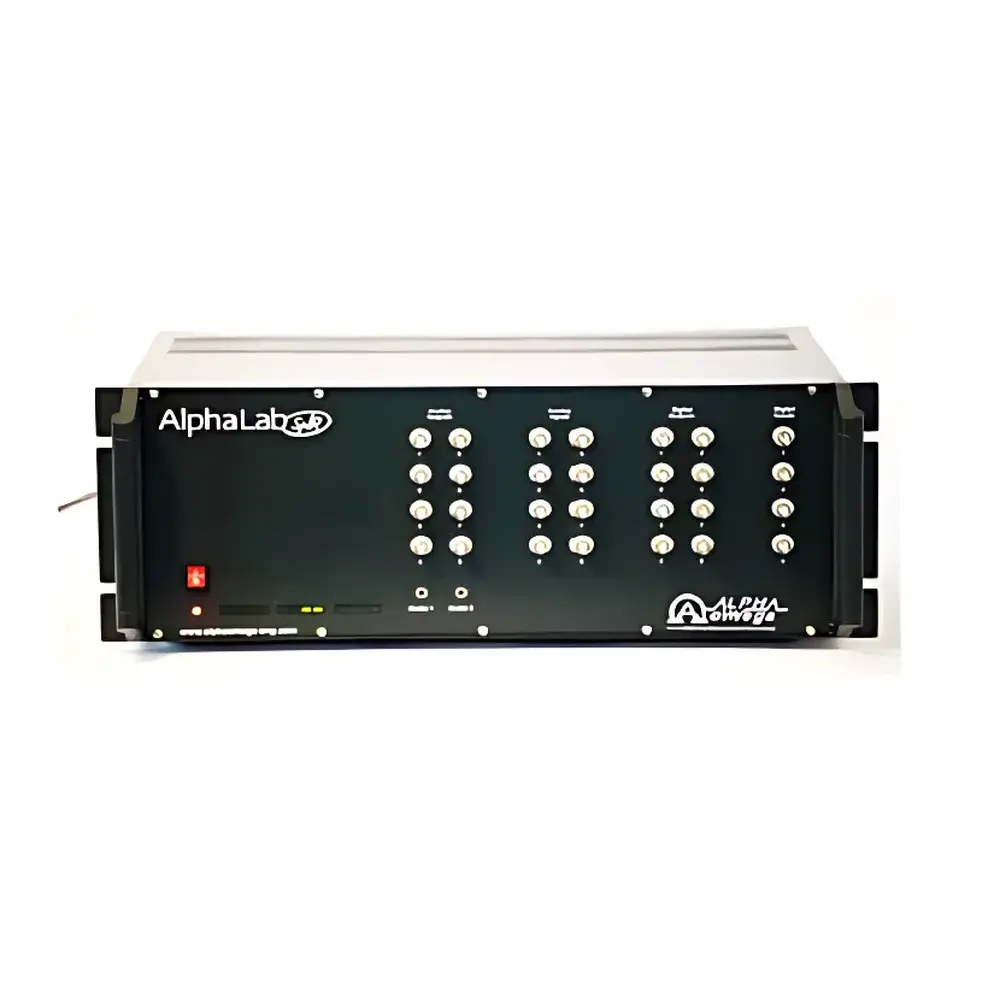
RWD AlphaLab SnR Multi-Channel Neurophysiological Recording and Stimulation System
| Brand | RWD |
|---|---|
| Origin | Guangdong, China |
| Manufacturer Type | Original Equipment Manufacturer (OEM) |
| Country of Origin | China |
| Model | AlphaLab SnR |
| Pricing | Available Upon Request |
Overview
The RWD AlphaLab SnR Multi-Channel Neurophysiological Recording and Stimulation System is a high-fidelity, modular electrophysiology platform engineered for in vivo extracellular neural signal acquisition and closed-loop experimental control in rodent and non-human primate models. Built upon low-noise analog front-end architecture and real-time digital signal processing (DSP), the system captures raw voltage waveforms at sampling rates up to 30 kS/s per channel with 16-bit resolution, enabling precise discrimination of action potentials (spikes), local field potentials (LFPs), electroencephalograms (EEG), electrooculograms (EOG), electromyograms (EMG), and electrocorticograms (ECoG). Its core design adheres to the principles of bidirectional neural interfacing—supporting simultaneous recording and programmable electrical microstimulation across configurable electrode channels. This capability facilitates causal interrogation of neural circuits during both freely moving and head-fixed behavioral paradigms, with hardware-level synchronization (<10 µs jitter) to external TTL triggers, video tracking systems, optogenetic drivers, and behavioral control modules.
Key Features
- Scalable channel architecture: Configurable from 16 to 128 recording channels per unit; multiple units can be synchronized via master-slave timing distribution for >512-channel experiments.
- Dual-mode acquisition: Simultaneous high-bandwidth spike sorting (0.3–10 kHz) and low-frequency LFP/EEG monitoring (0.1–500 Hz) on all channels without hardware switching.
- Integrated stimulation engine: Programmable biphasic current/voltage pulses (0.1–200 µA, 0.1–10 V, 10 µs–100 ms pulse width) with inter-stimulus interval control and artifact blanking.
- Real-time latency performance: End-to-end signal path delay <250 µs from analog input to digital output, validated under continuous 32-channel streaming at 30 kS/s.
- Ruggedized analog design: Input-referred noise ≤1.2 µVRMS (1–5000 Hz), common-mode rejection ratio (CMRR) >100 dB, and ±10 V input range with overvoltage protection.
- Modular expansion support: Compatible with RWD’s stereotaxic positioning systems, wireless telemetry adapters, and third-party commutators for chronic freely moving studies.
Sample Compatibility & Compliance
The AlphaLab SnR system supports acute and chronic recordings using silicon-based linear probes (e.g., Neuropixels, Cambridge Neurotech), tetrodes, microwire arrays, and custom ECoG grids. It accommodates standard 32-pin Omnetics connectors and provides configurable gain settings (100×–1000×) optimized for high-impedance microelectrodes (0.3–5 MΩ). All firmware and data acquisition protocols comply with GLP-aligned documentation standards, including audit-trail-enabled session logging, user-access controls, and timestamped metadata embedding (ISO/IEC 17025 traceability framework). While not FDA-cleared for clinical use, the system meets essential requirements of IEC 61000-4 electromagnetic compatibility standards and conforms to RoHS Directive 2011/65/EU for hazardous substance restrictions.
Software & Data Management
The proprietary SnR software suite (v5.2+) runs natively on Windows 10/11 (64-bit) and provides a unified interface for hardware configuration, real-time visualization, offline spike sorting (using integrated WaveClus and Kilosort 2.5 wrappers), and multi-modal data alignment. Raw data are stored in HDF5 format with embedded provenance metadata (animal ID, electrode coordinates, stimulus parameters, behavioral event markers). The software supports export to NWB 2.0, MAT, and Phy-compatible formats for interoperability with open-source analysis pipelines. For regulated environments, optional 21 CFR Part 11 compliance modules provide electronic signatures, role-based permissions, and immutable audit logs—fully compatible with GMP/GLP laboratory information management systems (LIMS).
Applications
- Systems neuroscience: Large-scale population coding analysis during decision-making, sensory discrimination, and memory encoding tasks.
- Closed-loop neuromodulation: Real-time detection of epileptiform activity or beta bursts coupled to responsive stimulation for seizure suppression or Parkinsonian symptom mitigation.
- Developmental neurophysiology: Longitudinal tracking of synaptic maturation and network synchrony across postnatal weeks in transgenic mouse models.
- Pharmacological screening: Quantitative assessment of drug-induced changes in firing rate, burst dynamics, and cross-frequency coupling (e.g., theta-gamma phase-amplitude coupling).
- Brain-machine interface (BMI) prototyping: Low-latency neural decoding for robotic arm control or virtual reality navigation in freely moving subjects.
FAQ
What is the maximum number of channels supported in a single synchronized setup?
Up to 512 channels via cascaded configuration of four AlphaLab SnR units with shared master clock distribution.
Does the system support wireless recording?
Yes—optional integration with RWD’s WIRELESS-32 telemetry module enables untethered recording from up to 32 channels at 30 kS/s with onboard compression and low-power RF transmission.
Can spike sorting be performed in real time?
Real-time spike detection and template matching are supported; full waveform-based sorting (e.g., Kilosort) occurs offline but can be initiated immediately post-acquisition with automated pipeline triggering.
Is technical support available outside China?
RWD maintains certified application engineers in the US, Germany, and Singapore, with remote diagnostics, firmware updates, and on-site installation support available under service-level agreements.
How is calibration traceability maintained?
Each unit ships with NIST-traceable calibration certificates for gain, offset, noise floor, and stimulation accuracy, updated annually via RWD’s global metrology lab network.




