
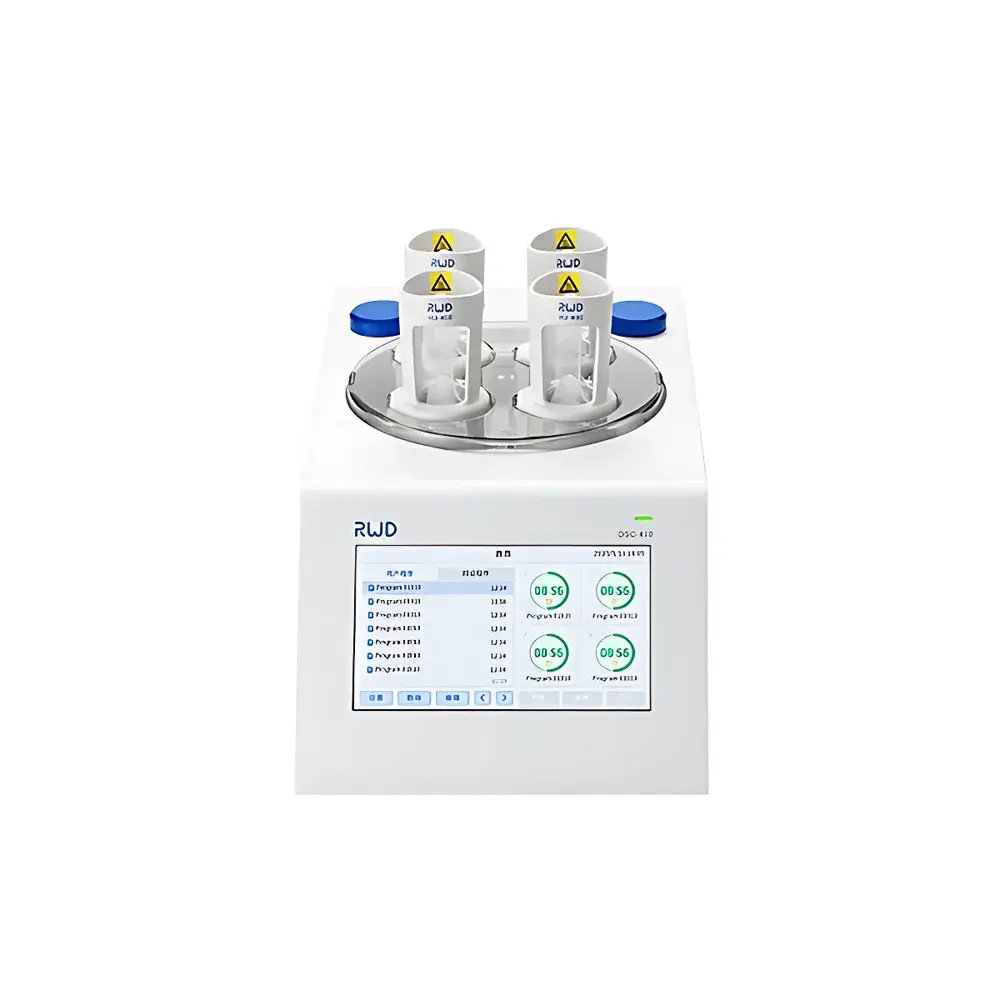
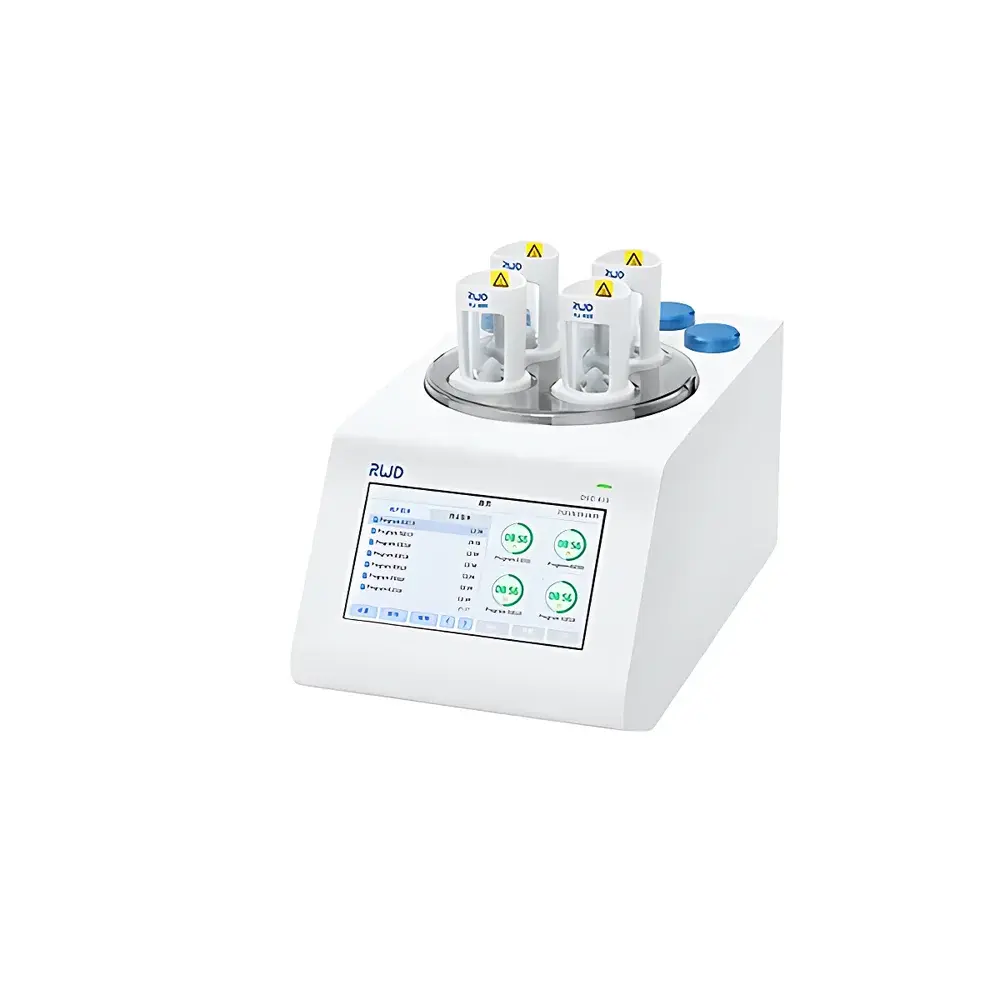
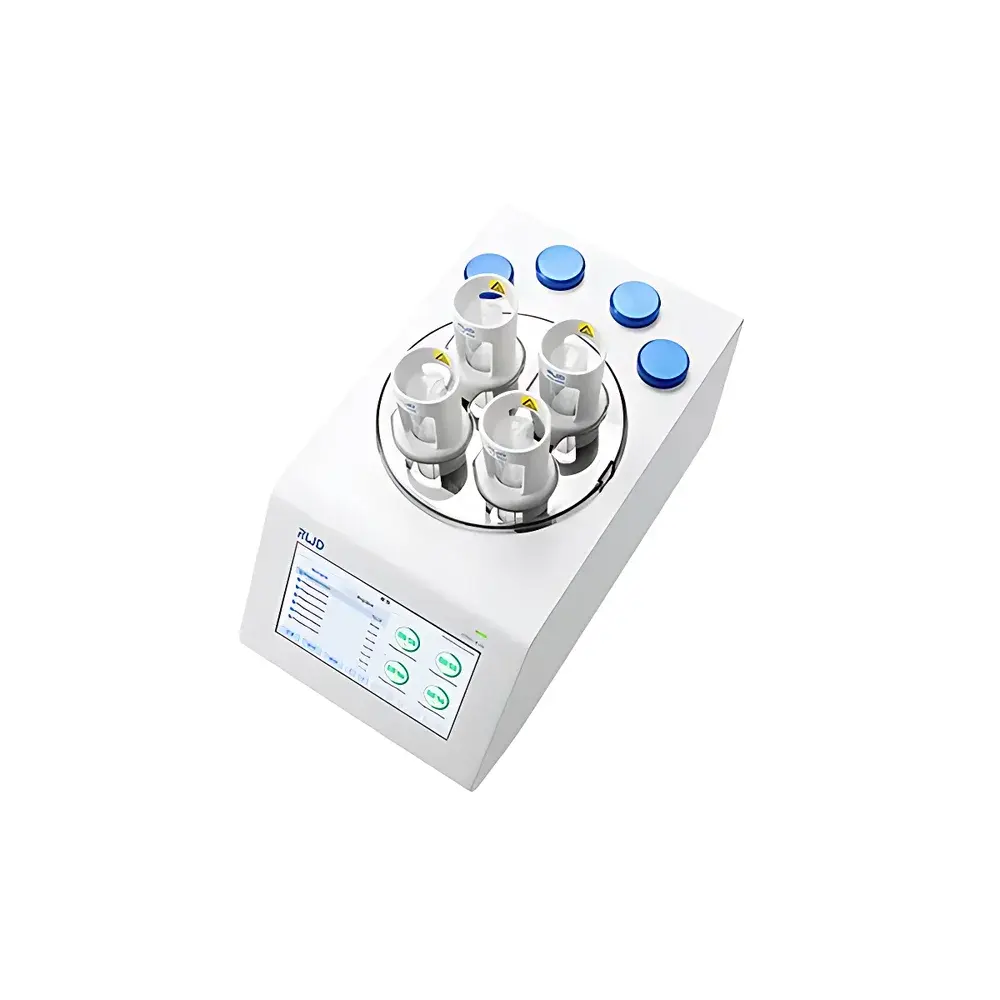
RWD DSC-400 Automated Single-Cell Suspension Preparation System
| Brand | RWD |
|---|---|
| Origin | Guangdong, China |
| Manufacturer Type | Original Equipment Manufacturer (OEM) |
| Country of Origin | China |
| Model | DSC-400 |
| Type | Fully Automated |
| Sample Mass Range | 20–4000 mg |
| Throughput | 4 Independent Channels |
| Temperature Control | 37 °C ± 1 °C |
Overview
The RWD DSC-400 Automated Single-Cell Suspension Preparation System is an engineered platform designed for reproducible, gentle, and standardized dissociation of fresh or preserved tissue specimens into viable single-cell suspensions or homogenates. It operates on a controlled mechanical–enzymatic dissociation principle, integrating programmable rotational agitation, temperature-regulated incubation (37 °C), and proprietary consumables—including tissue processing tubes and enzyme kits—to optimize cell yield, viability, and suspension uniformity. Unlike manual or semi-automated methods subject to operator variability, the DSC-400 delivers high inter-run reproducibility with cycle times ranging from 15 to 30 minutes per sample, making it suitable for high-throughput workflows in translational research laboratories, core facilities, and GLP-compliant preclinical labs.
Key Features
- Four independently controlled processing channels enable parallel processing of heterogeneous tissue types without cross-contamination or thermal interference.
- Integrated heating jacket maintains precise 37 °C temperature control across all channels—critical for enzymatic activity consistency and membrane integrity preservation.
- Programmable motor drive with adjustable speed range (0–4000 rpm) supports tunable shear stress profiles tailored to soft (e.g., brain, spleen) or fibrous (e.g., tumor, muscle) tissues.
- On-device graphical interface displays real-time status of each channel—including rotation speed, elapsed time, temperature, and step progress—ensuring full process transparency.
- Supports up to 1000 user-defined protocols; protocols can be saved locally or transferred via USB for fleet-wide standardization across multiple DSC-400 units.
- Hardware-level safety features include lid-in-place detection, abnormal vibration recognition, and automatic emergency stop to protect both operator and sample integrity.
- Hermetically sealed tissue processing tubes minimize aerosol generation and environmental contamination—aligning with biosafety Level 2 (BSL-2) laboratory requirements.
Sample Compatibility & Compliance
The DSC-400 accommodates a broad spectrum of mammalian tissue types—including murine, human, and non-human primate samples—from solid organs (liver, lung, kidney), immune-rich tissues (spleen, lymph node), tumors (xenografts, PDX models), and neural tissues. Its compatibility with commercially available enzyme kits (e.g., collagenase IV, DNase I, TrypLE) and RWD-optimized reagent systems ensures adherence to established dissociation best practices. While the system itself does not carry CE IVD or FDA 510(k) clearance, its design follows ISO 13485-aligned manufacturing controls, and operational parameters support compliance with Good Laboratory Practice (GLP) documentation standards—including audit-trail-capable protocol logging and timestamped run records. Note: RWD tissue processing tubes are not distributed in the United States due to regulatory classification pathways.
Software & Data Management
The embedded firmware provides local storage of all executed runs with metadata including date/time stamp, selected protocol ID, channel-specific parameters, and final temperature confirmation. USB export functionality enables raw log file transfer for integration into LIMS or ELN platforms. No cloud connectivity or remote access is implemented—ensuring data sovereignty and alignment with institutional IT security policies. Protocol synchronization via USB stick facilitates centralized method validation and version-controlled deployment across multi-instrument environments—essential for contract research organizations (CROs) and academic core facilities requiring SOP harmonization.
Applications
- Flow Cytometry & Cell Sorting: Generates suspensions with >90% viability and <15% debris content—meeting stringent input requirements for spectral flow cytometers and high-speed sorters (e.g., BD FACSAria, Beckman CytoFLEX).
- Primary Cell Culture: Preserves surface marker expression and functional responsiveness post-dissociation, supporting downstream applications such as 3D organoid formation, co-culture modeling, and cytokine profiling.
- Single-Cell Multi-Omics: Delivers nuclei- and whole-cell suspensions compatible with 10x Genomics Chromium, BD Rhapsody, and 10x ATAC-seq workflows—minimizing transcriptional artifacts induced by prolonged enzymatic exposure.
- Preclinical Drug Screening: Enables rapid generation of patient-derived or syngeneic tumor cell suspensions for ex vivo pharmacodynamic assays, checkpoint inhibitor response testing, and CAR-T cytotoxicity evaluation.
FAQ
Is the DSC-400 compliant with FDA 21 CFR Part 11?
No—the system does not include electronic signature capability or audit-trail encryption required for Part 11 compliance. However, exported logs may be manually archived within a validated LIMS environment meeting Part 11 requirements.
Can the DSC-400 process frozen tissue samples?
It is optimized for fresh or cold-stored (4 °C) tissues. Frozen samples must be fully thawed and equilibrated to room temperature prior to loading to avoid condensation-induced tube seal failure.
Are third-party enzyme kits supported?
Yes—any GMP-grade enzymatic dissociation reagents compatible with standard tissue processing tubes may be used, though RWD-validated kits ensure optimal performance and reproducibility.
What maintenance is required?
Routine cleaning of the rotor chamber and heating jacket surfaces is recommended after every 50 runs; no scheduled calibration is required—the system uses factory-trimmed thermal and rotational sensors.
Is remote monitoring or network integration possible?
No—network interfaces (Ethernet/Wi-Fi) are intentionally omitted to maintain data isolation and simplify regulatory validation in regulated environments.




