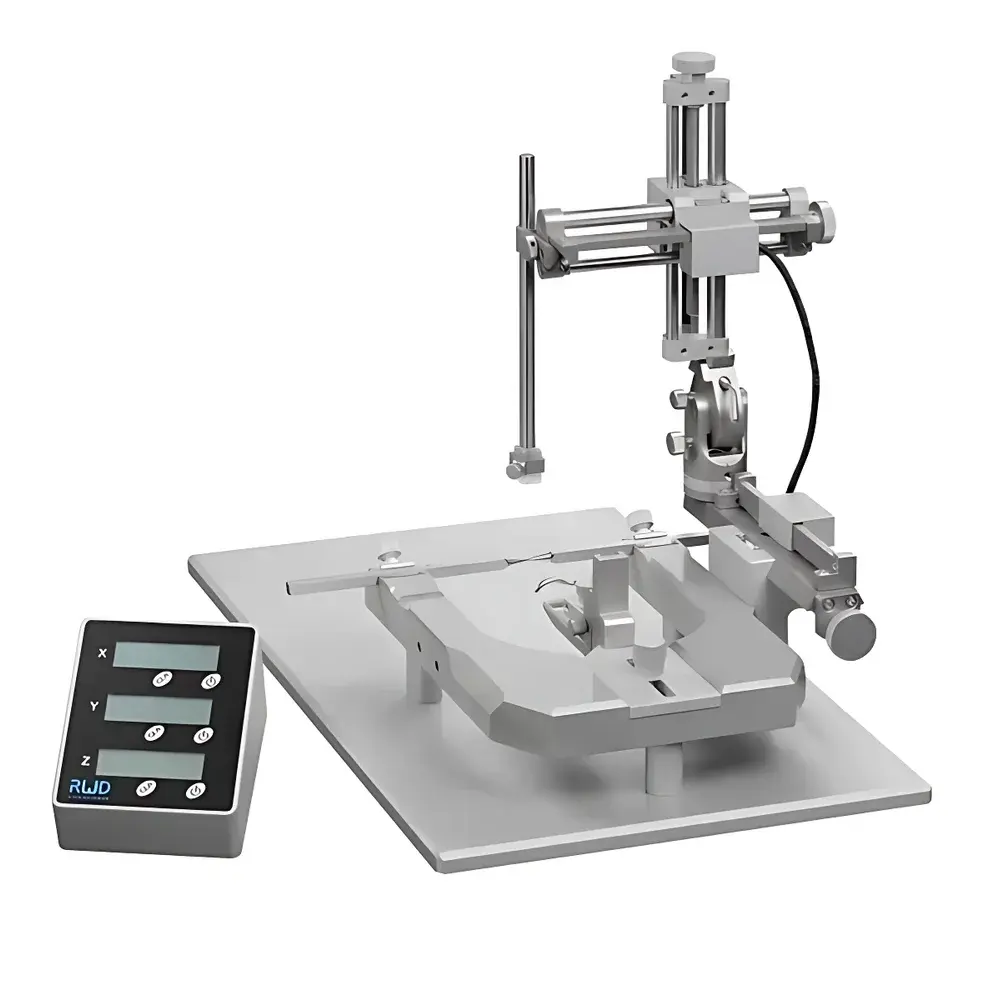
RWD 68016 Desktop Digital Stereotaxic Instrument for Rodent Neurosurgery
| Brand | RWD |
|---|---|
| Origin | Shenzhen, China |
| Manufacturer Type | Direct Manufacturer |
| Regional Classification | Domestic (China) |
| Model | Desktop Digital Stereotaxic Instrument |
| Price Range | USD 1,400 – 7,000 |
| X/Y/Z Axis Resolution | 10 µm |
| Power Supply | AA Battery (No AC Coupling) |
| Max Travel Range per Axis | 80 mm |
| Vertical Rotation | 0–180° with Locking Mechanism |
| Horizontal Rotation | 0–360° with Locking Mechanism |
| Sensor Source | European Imported Precision Displacement Sensors |
| Display | LCD with Real-time Three-Axis Coordinate Readout |
| Zero-Point Calibration | User-Defined Arbitrary Origin on All Axes |
| Material Surface | Chemically Resistant & Autoclavable Stainless Steel Finish |
| Compliance | Designed for GLP-compliant electrophysiology and stereotactic surgery workflows |
Overview
The RWD 68016 Desktop Digital Stereotaxic Instrument is an engineered solution for high-precision intracranial targeting in small animal neuroscience research. Based on the classical Kopf-type stereotaxic frame architecture, it integrates real-time digital displacement sensing into all three orthogonal axes (X, Y, Z), enabling direct coordinate readout without manual vernier interpolation or secondary calculation. The instrument operates on the principle of stereotactic coordinate transformation—mapping anatomical landmarks (bregma, lambda, interaural line) to a standardized brain atlas space—and delivers reproducible mechanical positioning with sub-10 µm resolution. Its battery-powered LCD module eliminates electromagnetic interference from AC mains, making it suitable for concurrent use with sensitive electrophysiological recording systems (e.g., patch-clamp rigs, extracellular arrays) where signal integrity is critical. The modular design supports both single-arm and dual-arm configurations, accommodating acute surgical setups as well as chronic implantation protocols requiring bilateral electrode or cannula placement.
Key Features
- Real-time digital display of X, Y, and Z coordinates on a backlit LCD screen, powered by two AA batteries to ensure zero electrical noise coupling.
- User-definable origin point: any position along the three axes can be set as (0,0,0), enabling rapid referencing against atlas-based coordinates without arithmetic recalibration.
- European-sourced linear displacement sensors guarantee long-term stability and thermal drift resistance across ambient lab temperatures (15–30°C).
- U-shaped open-base design with laser-etched scale markings improves visibility during deep-brain targeting and facilitates rapid visual verification.
- Dual-head precision lead screws provide smooth, backlash-free motion in all directions; combined with calibrated friction locks, they maintain positional fidelity under load.
- 180° vertical and 360° horizontal rotational capability of the manipulator arm, each with independent mechanical locking at arbitrary angles for angled trajectory insertion (e.g., hippocampal CA1, ventral tegmental area).
- Chemically inert, non-porous stainless steel surface finish resists corrosion from disinfectants (70% ethanol, 1% sodium hypochlorite) and withstands repeated autoclaving (up to 134°C, 3 min cycle).
Sample Compatibility & Compliance
The RWD 68016 system accommodates a full range of rodent and non-rodent models via interchangeable adapters—including mice (C57BL/6, BALB/c), juvenile and adult rats (Sprague-Dawley, Wistar), guinea pigs, pigeons, and geckos. Each adapter maintains consistent ear-bar geometry and incisor bar height relative to the stereotaxic zero plane, ensuring cross-species reproducibility. The instrument conforms to standard neuroanatomical reference frameworks including the Paxinos & Watson rat brain atlas (8th ed.) and Franklin & Paxinos mouse brain atlas (4th ed.). Its mechanical accuracy and traceable calibration path support regulatory compliance in preclinical studies conducted under Good Laboratory Practice (GLP) guidelines. While not certified for clinical use, its design aligns with ISO 13485-aligned manufacturing controls and documentation practices required for IACUC-approved animal protocols.
Software & Data Management
This is a hardware-only stereotaxic platform with no embedded firmware or proprietary software dependency. All coordinate data are displayed locally on the integrated LCD; no USB, Bluetooth, or network interface is present—intentionally eliminating potential sources of electromagnetic interference and cybersecurity risk. Users may manually log coordinates in ELN systems (e.g., LabArchives, Benchling) or export them via external digital calipers interfaced through RS-232 (optional accessory). For labs requiring audit trails, the device supports integration with time-stamped video recording systems (e.g., Basler ace cameras) synchronized to surgical timestamps, satisfying basic FDA 21 CFR Part 11 documentation requirements when paired with appropriate procedural SOPs.
Applications
- Intracerebral microinjection of viral vectors, tracers, or pharmacological agents with spatial accuracy ≤50 µm from target nuclei.
- Chronic implantation of microdrives, tetrodes, silicon probes, or optogenetic fibers into defined cortical or subcortical regions.
- Acute in vivo electrophysiology experiments requiring simultaneous multi-electrode positioning in awake or anesthetized preparations.
- Stereotactic lesioning (electrolytic, radiofrequency, or photochemical) with precise depth control and angular trajectory adjustment.
- Calibration and validation of MRI-guided targeting workflows using ex vivo rodent brain phantoms.
- Training platform for graduate neuroscience courses emphasizing surgical reproducibility and atlas-based navigation principles.
FAQ
Is this instrument compatible with electrophysiology rigs?
Yes—the battery-powered digital display eliminates AC line noise, and the non-magnetic stainless steel construction prevents magnetic field distortion near amplifiers or headstages.
Can I perform bilateral surgeries with a single-arm model?
The 68016 is a single-arm configuration; for true bilateral symmetry, select the dual-arm variant (68017 or 68019) which enables independent, synchronized movement of left and right manipulators.
What is the maximum weight the manipulator arm can support?
The arm supports up to 350 g static load while maintaining ≤10 µm repeatability; dynamic loads (e.g., during micromanipulator actuation) should remain below 200 g.
Are replacement adapters available for non-standard species?
Yes—RWD offers custom adapter design services upon request, including CAD-based validation against skull morphology databases (e.g., Allen Brain Atlas CT scans).
Does the digital module require recalibration?
No—factory-calibrated sensors retain accuracy over ≥10,000 operational cycles; users may verify zero-point consistency using NIST-traceable gauge blocks (not included).