
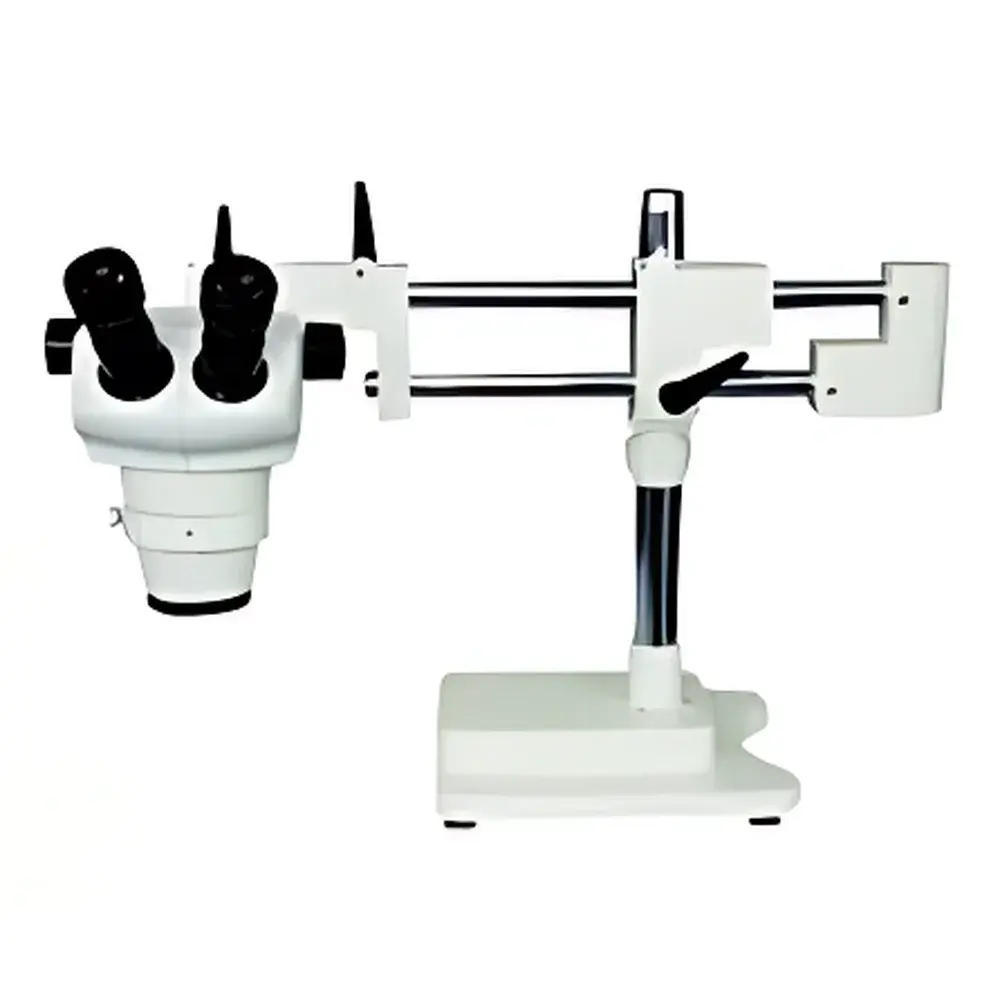
RWD 77019 Dual-Eyepiece Panoramic Stereo Microscope with Universal Articulating Stand
| Brand | RWD |
|---|---|
| Origin | Shenzhen, China |
| Manufacturer Type | OEM/ODM Manufacturer |
| Country of Origin | China |
| Model | 77019 (Binocular Configuration) |
| Zoom Ratio | 6.3:1 |
| Total Magnification Range | 8×–50× (expandable to 8×–200× with optional eyepieces) |
| Eyepieces | Standard 10× (optional 15×, 20×) |
| Working Distance | 115 mm |
| Stand Height | 380 mm |
| Optional Auxiliary Objectives | 0.5× (extended working distance) |
| Illumination Options | LED or Circular Fluorescent Lamp |
| Binocular Tube | 45° inclination, interpupillary adjustment range 52–75 mm |
| Electrostatic Dissipation (ESD) | Available on stand, zoom body, 10× eyepieces, and auxiliary objectives (optional) |
| Sealing | Dust/moisture sealing on zoom body and 10× eyepieces (optional) |
| Trinocular Port | Compatible with DSLR cameras (e.g., Nikon D3100/D90, Canon EOS 450D/1000D), 135 film cameras, and digital CMOS/CCD cameras |
Overview
The RWD 77019 Dual-Eyepiece Panoramic Stereo Microscope is an optomechanically engineered instrument designed for high-fidelity stereoscopic observation in life science research, preclinical surgical procedures, and precision industrial inspection. Based on the Greenough optical architecture—featuring dual independent optical paths—the system delivers upright, three-dimensional images with natural depth perception, eliminating image inversion and enabling intuitive spatial orientation during manipulation. Its 6.3:1 continuous zoom optics provide seamless magnification transitions across 8× to 50× (extendable to 200× with auxiliary eyepieces), while maintaining parfocality and consistent resolution throughout the range. With a fixed working distance of 115 mm and a rigid yet fully articulating universal stand, the microscope supports extended procedural durations without repositioning, making it particularly suitable for microsurgical interventions, neural dissection, and fine-assembly tasks where ergonomic stability and visual fidelity are critical.
Key Features
- Continuous zoom optics with 6.3:1 ratio and calibrated magnification markings for repeatable setting recall
- Binocular viewing head with 45° inclined tube and adjustable interpupillary distance (52–75 mm) to accommodate diverse user anthropometry
- Universal articulating stand with multi-axis rotational joints and locking mechanisms—enabling precise positioning at any angle and azimuth, with smooth, backlash-free motion control
- Robust focusing mechanism featuring hardened rack-and-pinion drive with mechanical end-stop protection to prevent gear damage during over-travel
- Optional ESD-compliant components—including stand base, zoom body, standard 10× eyepieces, and auxiliary objectives—for use in electrostatic-sensitive environments such as semiconductor handling or cleanroom-based device assembly
- Dust- and humidity-resistant sealed optical modules (zoom body and eyepieces) certified to IP54-equivalent ingress protection when configured with optional sealing kits
- Trinocular port with standardized C-mount and T-thread adapters for integration with scientific-grade imaging systems, including DSLRs, mirrorless cameras, and dedicated microscopy CCD/CMOS sensors
Sample Compatibility & Compliance
The RWD 77019 accommodates specimens ranging from live small-animal models (e.g., murine cranial windows, zebrafish embryos) to printed circuit boards, MEMS devices, and microfluidic chips. Its long working distance and wide field of view support both macro-level contextual assessment and localized high-magnification inspection without stage interference. The system complies with ISO 10993-5 biocompatibility guidelines for materials in contact with biological tissues when used with sterilizable accessories. Optional LED illumination meets IEC 62471 photobiological safety Class 1 requirements. While not FDA-cleared as a medical device, its optical performance and mechanical reproducibility align with ASTM E2912–22 standards for stereo microscope verification in laboratory quality control workflows. Documentation packages support GLP/GMP audit readiness, including calibration traceability logs and maintenance records.
Software & Data Management
The microscope operates independently of proprietary software; however, its trinocular output is fully compatible with third-party imaging platforms such as NIS-Elements (Nikon), ZEN Blue (Zeiss), and open-source tools like Fiji/ImageJ. When paired with USB3.0 or GigE cameras, metadata—including magnification level (via encoder-integrated zoom ring), exposure time, white balance, and timestamp—is embedded into TIFF or DICOM-formatted image files. Optional RWD-branded acquisition software provides basic annotation, measurement (distance, area, angle), and batch export functions compliant with 21 CFR Part 11 audit trail requirements when deployed on validated Windows workstations.
Applications
- Preclinical neurosurgery and cardiovascular microdissection requiring real-time depth perception and hand–eye coordination
- Quality assurance in electronics manufacturing: solder joint inspection, wire bonding validation, and PCB defect mapping
- Materials science: fracture surface analysis, coating uniformity evaluation, and additive manufacturing post-process characterization
- Botanical and entomological taxonomy: non-destructive morphological documentation under variable lighting conditions
- Educational laboratories: comparative anatomy instruction, embryology demonstration, and optics pedagogy on depth-of-field and stereopsis principles
FAQ
Is the 77019 compatible with fluorescence imaging?
No—the base configuration lacks epi-fluorescence illumination and filter cubes. However, external LED fluorescence modules with narrowband excitation can be mounted via the auxiliary port or coaxial adapter, provided emission wavelengths do not interfere with the Greenough path geometry.
Can the stand be mounted to a vibration isolation table?
Yes—the base features four M6 threaded holes arranged in a 100 mm square pattern, enabling rigid coupling to standard optical tables and active/passive damping platforms.
What is the maximum sensor size supported by the trinocular port?
With standard C-mount adapters, the system supports sensors up to APS-C format (23.6 × 15.6 mm); full-frame compatibility requires optional relay lens correction to mitigate vignetting.
Does RWD provide factory calibration certificates?
Yes—each unit shipped includes a metrology report verifying magnification accuracy (±2% tolerance per ISO 8578), working distance consistency, and interpupillary alignment, traceable to NIM (National Institute of Metrology, China).
Is service support available outside mainland China?
RWD maintains authorized service partners in Germany, USA, and Singapore; spare parts distribution is managed through regional logistics hubs with lead times under 10 business days for standard components.




