
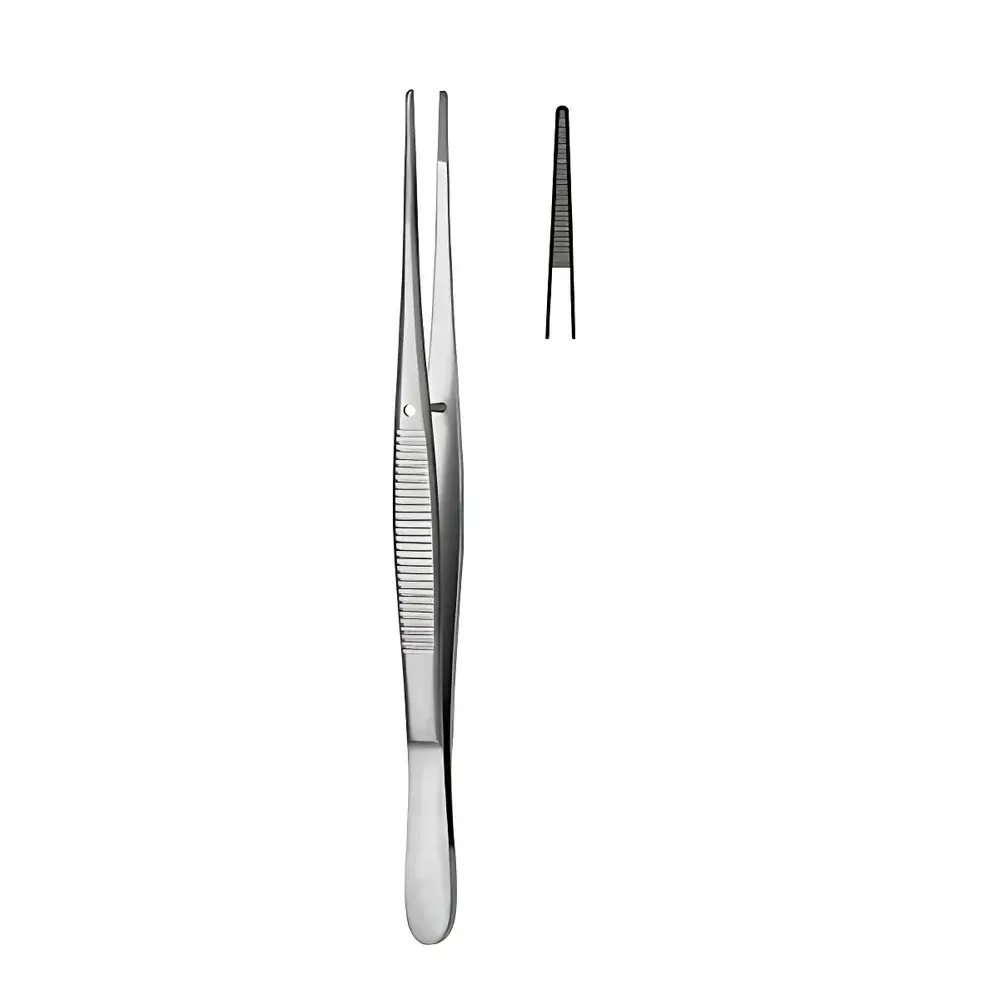
SEMKEN Fine Dissecting Forceps
| Brand | RWD |
|---|---|
| Origin | Shenzhen, China |
| Manufacturer Type | Direct Manufacturer |
| Country of Origin | China |
| Model Numbers | F12015-12, F12015-15 |
| Pricing | Available Upon Request |
Overview
The SEMKEN Fine Dissecting Forceps are precision-engineered stainless steel instruments designed for delicate manual manipulation in life science research, histology, microsurgery, and preclinical laboratory procedures. These forceps operate on a fundamental mechanical principle—lever-based tip closure with calibrated spring tension—to deliver consistent, low-force gripping without tissue slippage or deformation. Unlike general-purpose tweezers, SEMKEN dissecting forceps feature ultra-fine, hand-polished tips with parallel alignment and micron-level tip flatness, enabling reliable handling of fragile biological specimens such as neural tissue, embryonic structures, vessel walls, and cultured cell monolayers. Their 1.0 mm tip width and precisely tapered profile minimize lateral compression during grasping, preserving structural integrity during dissection, mounting, or transfer steps.
Key Features
- High-grade 316L surgical stainless steel construction for superior corrosion resistance, repeated autoclaving (up to 134 °C, 2 bar), and long-term dimensional stability.
- Two standardized lengths: 125 mm (F12015-12) and 150 mm (F12015-15), optimized for ergonomics under stereomicroscope or laminar flow hood operation.
- Parallel-tip geometry with ≤5 µm tip gap tolerance ensures uniform pressure distribution and eliminates point loading on sensitive samples.
- Electropolished surface finish (Ra < 0.2 µm) reduces protein adhesion and facilitates rapid cleaning between experimental runs.
- Ergonomic finger grooves and balanced weight distribution reduce operator fatigue during extended microdissection sessions.
Sample Compatibility & Compliance
These forceps are compatible with a broad range of biological sample types—including fixed and unfixed soft tissues, cryosections, paraffin-embedded specimens, hydrogel scaffolds, and live organotypic explants. They meet ISO 7153-1:2016 (Surgical Instruments — Materials — Part 1: Stainless Steels) and conform to ASTM F899-22 (Standard Specification for Wrought Stainless Steels for Surgical Instruments). All units undergo batch-certified passivation per ASTM A967 and are supplied non-sterile; terminal sterilization is validated per ISO 17664 for reusable medical devices. For GLP-compliant labs, traceability documentation—including material lot numbers and manufacturing date codes—is provided upon request.
Software & Data Management
As a manually operated mechanical instrument, the SEMKEN Fine Dissecting Forceps do not incorporate embedded electronics, sensors, or software interfaces. However, they integrate seamlessly into digitally documented workflows: each model is uniquely identifiable via laser-etched alphanumeric codes (e.g., “F12015-12-RWD-2408XXXX”) for inventory tracking in LIMS or electronic lab notebooks (ELN). When used in conjunction with digital imaging systems (e.g., Zeiss Axio Zoom.V16, Leica M205 FA), their consistent tip geometry supports reproducible image-based measurement protocols, including morphometric analysis of dissected structures. Full compliance with FDA 21 CFR Part 11 is maintained through procedural controls—such as controlled access to sterilization logs and calibration records for associated instrumentation—rather than device-level software.
Applications
- Microdissection of rodent brain regions (e.g., hippocampal subfields, cortical layers) in neuroscience studies.
- Embryonic tissue isolation and explant culture setup in developmental biology assays.
- Handling of fragile biopsy specimens during pathology specimen preparation and frozen section mounting.
- Precision placement of electrodes, micropipettes, or microcarriers in electrophysiology and microinjection platforms.
- Manipulation of hydrogel-based 3D cell cultures and organoid constructs during passaging or assay readout.
FAQ
Are these forceps suitable for sterile surgical use in vivo?
Yes—when terminally sterilized using steam autoclaving (134 °C, 2 bar, 5 min), ethylene oxide (EtO), or hydrogen peroxide plasma, they comply with ISO 13485 requirements for Class I reusable surgical instruments.
What is the recommended cleaning protocol between uses?
Rinse immediately with deionized water after use, followed by ultrasonic cleaning in enzymatic detergent (e.g., Enzol®) for 10 minutes, then rinse thoroughly and dry with lint-free cloth before autoclaving.
Can tip alignment be verified or adjusted in-house?
Tip parallelism can be assessed using optical comparator or digital caliper with 0.001 mm resolution; realignment requires specialized tooling and is recommended only by RWD-certified service centers to maintain tip geometry tolerances.
Is there a warranty or replacement policy for tip damage?
RWD provides a 24-month limited warranty covering material and workmanship defects; accidental tip deformation due to misuse is excluded but may be eligible for refurbishment under RWD’s Instrument Reconditioning Program.




