
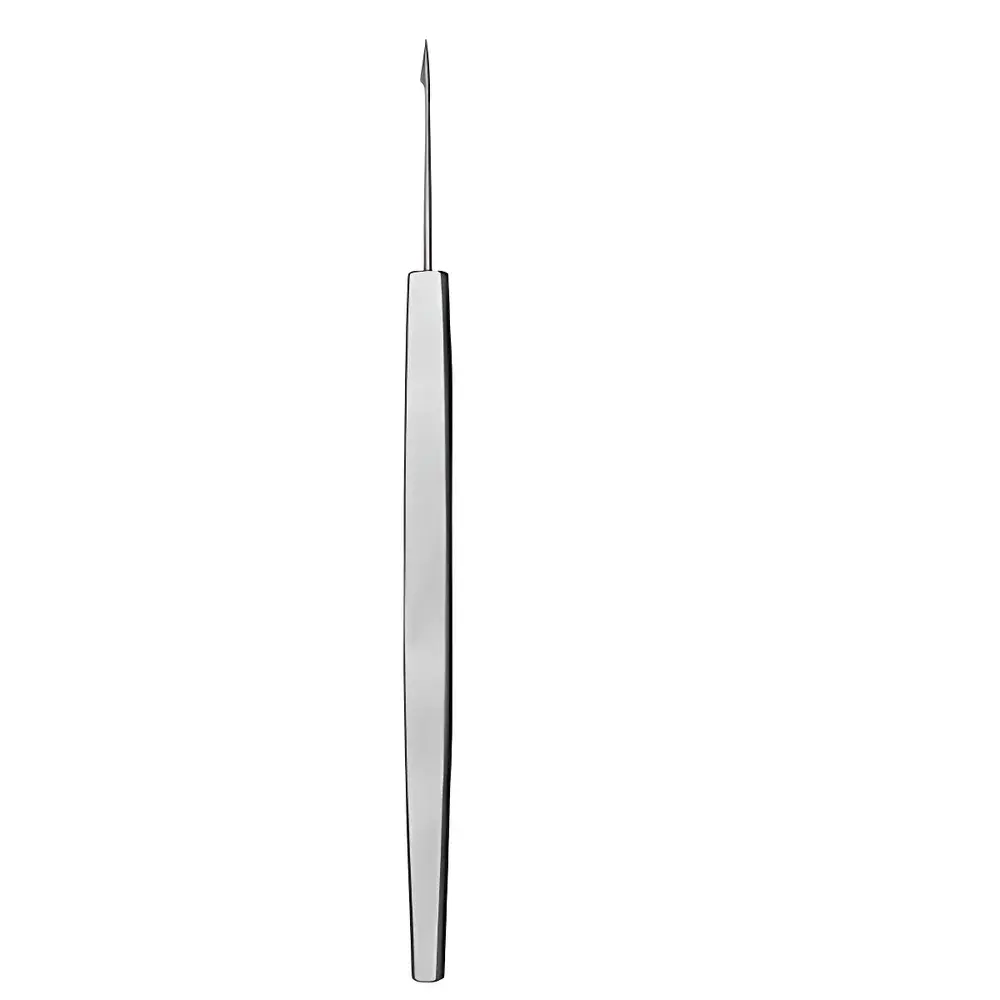
ZIEGLER S33007-12 Dural Membrane Dissector
| Brand | RWD |
|---|---|
| Origin | Shenzhen, China |
| Manufacturer Type | Direct Manufacturer |
| Country of Origin | China |
| Model | S33007-12 |
| Price | Upon Request |
Overview
The ZIEGLER S33007-12 Dural Membrane Dissector is a precision neurosurgical instrument engineered for controlled, atraumatic separation of the dura mater from underlying neural tissues during craniotomy, laminectomy, and other central nervous system procedures. Designed in accordance with established neuroanatomical handling principles, this dissector employs a rigid yet finely balanced stainless steel construction to deliver consistent tactile feedback and minimal tissue displacement. Its geometry—featuring an 8 mm blade length and 1.5 mm blade width mounted on a 12 cm (120 mm) ergonomic shaft—is optimized for subdural plane identification and circumferential dural elevation without risk of inadvertent penetration or shearing. The instrument operates on mechanical dissection principles, relying on precise tip control and calibrated lateral force application rather than thermal or ultrasonic energy, ensuring compatibility with intraoperative neuromonitoring and MRI-compatible surgical environments.
Key Features
- Blade geometry: 8 mm active cutting edge × 1.5 mm width, with polished convex curvature to minimize adhesion and facilitate smooth gliding along dural surfaces
- Shaft length: 120 mm total length, enabling deep-field access while maintaining surgeon wrist stability and reducing tremor transmission
- Material: Medical-grade austenitic stainless steel (ASTM F138/F136 compliant), passivated per ISO 10993-15 for biocompatibility and corrosion resistance
- Surface finish: Electropolished to Ra ≤ 0.4 µm, reducing protein adsorption and facilitating automated washer-disinfector compatibility (ISO 15883-1)
- Ergonomic handle: Knurled stainless steel shaft with non-slip tactile zones, designed for secure two-finger grip and rotational torque control during circumferential dissection
- Reusable design: Fully autoclavable at 134 °C / 273 °F (prevacuum cycle, 18 min), validated per AAMI ST79 and EN 285 standards
Sample Compatibility & Compliance
The S33007-12 dissector is intended for use in human and large-animal neurosurgical models where anatomical fidelity and procedural reproducibility are critical. It is routinely employed in preclinical studies involving rodent, porcine, and non-human primate dural exposure protocols (e.g., cortical window implantation, epidural electrode placement, CSF sampling). The device complies with ISO 7153-1:2016 (Surgical Instruments – Metallic Materials – Part 1: Stainless Steels) and meets essential requirements under the EU MDR 2017/745 Class I (non-sterile, reusable) classification. Sterilization validation documentation—including bioburden testing, half-cycle verification, and material stability post-50 autoclave cycles—is available upon request for GLP-compliant laboratory audits.
Software & Data Management
As a manually operated mechanical instrument, the S33007-12 requires no embedded electronics, firmware, or software integration. Its use does not generate digital output; however, it is fully compatible with electronic surgical documentation systems (e.g., OR Manager, Epic PeriOp) via manual entry of instrument ID (S33007-12), lot number, and sterilization cycle log. For institutions adhering to FDA 21 CFR Part 11 or ISO 13485 quality management systems, traceability is maintained through RWD’s serialized instrument labeling and accompanying Certificate of Conformance (CoC), which includes material certification, dimensional inspection reports, and passivation validation data.
Applications
- Microsurgical dural opening and reflection in supratentorial and infratentorial approaches
- Periosteal elevation prior to burr hole or craniotomy flap creation
- Dissection of arachnoid adhesions adjacent to major venous sinuses
- Preparation of dural flaps for duraplasty or graft anchoring
- Intraoperative identification of dural venous lakes and emissary veins
- Standardized dural exposure in rodent stereotaxic surgery (e.g., viral vector injection, fiber photometry cannula implantation)
FAQ
Is the S33007-12 supplied sterile?
No—this instrument is provided non-sterile and must be sterilized by the end user prior to first use, following institutional protocols.
What is the recommended sterilization method?
Steam sterilization (prevacuum cycle, 134 °C, 18 min) is validated; ethylene oxide and low-temperature hydrogen peroxide plasma are not recommended due to potential residue retention in micro-textured surfaces.
Can this dissector be used for pediatric neurosurgery?
Yes—the 8 mm × 1.5 mm blade profile is appropriate for infant and pediatric dural anatomy when used under high-magnification microscopy and with appropriate depth control techniques.
Does RWD provide instrument tracking or lot-level documentation?
Yes—each S33007-12 unit carries a laser-etched alphanumeric identifier; full traceability documentation (material certs, dimensional QA reports, passivation logs) is accessible via RWD’s customer portal using the serial number.
How often should the blade edge be inspected for wear?
Visual and tactile inspection is required before each use; any evidence of nicks, dulling, or deformation mandates immediate removal from service and reprocessing or replacement per ISO 17664.



