
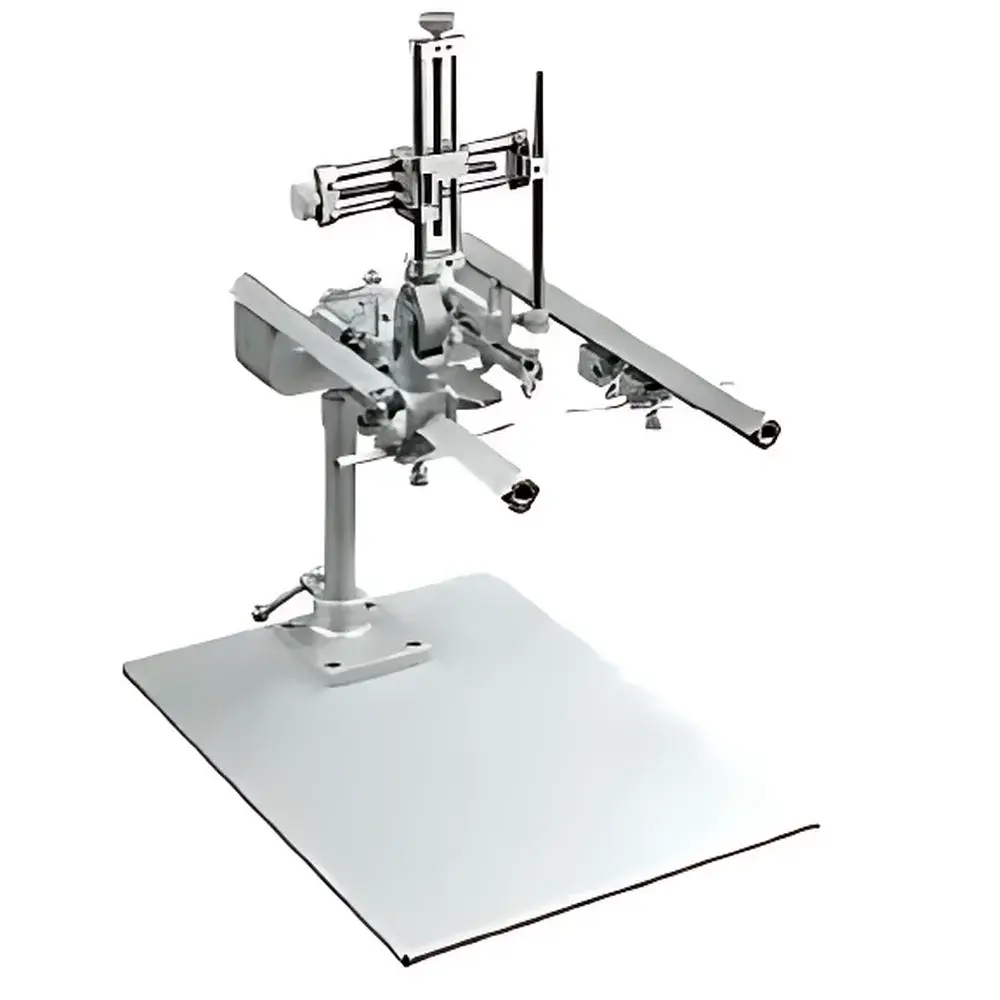
RWD 68902 Large-Animal Stereotaxic Instrument
| Brand | RWD |
|---|---|
| Origin | Guangdong, China |
| Manufacturer Type | Direct Manufacturer |
| Origin Category | Domestic (China) |
| Model | 68902 |
| Pricing | Upon Request |
| Positioning Accuracy | 100 µm / 10 µm (selectable) |
| Y-Axis Travel | 200 mm |
| Arm Configuration | Dual-Arm |
| Compatible Species | Dog, Pig, Non-Human Primate (NHP), Cat |
| Display Type | Analog (standard) |
| Optional Accessories | Precision Ear Bars with Graduated Scale, Skull Adapter Kits, Micro-Handheld Cranial Drill, Multi-Axis Manipulators for Viral Injection or Fiber Optic Implantation |
Overview
The RWD 68902 Large-Animal Stereotaxic Instrument is an engineered precision platform designed for neurosurgical interventions in non-rodent species—specifically dogs, pigs, cats, and non-human primates (NHPs). Unlike rodent stereotaxic systems, which rely on standardized atlases derived from small-brain anatomy, large-animal stereotaxy requires extended mechanical travel, enhanced structural rigidity, and anatomical adaptability to accommodate variable skull morphology, thicker cranial bone, and greater intracranial volume. This instrument operates on the principle of three-dimensional Cartesian coordinate localization relative to defined bregma–lambda reference points, enabling reproducible targeting of deep brain structures—including basal ganglia, thalamus, hippocampus, and cortical layers—with sub-millimeter spatial fidelity. Its design bridges translational neuroscience gaps by supporting preclinical models where physiological, metabolic, and neuroanatomical fidelity to human subjects is essential for evaluating neuromodulation therapies, gene delivery vectors, and neural interface devices under GLP-compliant experimental conditions.
Key Features
- Two selectable positioning resolutions: 100 µm coarse adjustment and 10 µm fine micrometer adjustment per axis (X/Y/Z), calibrated against NIST-traceable standards and verified via optical interferometry during factory QA.
- Extended Y-axis linear motion system featuring a hardened steel dual-rail slide mechanism with 200 mm total travel—optimized for sagittal access to rostral-caudal targets in large skulls without repositioning the animal.
- Dual-arm configuration supports simultaneous bilateral procedures or independent multi-target interventions (e.g., contralateral viral vector injection + ipsilateral fiber photometry probe implantation).
- Z-axis column includes tactile and visual “UP” directional labeling adjacent to the micrometer knob—minimizing operator-induced inversion errors during dorsoventral descent near delicate dural surfaces.
- Graduated ear bar adapters with laser-etched scale markings (0.1 mm increments) ensure consistent interaural alignment and midline symmetry across repeated surgical sessions, critical for longitudinal electrophysiology or imaging studies.
- Modular mounting interface compatible with third-party microdrills, hydraulic microinjectors (e.g., UMP3), optical cannulae holders, and custom-built electrode arrays.
Sample Compatibility & Compliance
The RWD 68902 accommodates head fixation for canines (body weight ≥12 kg), domestic pigs (≥25 kg), macaques (≥4 kg), and felines (≥3.5 kg) using species-specific adapter kits validated per ASTM F2971-21 (Standard Practice for Preclinical Neurosurgical Device Testing in Large Animals). All metallic components are constructed from medical-grade stainless steel (ASTM F138) and undergo passivation per ISO 10993-15. The system supports IACUC-approved surgical workflows and integrates seamlessly into AAALAC-accredited facilities. When used with FDA-cleared ancillary devices (e.g., sterile ceramic ferrules, USP Class VI silicone-coated electrodes), full documentation packages—including calibration logs, maintenance records, and traceable component lot numbers—are maintained to satisfy 21 CFR Part 58 (Good Laboratory Practice) audit requirements.
Software & Data Management
While the RWD 68902 is a manually operated mechanical system (no embedded firmware or onboard software), it is fully interoperable with digital stereotaxic planning platforms such as Paxinos–Watson primate brain atlas modules (v5.0+), BrainSuite’s BDP pipeline, and open-source tools like QuickNII and ITK-SNAP. Coordinate transfer files (.csv, .xml) generated from MRI-guided target planning can be directly mapped to the instrument’s vernier scales using RWD-provided conversion templates. All accessory calibration certificates, mechanical tolerance reports, and service history logs are stored in PDF/A-2b format compliant with ISO 19005-2, ensuring long-term archival integrity for regulatory submissions.
Applications
- Intracerebral viral vector delivery: Precise placement of AAV or lentiviral constructs into nucleus accumbens or substantia nigra pars compacta for Parkinson’s disease modeling in NHPs.
- Fiber photometry and optogenetics: Bilateral implantation of 200 µm core multimode fibers into ventral tegmental area (VTA) and prefrontal cortex (PFC) for real-time Ca²⁺ dynamics monitoring during behavioral assays.
- In vivo electrophysiology: Chronic implantation of silicon-based Neuropixels probes or tungsten microelectrodes into motor cortex or hippocampal CA1 with ≤50 µm targeting error variance across n=12 animals.
- Chronic lens implantation for miniscope imaging: Stable cranial window integration with GRIN lenses (0.5–1.0 mm diameter) aligned to layer V pyramidal neurons in frontal association cortex.
- Deep brain stimulation (DBS) lead validation: Anchoring of clinical-grade DBS electrodes into subthalamic nucleus (STN) for acute and chronic stimulation efficacy testing prior to first-in-human trials.
FAQ
Is the RWD 68902 compatible with MRI-guided surgical planning workflows?
Yes—the instrument’s coordinate system aligns with standard stereotactic space conventions (e.g., AC-PC referenced), and RWD provides documented transformation matrices for mapping DICOM-derived targets to physical manipulator settings.
What maintenance intervals are recommended for the micrometer mechanisms?
Annual recalibration by an ISO/IEC 17025-accredited metrology lab is advised; routine cleaning with isopropyl alcohol and light mineral oil lubrication of lead screws every 6 months ensures long-term repeatability.
Can the dual-arm configuration support independent XYZ control for each arm?
Each arm features fully decoupled X-Y-Z micrometer drives with independent locking collars, enabling asynchronous positioning without mechanical coupling or cross-axis interference.
Does RWD provide species-specific skull template files for digital planning?
RWD supplies anatomical reference templates for rhesus macaque, beagle dog, and Yorkshire pig in STL and NIfTI formats, co-registered to public-domain atlases including the NMT v2.0 and D99.
Is the system suitable for use inside biosafety level 2 (BSL-2) surgical suites?
All surface materials are autoclavable at 134°C (273°F) for 18 minutes; ear bars, adapters, and manipulator clamps meet ISO 17664 requirements for reprocessing of surgical instruments.



