
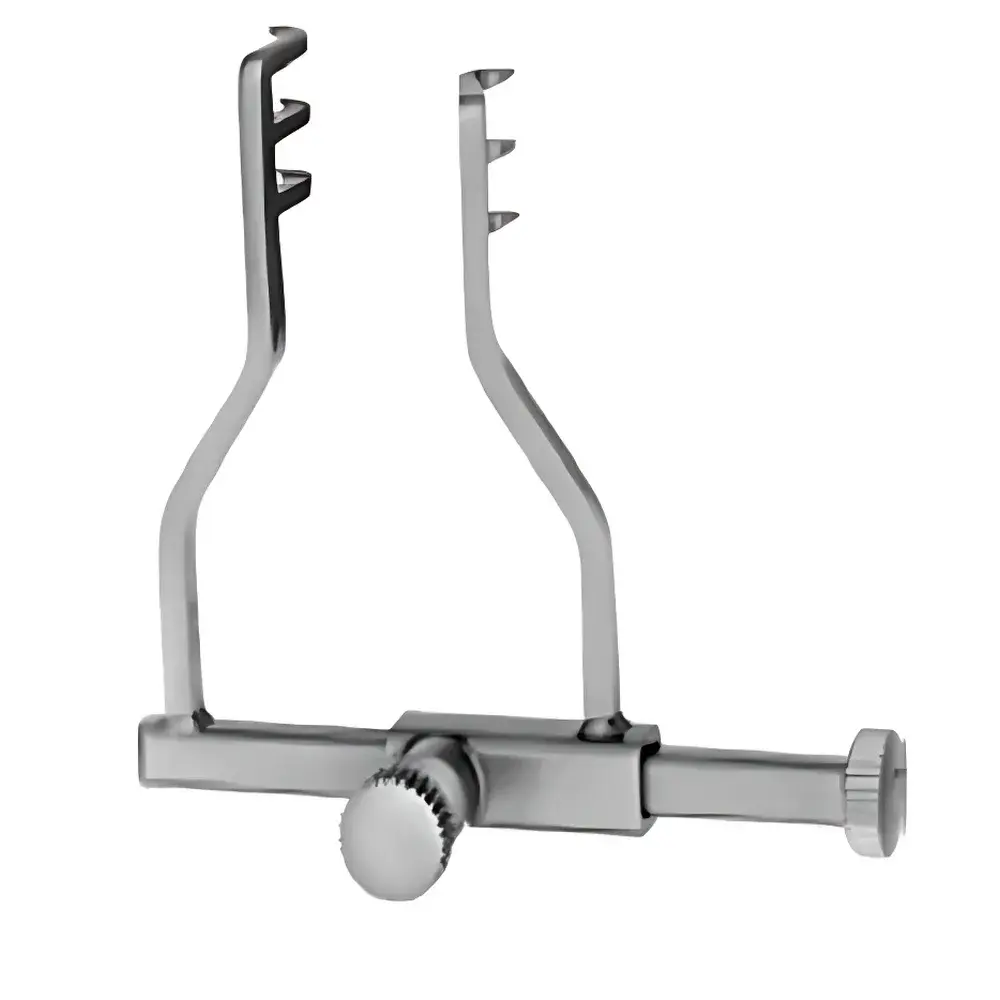
LOGAN R22011-50 3×3-Tooth Automatic Retractor
| Brand | RWD |
|---|---|
| Origin | Shenzhen, China |
| Manufacturer Type | Original Equipment Manufacturer (OEM) |
| Product Origin | Domestic (China) |
| Model | R22011-50 |
| Price | USD 30 (approx. based on ¥216 at 1 USD ≈ ¥7.2) |
Overview
The LOGAN R22011-50 3×3-Tooth Automatic Retractor is a precision-engineered surgical retractor designed for controlled, hands-free tissue exposure during minimally invasive and open procedures. Utilizing a spring-loaded bistable mechanism, the device maintains consistent, adjustable mechanical force across three parallel upper and three lower stainless steel teeth—forming a symmetrical 3×3 tooth array—to achieve stable, self-retaining separation of soft tissues without manual clamping or external fixation. Its compact 5.5 cm overall length and low-profile tooth geometry are optimized for access in confined anatomical spaces, including oral, otolaryngologic, and small-animal surgical fields. The retractor operates on passive mechanical actuation—eliminating reliance on batteries, electronics, or disposable actuators—ensuring reliability under sterile conditions and compatibility with standard autoclaving protocols (134 °C, 2 bar saturated steam).
Key Features
- Self-retaining 3×3 tooth configuration: Six precisely aligned, polished stainless steel teeth (three upper, three lower) engage tissue symmetrically to minimize localized pressure necrosis and enhance visual field stability.
- Spring-actuated automatic deployment: Integrated torsion-spring mechanism delivers repeatable opening force (typical range: 0.8–1.2 N per jaw) with tactile feedback for controlled insertion and release.
- Compact 5.5 cm working length: Designed for high-magnification microsurgery and rodent-scale preclinical models where spatial constraints limit conventional retractor use.
- Autoclavable 316L stainless steel construction: Fully compliant with ISO 17664 for cleaning validation and ISO 13485-certified manufacturing; resistant to corrosion from saline, iodine, and enzymatic decontaminants.
- Ergonomic handle with textured grip: Non-slip polymer overmold provides secure handling under wet or gloved conditions while reducing surgeon hand fatigue during prolonged procedures.
Sample Compatibility & Compliance
The R22011-50 is validated for use with human and non-human mammalian tissues—including murine, porcine, and primate models—in both acute and chronic surgical settings. It meets ISO 10993-1 biocompatibility requirements for short-term mucosal contact (Category: Class IIa). Device labeling and packaging documentation conform to EU MDR 2017/745 Annex I essential requirements and FDA 21 CFR Part 820 quality system regulations. Sterilization validation includes 20 consecutive cycles of steam sterilization (134 °C, 18 min), with post-cycle inspection confirming no dimensional deviation (>±0.05 mm) or spring-force degradation (>5% loss in initial torque).
Software & Data Management
As a purely mechanical, non-electronic instrument, the R22011-50 does not incorporate embedded firmware, wireless connectivity, or digital data output. It requires no software installation, calibration routines, or cybersecurity updates. All usage records—including sterilization logs, maintenance intervals, and procedural annotations—are maintained manually within institutional surgical documentation systems compliant with GLP and GCP standards. Device traceability is supported via laser-etched alphanumeric serial number (format: R22011-50-XXXXX) on the handle base, enabling integration into hospital asset management databases.
Applications
- Preclinical neuroscience surgery: Dural retraction during stereotactic craniotomy in mice and rats, minimizing cortical compression during electrode or viral vector delivery.
- Otolaryngology microsurgery: Exposure of tympanic cavity structures and laryngeal subglottis during endoscopic laser procedures.
- Dental and oral maxillofacial surgery: Retraction of buccal mucosa and gingival margins during implant site preparation or cyst enucleation.
- Translational wound healing studies: Sustained edge approximation in full-thickness skin incision models without suture-induced artifact.
- Training modules for surgical residents: Standardized tissue handling practice under simulated OR conditions with objective assessment of retraction stability and tissue trauma metrics.
FAQ
Is the R22011-50 compatible with magnetic resonance imaging (MRI) environments?
Yes—the entire device is fabricated from non-ferromagnetic 316L stainless steel and contains no electronic components, making it safe for use in MRI suites up to 3 Tesla.
What is the recommended maximum sterilization cycle count before replacement?
RWD specifies a service life of 50 validated autoclave cycles; however, routine visual inspection for tooth deformation, spring fatigue, or surface pitting is required prior to each use.
Can the opening width be adjusted intraoperatively?
No—the device features fixed mechanical stops that define a nominal 12 mm inter-tooth aperture at full deployment; variable-width alternatives are available under model R22011-50-VW.
Does this retractor meet USP or requirements for compounding sterile preparations?
While not a compounding tool per se, its autoclavability, non-shedding surface, and absence of adhesives or coatings satisfy material eligibility criteria outlined in USP Appendix A for sterile surgical accessories.



