
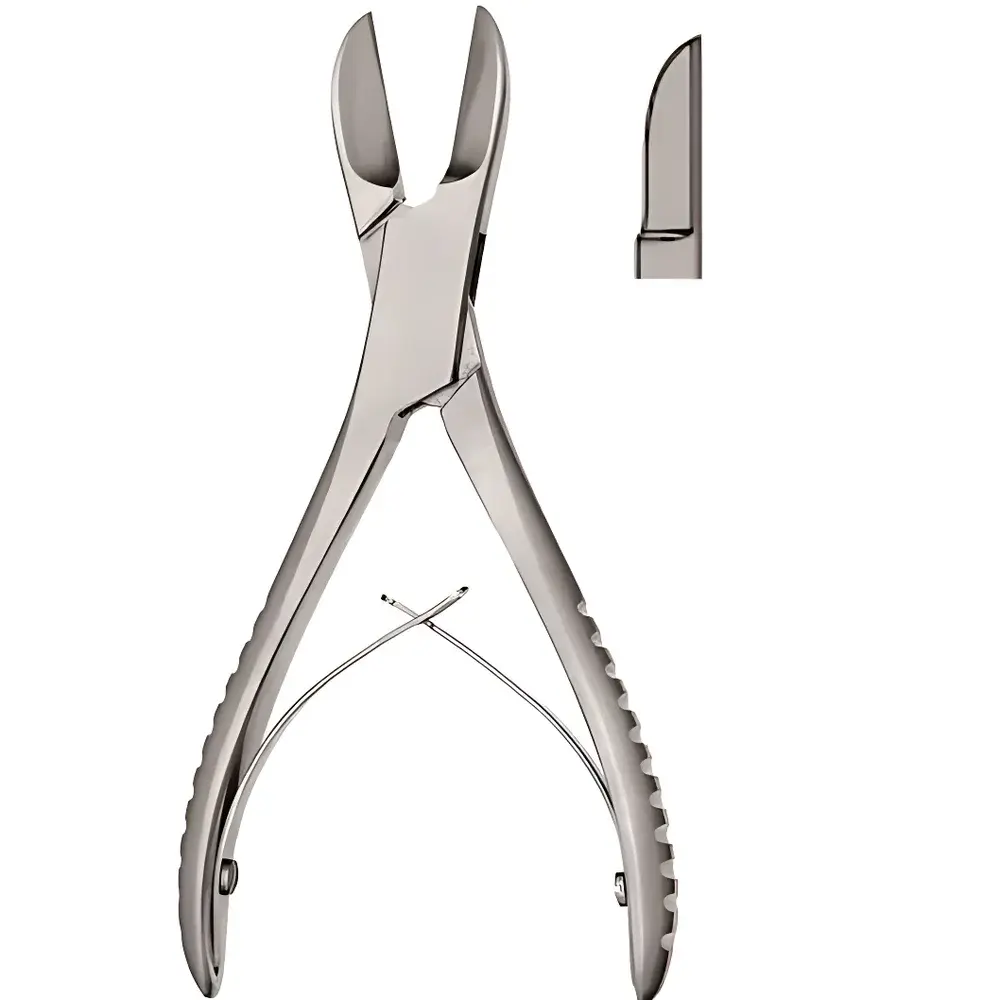
LISTON Single-Joint Bone Rongeur – Flat Profile, 14 cm
| Brand | RWD |
|---|---|
| Origin | Shenzhen, China |
| Manufacturer Type | Direct Manufacturer |
| Country of Origin | China |
| Model | S22002-14 |
| Price | USD 62 (approx.) |
Overview
The LISTON Single-Joint Bone Rongeur (Model S22002-14) is a precision surgical instrument engineered for controlled bone and calcified tissue resection in preclinical research and laboratory-based orthopedic procedures. Designed with a single-axis pivot mechanism, this rongeur delivers consistent mechanical advantage and tactile feedback during manual osteotomy tasks. Its flat-profile blade geometry enables precise, shallow-depth bone trimming—particularly suited for cranial window preparation, vertebral laminectomy, and long-bone cortical scoring in rodent and small-animal models. The device operates on purely mechanical leverage principles without electronic or powered components, ensuring full compatibility with sterile field protocols, MRI environments, and biosafety cabinets where electromagnetic interference must be avoided.
Key Features
- Single-joint articulation provides high mechanical efficiency and predictable force transmission across the entire cutting stroke.
- 14 cm overall length balances maneuverability in confined anatomical spaces with sufficient handle leverage for controlled bone removal.
- Flat-profile tungsten-carbide-coated blades offer enhanced edge retention and resistance to micro-chipping during repetitive use on cortical bone.
- Ergonomically contoured stainless-steel handles feature non-slip knurling and symmetrical finger ring geometry to reduce operator fatigue during extended procedures.
- Autoclavable up to 134 °C (273 °F) at 2 bar pressure; fully compliant with ISO 17664 for cleaning and sterilization validation requirements.
- Manufactured under ISO 13485-certified quality management systems, with batch traceability and material certification documentation available upon request.
Sample Compatibility & Compliance
This rongeur is validated for use on fresh-frozen and formalin-fixed murine, rat, and rabbit skeletal specimens. It is not intended for human clinical use and carries no CE marking for medical devices under EU MDR 2017/745 or FDA 510(k) clearance. Its design adheres to ASTM F899–22 (Standard Specification for Stainless Steels for Surgical Instruments) for material composition and surface finish. All instruments undergo visual inspection and functional testing per ANSI/AAMI ST79:2023 Annex D for reusable surgical instrumentation prior to packaging. Device labeling conforms to ISO 15223-1:2021 for symbols used in medical device labeling.
Software & Data Management
As a manually operated mechanical instrument, the LISTON S22002-14 does not incorporate embedded electronics, firmware, or connectivity features. Consequently, it requires no software installation, calibration routines, or data logging interfaces. This absence of digital components eliminates concerns related to cybersecurity, firmware obsolescence, or regulatory compliance under FDA 21 CFR Part 11 or EU Annex 11 for computerized systems. Maintenance records—including sterilization cycles, sharpening history, and visual inspection logs—can be managed via standard laboratory inventory tracking systems or GLP-compliant electronic lab notebooks (ELNs) such as LabArchives or Benchling.
Applications
- Craniotomy site preparation in stereotactic neuroscience studies requiring minimal dural trauma.
- Cortical bone thinning for optical imaging windows in transgenic mouse models of neurodegeneration.
- Vertebrectomy and spinal cord exposure in cervical or thoracic laminectomy protocols.
- Ex vivo biomechanical testing sample preparation, including standardized defect creation in femoral or tibial specimens.
- Training modules for surgical technique development in veterinary and comparative anatomy curricula.
- Supporting histomorphometric analysis workflows where geometrically defined bone margins improve section alignment and staining reproducibility.
FAQ
Is this instrument suitable for human surgical use?
No. The LISTON S22002-14 is designated exclusively for preclinical research and educational applications. It is not manufactured, tested, or certified for human implantation or clinical intervention.
What sterilization methods are validated for this rongeur?
Steam autoclaving at 134 °C for 5 minutes (pre-vacuum cycle) is the primary validated method. Ethylene oxide (EtO) and hydrogen peroxide plasma sterilization are also compatible, provided cycle parameters align with ISO 14937 and manufacturer-recommended load configurations.
Does the instrument require periodic recalibration?
No. As a passive mechanical tool, it does not contain sensors, actuators, or measurement circuitry. Routine functional verification—such as blade alignment check and smooth articulation assessment—is recommended before each use per institutional biosafety protocols.
Can replacement blades be purchased separately?
No. The S22002-14 is supplied as a monolithic, non-modular unit. Blade resharpening services are available through authorized RWD technical support centers upon return of the instrument.
Is material certification available for this model?
Yes. Mill test reports (MTRs) confirming AISI 420 stainless steel composition and hardness (52–56 HRC) can be provided upon order confirmation for GLP/GMP-regulated studies.



