
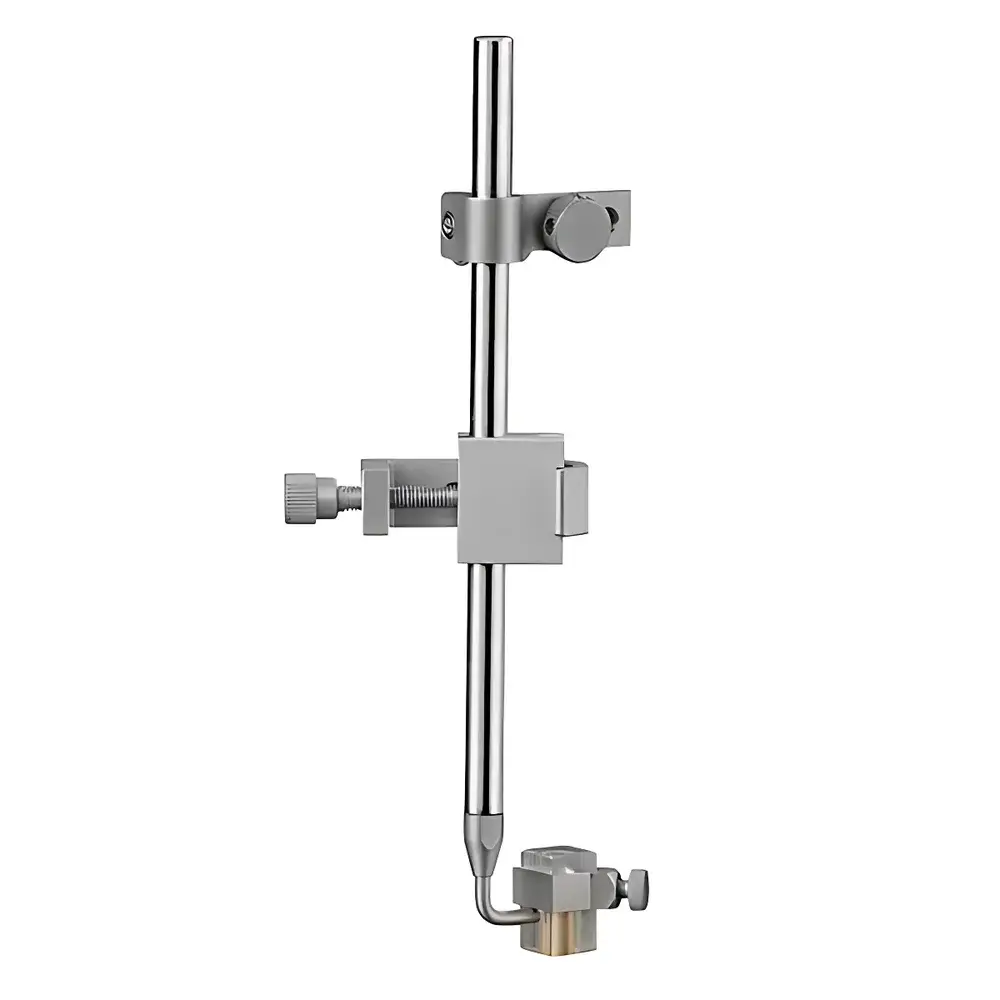
RWD 68218 Syringe Holder for Stereotactic Instrumentation
| Brand | RWD |
|---|---|
| Origin | Shenzhen, China |
| Manufacturer Type | Original Equipment Manufacturer (OEM) |
| Country of Origin | China |
| Model | 68218 |
| Pricing | Upon Request |
| Clamp Range | 0.1–7.0 mm |
| Design | C-shaped, laterally open configuration |
Overview
The RWD 68218 Syringe Holder is a precision-engineered mechanical accessory designed specifically for integration with stereotactic frames and electrophysiology workstations used in preclinical neuroscience research. It operates on a passive mechanical clamping principle—relying on spring-loaded, adjustable C-shaped jaws—to secure syringes, microinjection needles, or other cylindrical manipulanda during chronic or acute intracranial delivery procedures. Its lateral opening architecture enables unobstructed access to the mounted device’s side ports, connectors, or heat-dissipating surfaces—critical when interfacing with headstages, miniature preamplifiers (e.g., Plexon OmniPlex Headstages), or custom-designed neural interface hardware such as TBSI head-mounted amplifiers. The holder is not an actuated or motorized component; rather, it serves as a stable, vibration-damped mounting interface that maintains positional fidelity under standard lab bench conditions and during slow, manual micromanipulator adjustments.
Key Features
- C-shaped structural design with lateral aperture—facilitates side-access installation and real-time hardware monitoring without disassembly
- Adjustable clamping range spanning 0.1 mm to 7.0 mm diameter—accommodates standard glass capillaries, stainless-steel injection needles, polyimide-coated tubing, and OEM-specific microfluidic probes
- Machined from high-strength anodized aluminum alloy—ensures dimensional stability, corrosion resistance, and compatibility with ethanol/isopropanol disinfection protocols
- Integrated M3 threaded mounting interface—enables direct attachment to RWD stereotactic adapters, custom 3D-printed baseplates, or third-party micromanipulator rails (e.g., Narishige MO-10, Scientifica PatchStar)
- No magnetic or electrically conductive components—eliminates electromagnetic interference (EMI) risk near sensitive low-noise electrophysiology signal chains
Sample Compatibility & Compliance
The RWD 68218 is routinely deployed in GLP-aligned rodent neuropharmacology studies, optogenetic vector delivery workflows, and multi-electrode array (MEA) co-localization experiments. It supports syringes and cannulae compliant with ISO 8536-4 (glass syringes), ISO 7886-1 (single-use plastic syringes), and ASTM F2792 (standard terminology for additive manufacturing). While the device itself carries no CE marking or FDA 510(k) clearance—as it is classified as a Class I non-invasive mechanical support tool—it conforms to ISO 13485:2016 quality management system requirements for medical device component suppliers. Its material composition and surface finish meet USP and biological reactivity testing criteria for short-term implant-contact applications.
Software & Data Management
As a purely mechanical mounting solution, the RWD 68218 does not incorporate embedded electronics, firmware, or software interfaces. It requires no driver installation, calibration routines, or network connectivity. However, its dimensional repeatability (±0.05 mm jaw centering tolerance) ensures consistent coordinate registration across imaging modalities—including MRI-guided targeting, CT-based atlas registration, and post-hoc histological reconstruction workflows. When used in conjunction with RWD’s Neurostar Pro stereotactic planning suite or third-party platforms like Brainstorm or QuickNII, the holder’s fixed offset geometry can be preloaded into coordinate transformation matrices to improve intra-procedural targeting accuracy.
Applications
- Chronic AAV or lentiviral vector delivery into hippocampal subfields (CA1, DG) or cortical layers (L2/3, L5) in mouse and rat models
- Co-registration of microinjection sites with simultaneous extracellular recordings using headstage-integrated probes
- Multi-modal interventions combining pharmacological microinfusion with optogenetic stimulation or fMRI acquisition
- Standardized cannula placement for repeated drug administration in behavioral pharmacokinetic studies
- Mounting of thermal or pressure sensors alongside infusion lines in closed-loop neuromodulation rigs
FAQ
Is the RWD 68218 compatible with non-RWD stereotactic frames?
Yes—it features standardized M3 threaded mounting holes and a 12.7 mm pitch spacing, enabling mechanical integration with Narishige, Kopf, and Stoelting frames via adapter plates.
Can it hold tapered or conical tips securely?
It is optimized for uniform cylindrical cross-sections; tapered elements require supplemental O-ring or silicone sleeve stabilization to prevent axial slippage.
Does it support autoclaving?
No—aluminum anodization degrades above 121 °C; validated sterilization methods include 70% ethanol wipe-down, UV-C exposure (254 nm, 30 min), or ethylene oxide gas treatment.
What is the maximum recommended load mass?
The holder maintains positional integrity up to 150 g static load under gravitational orientation; dynamic loads exceeding 5 g at >10 Hz require additional frame damping.
Is technical documentation available in English?
Yes—dimensional drawings, torque specifications, and ISO-compliance summaries are provided in English upon request through RWD’s global technical support portal.



