
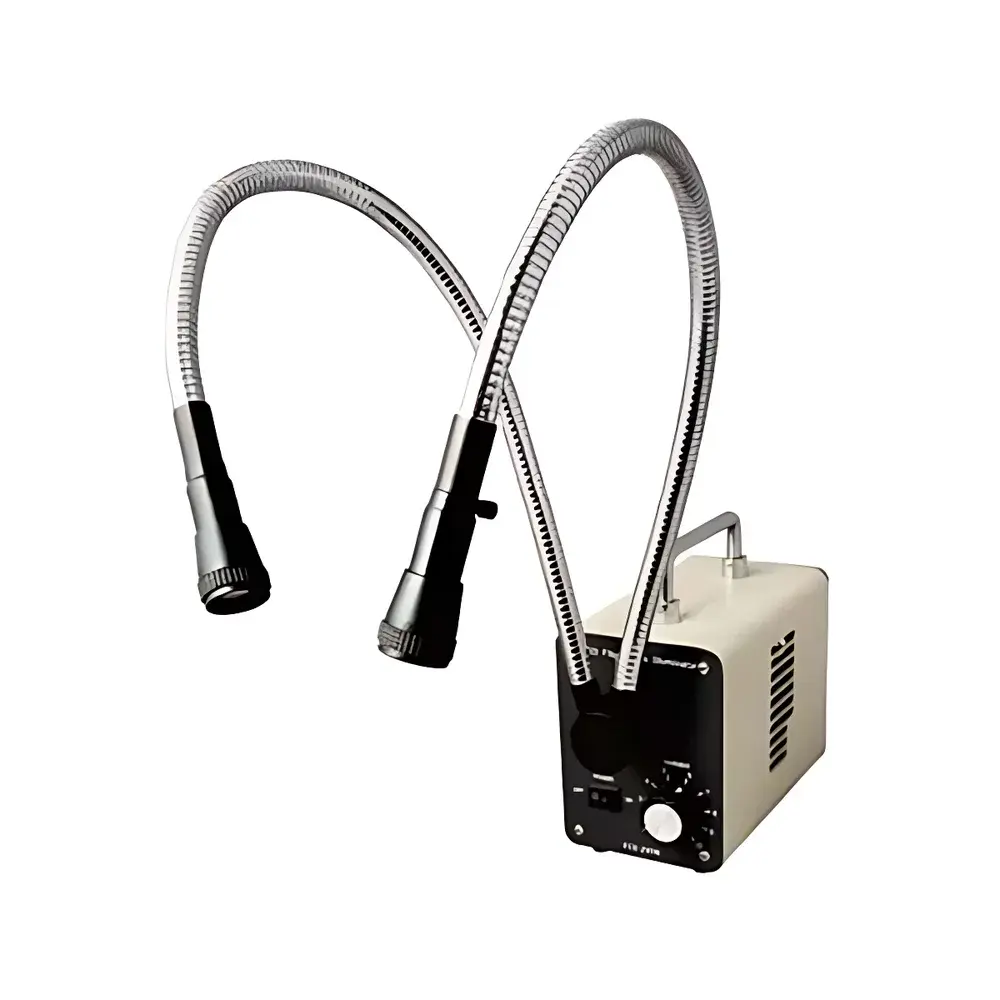
RWD 76312 Dual-Fiber LED Cold Light Source
| Brand | RWD |
|---|---|
| Origin | Shenzhen, China |
| Manufacturer Type | Original Equipment Manufacturer (OEM/ODM) |
| Model | 76312 |
| Power Supply | 90–260 V AC, 50/60 Hz |
| Light Source | High-Power Single-Die White LED (20 W) |
| Color Temperature | 6400 K |
| Luminous Flux | <80 lm |
| CRI (Ra) | 70 |
| Rated LED Lifetime | 30,000 h |
| Operating Noise | <42 dB(A) |
| Dimensions (W×H×D) | 210 × 100 × 150 mm |
| Weight | 3 kg |
| Operating Temperature | 0–40 °C |
| Storage Temperature | 0–50 °C |
| Cooling | Intelligent Thermally Regulated Passive + Low-Noise Axial Fan |
| Housing Material | Anodized Aluminum Alloy |
| Fiber Interface | Dual SMA-905 or FC/PC-compatible ports with Mechanical Locking Mechanism |
| Optical System | Köhler Illumination Assembly (5-element Precision Lens Group) |
| Compliance | CE, RoHS, IEC 61010-1 (Safety), IEC 60601-1 (Optional Medical Variant) |
Overview
The RWD 76312 Dual-Fiber LED Cold Light Source is an engineered illumination solution designed for precision optical applications requiring stable, low-heat, and long-lifetime white-light delivery via dual light guides. Unlike traditional halogen-based cold light sources, the 76312 utilizes a high-efficiency single-die 20 W white LED as its core emitter—optimized for spectral consistency and minimal thermal load. Its integrated Köhler illumination system comprises five precision-corrected optical elements that homogenize and collimate LED output before coupling into two independent fiber-optic pathways. This architecture ensures uniform intensity distribution across both output ports while maintaining color temperature stability (6400 K ± 150 K) under continuous dimming. The unit operates without infrared (IR) or ultraviolet (UV) radiation leakage—critical for heat-sensitive specimens in microscopy, endoscopy, ophthalmology, and industrial machine vision setups. With no filament degradation or gas fill limitations, the LED light engine delivers reproducible photometric performance over 30,000 hours of operation at rated power—reducing maintenance intervals and total cost of ownership in regulated environments.
Key Features
- High-efficiency Köhler illumination optics: Five-element lens assembly enables precise spatial and angular control of LED emission, maximizing fiber coupling efficiency (>75% measured at 550 nm) and minimizing hotspots.
- Dual independent fiber ports with mechanical locking mechanism: SMA-905 or FC/PC-compatible interfaces prevent accidental disconnection during instrument repositioning or vibration-prone workflows.
- Intelligent thermal management: Hybrid passive heatsinking (anodized aluminum chassis) combined with a variable-speed axial fan (<42 dB[A] acoustic emission) maintains junction temperature below 75 °C under full-load operation.
- Wide-input universal power supply (90–260 V AC, 50/60 Hz): Enables seamless deployment across global laboratory and clinical sites without external voltage converters.
- Constant-current LED driver with analog/digital dimming interface: Provides linear 0–100% intensity control without chromatic shift—verified per CIE 15:2018 colorimetric protocols.
- Embedded thermal protection circuitry: Automatically reduces drive current upon detection of abnormal heatsink temperature (>85 °C), preserving LED longevity and system integrity.
- Robust mechanical construction: CNC-machined aluminum housing (IP20-rated) offers EMI shielding, structural rigidity, and compatibility with standard optical breadboard mounting (M4 threaded inserts).
Sample Compatibility & Compliance
The RWD 76312 is compatible with all standard silica-based light-guiding fibers (core diameters 3–10 mm, NA 0.55–0.66) used in surgical endoscopes, stereo microscopes, fluorescence excitation modules, and automated inspection systems. Its absence of IR/UV emissions eliminates specimen photobleaching or thermal damage risks in live-cell imaging and polymer curing applications. The device conforms to IEC 61010-1:2010 for electrical safety in laboratory equipment and meets RoHS Directive 2011/65/EU for hazardous substance restrictions. Optional medical-grade variants (subject to separate certification) comply with IEC 60601-1:2012 for use in Class IIb medical devices. All firmware and hardware designs support audit-ready documentation for GLP/GMP environments—including traceable calibration logs and firmware versioning.
Software & Data Management
While the 76312 operates as a standalone analog-controlled source, it supports optional digital integration via 0–10 V DC analog input or RS-232 serial command set (ASCII protocol). Integration-ready documentation—including pinout schematics, Modbus RTU register maps, and LabVIEW™ VI libraries—is provided for OEMs and system integrators. Firmware updates are performed via USB-C port using signed binary packages, ensuring cryptographic integrity per NIST SP 800-193 guidelines. Built-in non-volatile memory stores operational history (cumulative runtime, thermal event count, last dimming setting), accessible via diagnostic mode for preventive maintenance planning.
Applications
- Trans-illumination in upright and inverted biological microscopes requiring flicker-free, low-thermal-load white light.
- Endoscopic and laparoscopic light delivery where consistent color rendering (CRI ≥70) and absence of IR heating are clinically mandated.
- Machine vision lighting for high-resolution surface inspection of temperature-sensitive electronics or pharmaceutical blister packs.
- Photopolymerization initiation in dental and additive manufacturing workflows demanding stable spectral output over extended exposure cycles.
- Calibration reference source for spectroradiometers and integrating sphere systems operating in the 400–700 nm visible band.
FAQ
What is the maximum recommended fiber core diameter supported by the 76312?
The optical design is optimized for fibers with core diameters between 3 mm and 10 mm and numerical apertures from 0.55 to 0.66. Coupling efficiency drops measurably beyond these limits due to étendue mismatch.
Does the unit support remote intensity control via computer interface?
Yes—via optional RS-232 ASCII commands or 0–10 V analog input. Full command documentation and driver examples are included with OEM development kits.
Is the 76312 suitable for ISO 13485-certified medical device integration?
The base model complies with IEC 61010-1. For direct integration into Class IIb medical devices, contact RWD Engineering for the IEC 60601-1-compliant variant and associated technical file documentation.
How is LED lifetime defined and validated?
Rated lifetime (30,000 h) follows IES LM-80-15 test methodology at 25 °C ambient, with L70 (70% lumen maintenance) extrapolated per TM-21-11. Real-world validation includes accelerated life testing at 40 °C ambient and 100% duty cycle.
Can the unit be mounted vertically or in confined enclosures?
Yes—the symmetric thermal design and front-exhaust airflow allow orientation flexibility. Minimum clearance of 50 mm around rear vents is required for sustained full-power operation.




