
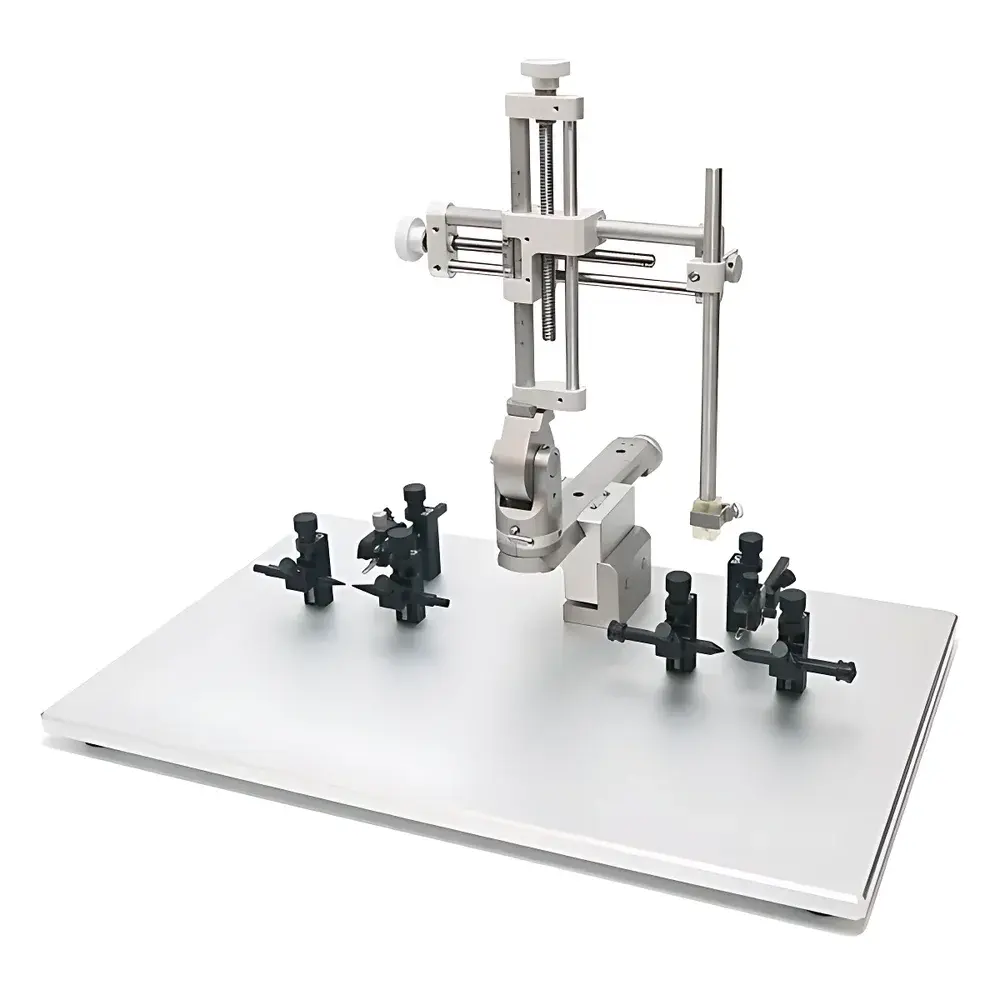
RWD Lightweight Dual-Animal Stereotaxic Instrument for Mice
| Brand | RWD |
|---|---|
| Origin | Shenzhen, China |
| Manufacturer Type | OEM Manufacturer |
| Regional Classification | Domestic (China) |
| Model | Lightweight |
| Price Range | USD 1,400 – 7,000 |
| Animal Capacity | Dual-mouse (simultaneous fixation) |
| Base Dimensions | 255 mm × 255 mm |
| Vertical & Horizontal Rotation | 180° and 360° with independent locking |
| Micrometer Resolution | 0.1 mm |
| Ear Bar Vertical Adjustment Range | 0–20 mm |
| Incisor Bar Vertical Adjustment Range | 0–20 mm |
| Ear Bar Scale Graduation | 1 mm |
| Ear Bar Tip Design | 18° blunt conical tip + circular hollow serrated interface |
| Manipulator Travel Range (X/Y/Z) | 80 mm each axis |
| Construction Material | Polyoxymethylene (POM) ear bars |
| Base Surface Treatment | Wear-resistant engineered finish |
| Operating Temperature Stability | Maintains dimensional stability across standard lab ambient conditions (15–30 °C) |
| Compatibility | Interfaced with microinjection pumps, stereomicroscopes, cranial drills, and digital imaging systems |
Overview
The RWD Lightweight Dual-Animal Stereotaxic Instrument is an engineered solution for high-precision intracranial interventions in murine neuroscientific research. Designed specifically for laboratories conducting parallel experiments on genetically modified mice—including knockout, transgenic, and Cre-lox models—the system enables simultaneous stereotactic positioning of two animals without compromising mechanical rigidity or coordinate reproducibility. Its operational principle relies on the standardized stereotaxic coordinate system (bregma-lambda reference plane), where orthogonal X (anterior–posterior), Y (medial–lateral), and Z (dorsal–ventral) axes are manipulated via calibrated micrometer-driven mechanisms. The instrument integrates a dual-animal fixation architecture while preserving full 3D adjustability and rotational freedom—critical for multi-target injections, bilateral electrode implantation, or comparative pharmacological studies requiring matched controls and treated cohorts within the same experimental session.
Key Features
- Dual-animal capability: Simultaneous secure fixation of two adult mice (or juvenile rats), reducing inter-session variability and increasing throughput in longitudinal or dose-response studies.
- Precision-engineered manipulator: 80 mm travel range along all three axes with 0.1 mm micrometer resolution; dual-lead screw mechanism ensures minimal backlash and smooth, repeatable positioning under load.
- Rotational versatility: Independent 180° vertical tilt and 360° horizontal rotation, each with dedicated locking collars to maintain orientation during microinjection or electrophysiological recording.
- Biocompatible ear bar system: Polyoxymethylene (POM) construction provides low friction, chemical resistance, and consistent mechanical response across temperature fluctuations (15–30 °C); graduated scale markings (1 mm intervals) reduce visual fatigue during extended procedures.
- Minimally invasive fixation geometry: 18° blunt-conical ear bar tips combined with circular hollow serrations distribute pressure evenly across the zygomatic arch, preventing skull deformation or tympanic membrane trauma during clamping.
- Ergonomic incisor and ear bar adjustment: 20 mm vertical range for both incisor plate and ear bars, enabling precise leveling of the skull relative to the bregma–lambda plane—essential for accurate atlas-based targeting.
- Dedicated small-animal baseplate: Compact 255 mm × 255 mm footprint optimized for benchtop integration with auxiliary equipment including motorized microinjectors, fluorescence stereomicroscopes, and high-speed cranial drilling systems.
Sample Compatibility & Compliance
The instrument accommodates a broad spectrum of rodent and non-rodent species through interchangeable adapters—validated for mice, rats (juvenile), guinea pigs, rabbits, cats, birds, and geckos. All structural components comply with ISO 13485-aligned manufacturing practices for laboratory instrumentation. While not a medical device, its mechanical design adheres to GLP-relevant principles for experimental traceability: engraved serial numbers, permanent calibration markings, and non-corrosive surface treatments ensure long-term dimensional integrity. The POM ear bars meet USP Class VI biocompatibility requirements for short-term ex vivo contact. No electrical or software components require FDA 21 CFR Part 11 compliance; however, when integrated with validated third-party injection or imaging platforms, the full workflow may be documented under ISO/IEC 17025 or AAALAC-accredited protocols.
Software & Data Management
This is a purely mechanical stereotaxic platform with no embedded electronics or firmware. All positional data is manually recorded using engraved micrometer dials and calibrated scales. For laboratories requiring digital documentation, the instrument is fully compatible with external coordinate logging systems—including RWD’s optional digital readout upgrade (Model 68518) and third-party microscope-mounted camera rigs equipped with stage-position encoders. When used in conjunction with compliant LIMS or ELN platforms (e.g., LabArchives, Benchling), users may log coordinates, animal IDs, procedure timestamps, and operator signatures in accordance with institutional GLP/GCP policies. No proprietary drivers or cloud connectivity are involved, ensuring full data sovereignty and audit readiness.
Applications
- Stereotactic delivery of AAV vectors, CRISPR-Cas9 constructs, or siRNA into discrete brain nuclei (e.g., hippocampus, striatum, prefrontal cortex) in parallel mouse cohorts.
- Bilateral electrode or optrode implantation for chronic electrophysiology or optogenetic modulation studies requiring matched anatomical targeting.
- Intracerebroventricular (ICV) or intraparenchymal drug infusions in pharmacokinetic/pharmacodynamic models.
- Craniotomy-guided microsurgery training platforms in academic neuroscience programs.
- Development and validation of novel stereotaxic atlases for emerging transgenic mouse lines with atypical skull morphology.
FAQ
Is this instrument suitable for rat stereotaxy?
Yes—when equipped with the optional rat-specific adapter (sold separately), the system supports juvenile rats up to ~250 g. Adult rats require the RWD Heavy-Duty Stereotaxic Frame (Model 68520).
Can I integrate it with a motorized microinjection pump?
Absolutely. The standard mounting interface (M6 threaded holes on the manipulator base) is compatible with major brands including World Precision Instruments (WPI), KD Scientific, and RWD’s own UMP3 series.
Does the baseplate include anti-slip features?
Yes—the underside incorporates molded rubberized feet with >0.6 coefficient of static friction, verified per ASTM D1894, ensuring stable placement on stainless steel or laminated lab benches.
What maintenance is required?
Annual inspection of micrometer gear wear and recalibration of zero-reference points using RWD-provided alignment jigs; no lubrication is required due to self-lubricating POM and stainless-steel lead screws.
Is technical support available outside China?
Yes—RWD maintains authorized service partners in the US, Germany, Japan, and Australia, with spare parts fulfillment under ISO 9001-certified logistics channels.




