
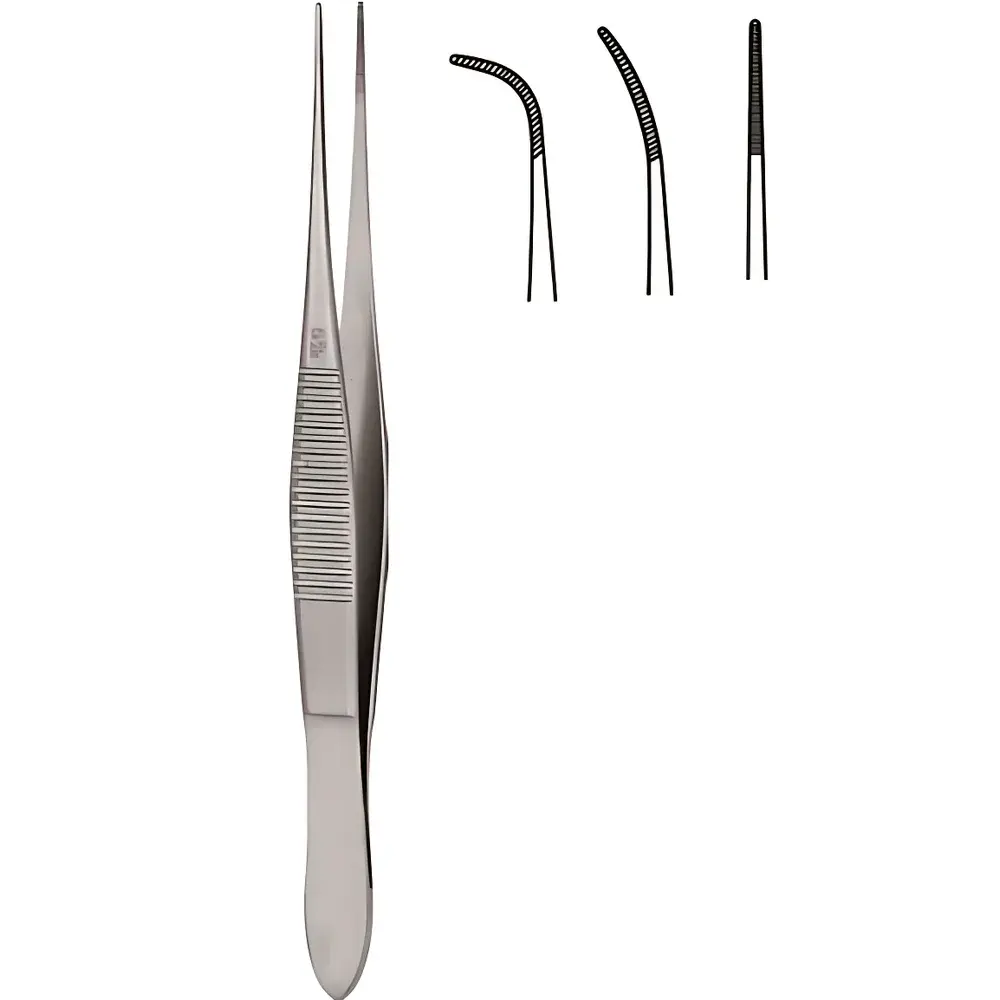
RWD Micro Dissection Forceps
| Brand | RWD |
|---|---|
| Origin | Shenzhen, China |
| Manufacturer Type | Direct Manufacturer |
| Country of Origin | China |
| Model Numbers | F12005-10 (Straight, 1.0 mm tip width, 100 mm length), F12006-10 (Curved Small, 1.0 mm tip width, 100 mm length), F12007-10 (Curved Large, 0.9 mm tip width, 100 mm length) |
| Pricing | Available Upon Request |
Overview
RWD Micro Dissection Forceps are precision-crafted surgical instruments engineered for high-fidelity manipulation of delicate biological tissues during microsurgical and neuroanatomical procedures. Designed in accordance with ISO 7153-1:2016 (Surgical Instruments — Metallic Materials — Part 1: Stainless Steel) and manufactured under ISO 13485-certified quality management systems, these forceps employ a refined ergonomic handle geometry and ultra-fine tungsten carbide–reinforced tips to ensure tactile sensitivity, consistent grip, and minimal tissue trauma. The instruments operate on the principle of controlled mechanical leverage—translating subtle finger motion into precise tip displacement—enabling stable handling of neural filaments, vascular structures, and embryonic tissues at sub-millimeter scales. Their application spans stereotactic brain dissection, retinal layer isolation, cochlear explant preparation, and in vivo intracranial electrode placement where micron-level control and non-slip tip engagement are critical.
Key Features
- Three standardized configurations: straight (F12005-10), small-curved (F12006-10), and large-curved (F12007-10) tip geometries—each optimized for distinct anatomical access pathways and tissue orientation requirements.
- Tungsten carbide inserts embedded at the distal 3 mm of each tip, delivering hardness ≥1800 HV and maintaining edge integrity over repeated autoclaving cycles (tested per ISO 17664).
- Polished 420 stainless steel shaft with electropolished surface finish (Ra ≤ 0.2 µm), minimizing protein adhesion and facilitating complete sterilization via steam (134 °C, 3 min), ethylene oxide, or hydrogen peroxide plasma.
- Ergonomic, knurled stainless-steel handles with 100 mm total length—designed to reduce operator fatigue during prolonged microdissection sessions and compatible with standard microscope-integrated handrests.
- Tip widths precisely maintained at 1.0 mm (straight and small-curved) or 0.9 mm (large-curved) across production lots, verified by calibrated optical profilometry (traceable to NIST standards).
Sample Compatibility & Compliance
These forceps are validated for use with fresh, fixed, cryosectioned, and paraffin-embedded biological specimens—including murine cortical slices, zebrafish larvae, avian embryos, and human retinal explants. Tip geometry and surface chemistry support compatibility with enzymatic dissociation buffers (e.g., papain, trypsin-EDTA), glutaraldehyde-based fixatives, and aqueous mounting media without corrosion or functional degradation. All models comply with EU Medical Device Regulation (MDR 2017/745) Class I classification, carry CE marking, and meet biocompatibility requirements per ISO 10993-1 (cytotoxicity, sensitization, irritation). Sterility assurance level (SAL) is 10−6 when supplied non-sterile and processed using validated hospital-grade autoclave cycles.
Software & Data Management
As a manually operated mechanical instrument, RWD Micro Dissection Forceps require no embedded electronics, firmware, or software integration. However, they are fully compatible with digital documentation workflows common in GLP- and GMP-regulated laboratories: tip geometry specifications, lot traceability codes, and sterilization logs can be recorded in electronic lab notebooks (ELNs) such as LabArchives or Benchling. Each instrument bears a laser-etched alphanumeric lot identifier enabling full audit trail linkage to raw material certifications, dimensional inspection reports, and sterilization validation summaries—supporting compliance with FDA 21 CFR Part 11 when used within regulated preclinical research environments.
Applications
- Microdissection of hippocampal subfields (CA1–CA3, dentate gyrus) from acute brain slices for electrophysiological recording.
- Isolation of individual retinal ganglion cells or photoreceptor layers in enucleated eyes for single-cell RNA sequencing library prep.
- Explant culture of dorsal root ganglia (DRG) with preservation of proximal nerve stumps for axon outgrowth assays.
- Manual removal of meningeal membranes from neonatal rodent brains prior to primary neuron culture.
- Positioning and anchoring of silicon-based microelectrode arrays during chronic intracortical implantation surgery.
FAQ
Are these forceps suitable for sterile, in vivo rodent surgery?
Yes—when terminally sterilized via autoclaving or ethylene oxide, they meet AALAS and FELASA guidelines for aseptic small-animal surgical instrumentation.
What is the recommended cleaning protocol between uses?
Rinse immediately in warm deionized water, followed by ultrasonic cleaning in enzymatic detergent (e.g., Enzol®) for 10 min, then rinse thoroughly and dry before autoclaving.
Can the tungsten carbide tips be resharpened?
No—tungsten carbide inserts are not user-serviceable; resharpening would compromise structural integrity and tip symmetry. Replacement is advised after visible wear or loss of grip fidelity.
Do you provide calibration or metrology documentation?
Yes—dimensional verification reports (including tip width, jaw parallelism, and opening angle) are available upon request for each production lot, traceable to ISO/IEC 17025-accredited metrology labs.
Is there a warranty or replacement policy for damaged tips?
RWD offers a 12-month limited warranty covering manufacturing defects; accidental damage or misuse is excluded but may qualify for discounted replacement under our instrument exchange program.




