
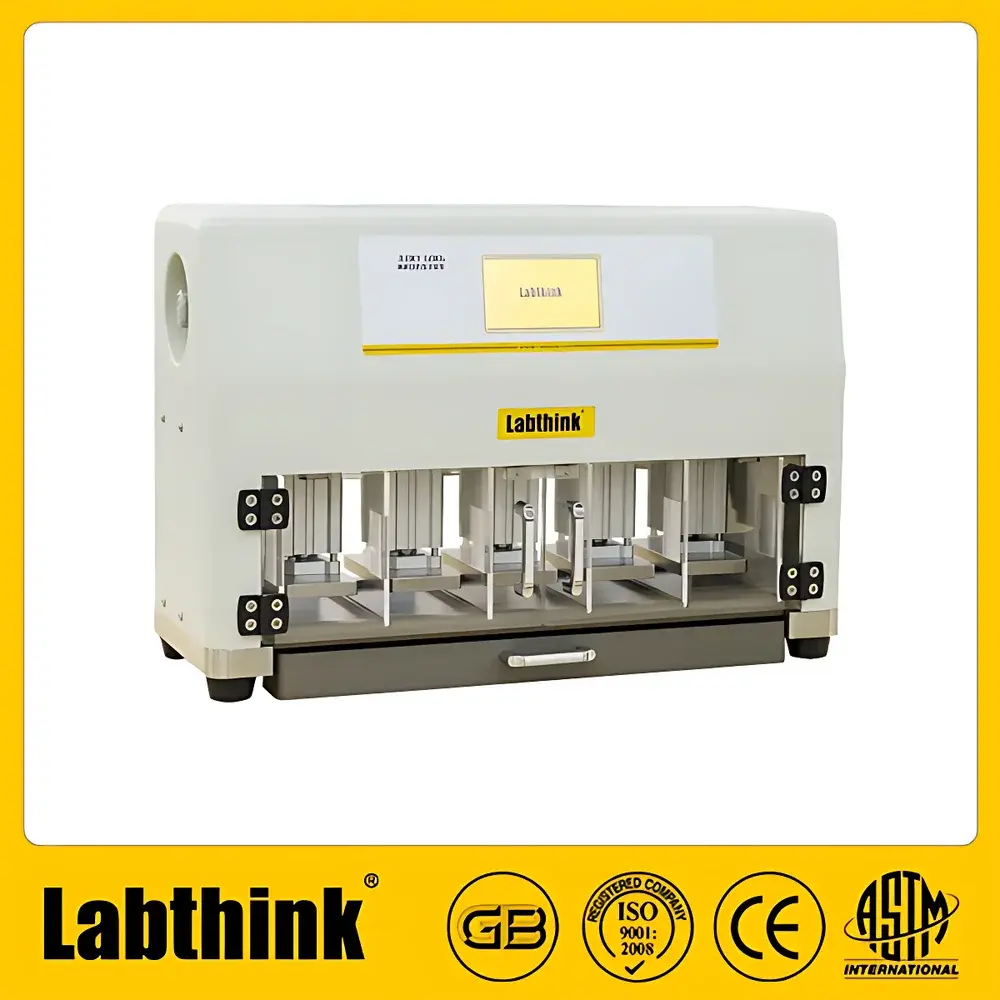
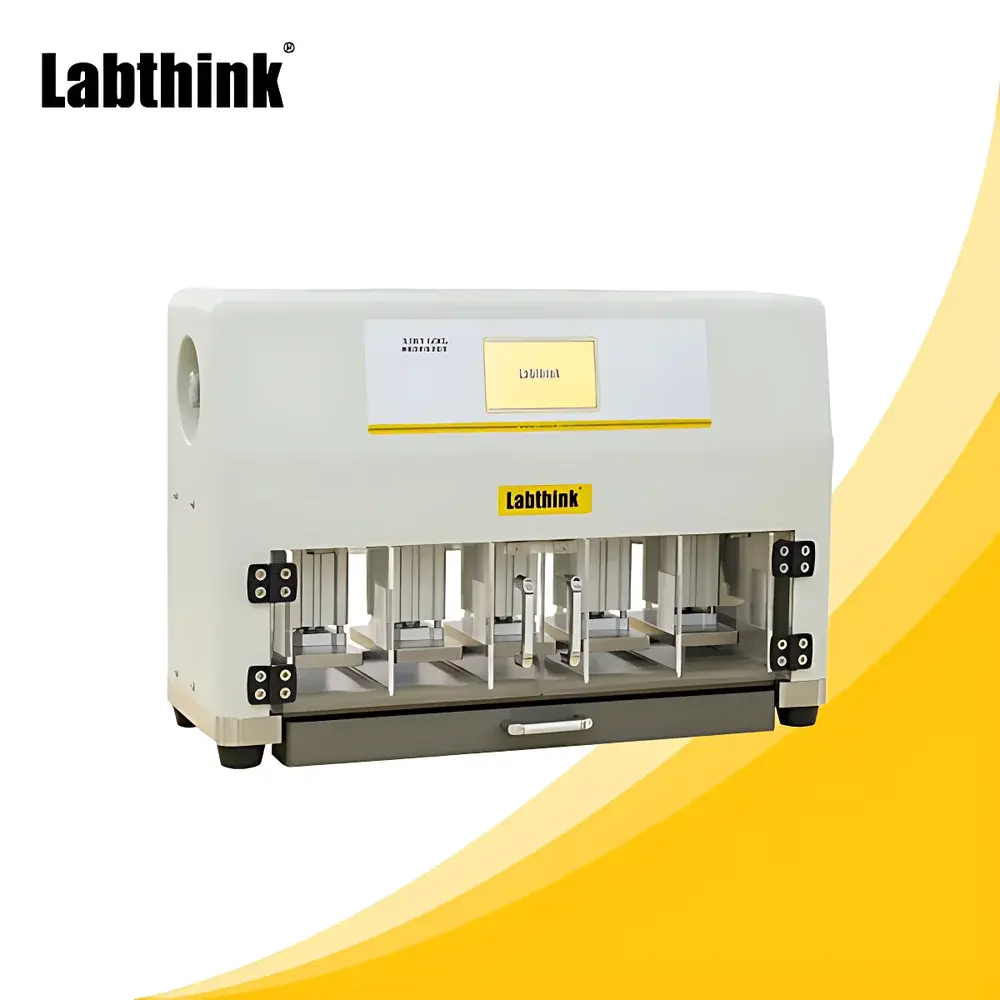
Labthink JLBKY-60KG Sauce Pouch Compression Tester
| Brand | Labthink |
|---|---|
| Origin | Shandong, China |
| Manufacturer Type | OEM/ODM Manufacturer |
| Country of Origin | China |
| Model | JLBKY-60KG |
| Max Load Capacity | 60 kgf (588 N) |
| Test Stations | 5 independent stations |
| Holding Time Range | 1–300 s (adjustable) |
| Control Interface | 7-inch TFT LCD touchscreen with footswitch option |
| Compliance Standard | GB/T 10004–2008 Clause 6.6.3 “Compression Resistance of Flexible Packaging Bags” |
| Construction Materials | 304 stainless steel load frame, ABS polymer housing, transparent acrylic observation panels and inter-station dividers |
| Safety Features | Anti-pinch mechanism, removable trays and dividers for cleaning, IP54-rated enclosure |
Overview
The Labthink JLBKY-60KG Sauce Pouch Compression Tester is an engineered solution for quantitative evaluation of mechanical integrity in flexible food pouches under static compressive load. Designed specifically for small-format retortable and ambient-stable sauce packaging—including ketchup, tomato paste, salad dressing, cream, jam, and vegetable puree pouches—the instrument applies a controlled, uniform compressive force across up to five specimens simultaneously, replicating real-world stacking and transport conditions. Its operation adheres strictly to the methodology defined in GB/T 10004–2008, Section 6.6.3 (“Compression Resistance Test for Flexible Plastic Composite Films and Bags”), which specifies standardized procedures for assessing leakage, seal rupture, and structural deformation under sustained load. Unlike general-purpose universal testers, the JLBKY-60KG integrates purpose-built fixturing, synchronized pneumatic actuation, and visual inspection ergonomics to ensure repeatability and operator safety during high-throughput QC screening.
Key Features
- Five independent, identically actuated test stations—enabling parallel assessment of five identical or mixed-specimen pouches per cycle.
- Pneumatically driven compression plate with centralized pressure regulation; all stations receive identical force application and timing control.
- 7-inch capacitive touchscreen interface with intuitive icon-based workflow navigation; supports both manual start (touch button) and hands-free initiation (optional footswitch).
- Full-view transparent acrylic front and side panels, with individual inter-station partitions to contain potential leakage or burst debris without cross-contamination.
- Removable stainless-steel sample trays and acrylic dividers—designed for rapid cleaning and residue removal between batches, supporting hygiene-critical food production environments.
- Integrated anti-pinch safety circuitry that halts downward motion immediately upon contact detection, meeting ISO 13857 minimum safety distances for machinery.
- Robust structural assembly using 304 stainless steel load-bearing components and corrosion-resistant ABS polymer housing (IP54 ingress protection rating).
Sample Compatibility & Compliance
The JLBKY-60KG accommodates pouch dimensions up to 120 mm × 120 mm (W × H), with customizable tray inserts available for non-standard formats. It is validated for use with laminated structures including PET/AL/PE, PET/PE, OPP/CPP, and metallized polyester composites—commonly employed in shelf-stable sauce packaging. All test protocols align with national standard GB/T 10004–2008, and the system’s traceable force application (calibrated per JJG 475–2018) supports internal quality audits and regulatory readiness. While not certified to ASTM F1140 or ISO 11607–2 by default, its mechanical architecture and documentation framework allow straightforward adaptation for compliance mapping in multinational supply chains requiring FDA 21 CFR Part 11–aligned validation packages.
Software & Data Management
The embedded firmware records each test session with timestamped metadata: applied load (kgf), hold duration (s), station-specific pass/fail status, and user-assigned defect codes (e.g., “seal split”, “corner burst”, “delamination”). Results are stored locally on internal flash memory (≥10,000 test records) and exportable via USB to CSV or PDF report templates. Audit trail functionality logs all parameter modifications, user logins, and calibration events—supporting GLP/GMP-aligned documentation practices. Optional Labthink LTM-Link software enables remote data aggregation, trend analysis across shifts or production lines, and integration with MES platforms via Modbus TCP protocol.
Applications
- Routine QC release testing of filled sauce pouches prior to palletization and distribution.
- Comparative evaluation of seal strength across different adhesive formulations or heat-sealing parameters.
- Accelerated stability studies assessing pouch integrity after thermal processing (e.g., retort cycles) or ambient aging.
- Supplier qualification—verifying incoming packaging meets minimum compression resistance thresholds (e.g., ≥60 kgf for 60 s without leakage).
- Root cause analysis of field complaints related to pouch collapse, leakage, or premature burst during logistics handling.
- Process validation support for new packaging line commissioning or change control initiatives.
FAQ
What is the maximum compressive load capacity of the JLBKY-60KG?
The system delivers a calibrated maximum compressive force of 60 kgf (588 N), adjustable in 1 kgf increments.
Can the tester accommodate pouches larger than 120 × 120 mm?
Standard configuration supports up to 120 × 120 mm; custom trays and extended-height fixtures are available upon request.
Is calibration traceable to national standards?
Yes—load cell calibration follows JJG 475–2018 (Chinese verification regulation for electronic universal testing machines) and includes certificate of conformity with uncertainty budget.
Does the instrument meet FDA or EU regulatory requirements for food contact testing?
While the device itself is not a food-contact material, its construction complies with EC 1935/2004 for food-safe materials (304 SS, food-grade ABS, non-leaching acrylic); full regulatory alignment depends on end-user validation protocols.
How is data integrity ensured during long-term deployment?
All test records include digital signatures, immutable timestamps, and write-once storage logic; optional LTM-Link software adds electronic signature capability and 21 CFR Part 11 audit trail modules.




