
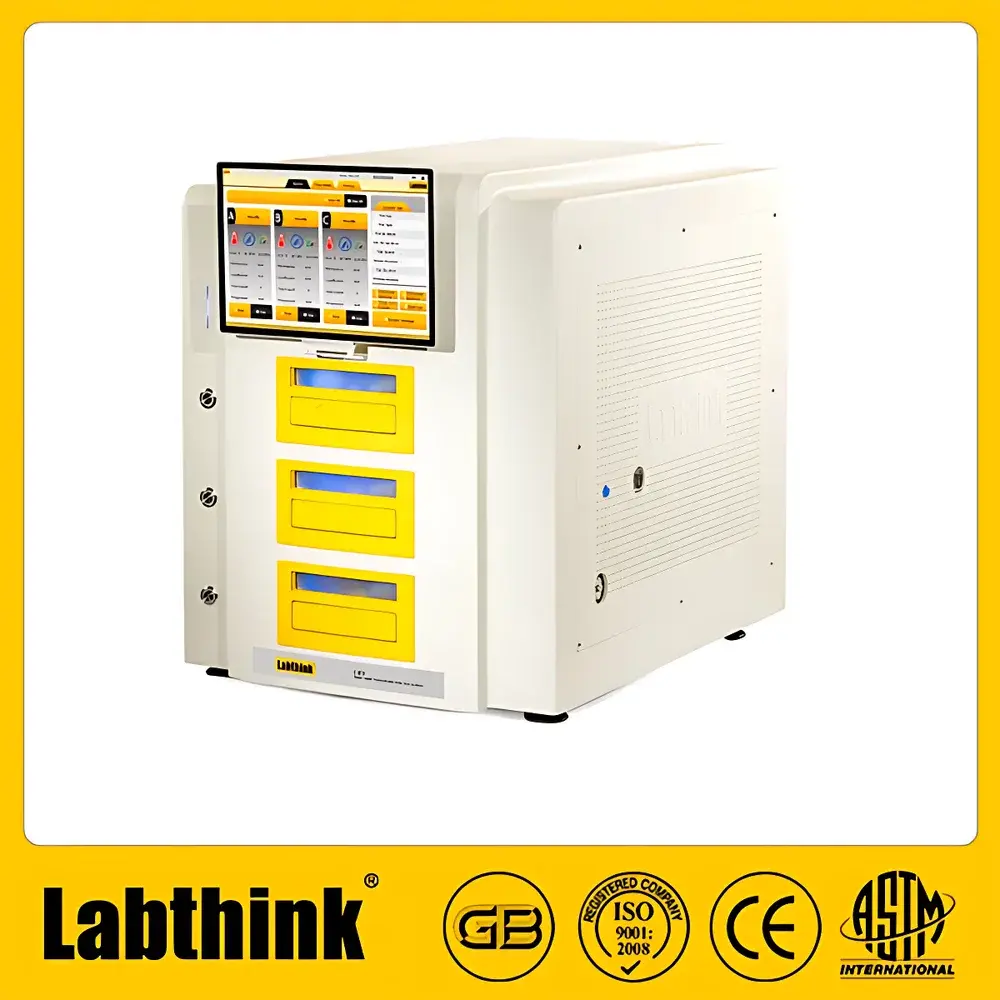
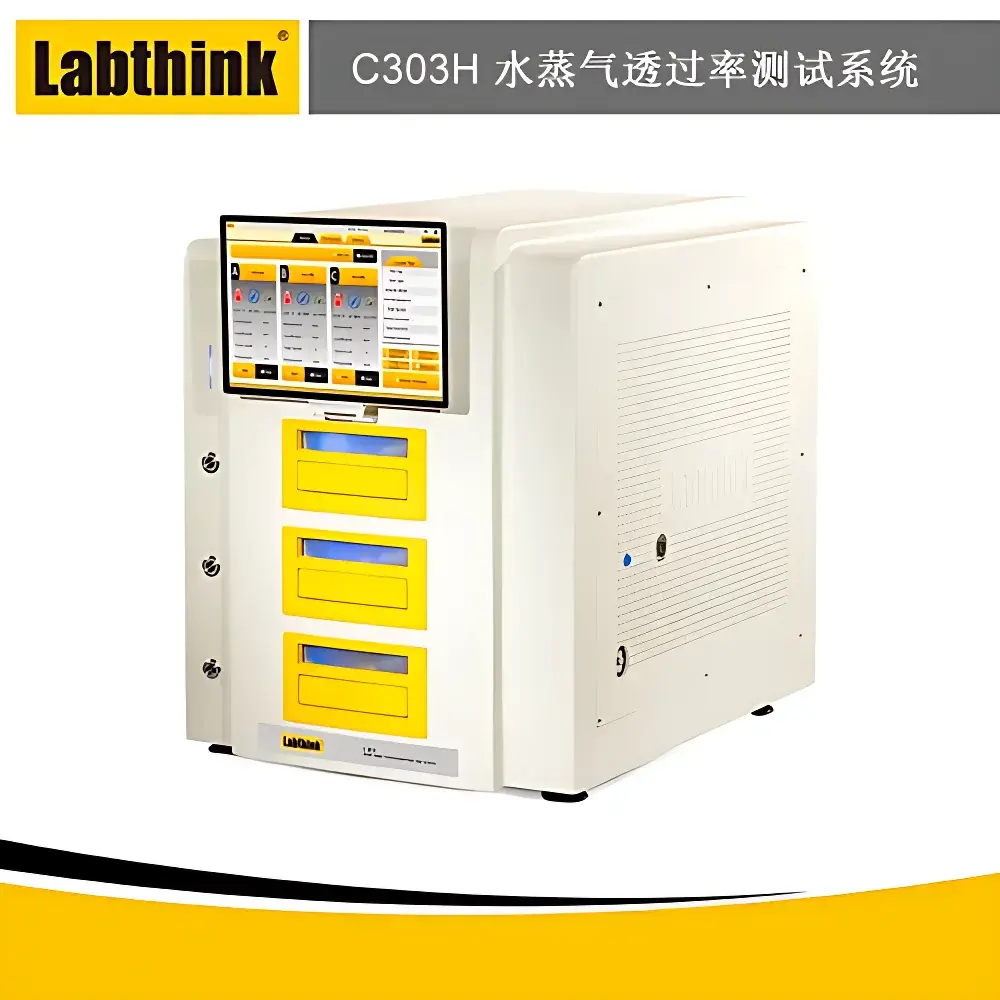
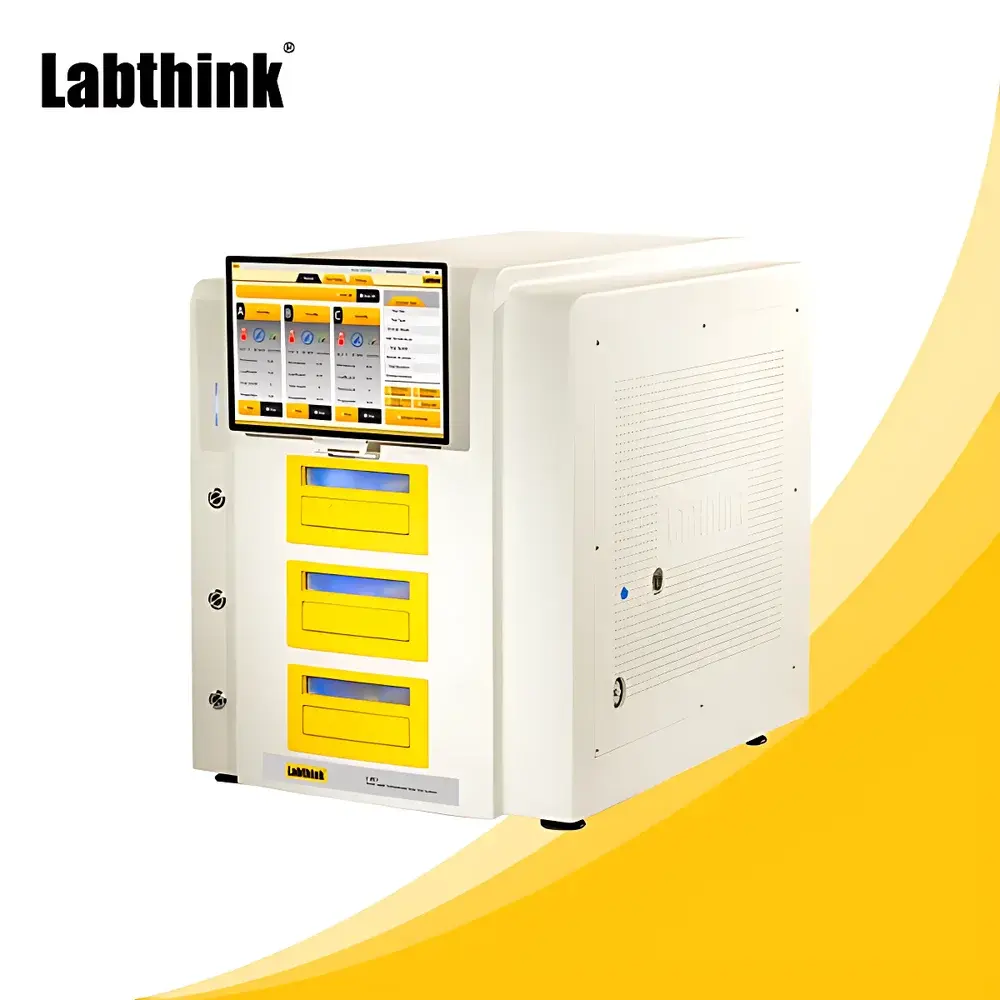
Labthink C303H Infrared Water Vapor Transmission Rate (WVTR) Tester
| Brand | Labthink |
|---|---|
| Model | C303H |
| Origin | Shandong, China |
| Manufacturer Type | Direct Manufacturer |
| Country of Origin | China |
| Price Range | USD 14,000 – 98,000 |
| Test Principle | Infrared Detection per ASTM F1249 & ISO 15106-2 |
| Test Area | 50 cm² (standard), optional 5 cm² or 1 cm² MASK fixtures |
| WVTR Range | 0.02–40 g/(m²·day) (50 cm²), 0.2–400 g/(m²·day) (5 cm²), 1–2000 g/(m²·day) (1 cm²) |
| Resolution | 0.0001 g/(m²·day) |
| Repeatability | ±0.02 g/(m²·day) or ±2%, whichever is greater |
| Temperature Range | 15–50 °C (standard), 5–60 °C (custom) |
| Temp Stability | ±0.05 °C |
| RH Range | 5–90 %RH ±2 %RH |
| Chamber Configuration | Triple independent test chambers |
| Sample Size | 11.2 cm × 11.2 cm |
| Max Thickness | 3 mm |
| Carrier Gas | 99.999% N₂ (user-supplied) |
| Gas Inlet | 1/8″ stainless steel tube |
| Power | 120 VAC ±10% 60 Hz / 220 VAC ±10% 50 Hz |
| Dimensions | 600 × 500 × 700 mm |
| Weight | 100 kg |
Overview
The Labthink C303H Infrared Water Vapor Transmission Rate (WVTR) Tester is an engineered solution for precise, traceable, and high-throughput measurement of water vapor permeation through packaging and barrier materials. It operates on the principle of infrared moisture detection—where water vapor diffusing across a test specimen under controlled humidity gradient is swept by dry carrier nitrogen to a non-consumable, patented IR sensor. The sensor quantifies vapor concentration via differential absorption of near-infrared light at characteristic wavelengths (e.g., 1.93 µm), enabling direct, real-time calculation of mass flux. This method complies strictly with ASTM F1249 (“Standard Test Method for Water Vapor Transmission Rate Through Plastic Film and Sheeting Using a Modulated Infrared Sensor”) and ISO 15106-2 (“Plastics — Film and sheeting — Determination of water vapour transmission rate — Part 2: Infrared detection method”), ensuring regulatory acceptability in global food, pharmaceutical, and medical device packaging validation workflows.
Key Features
- Triple independent test chambers (50 cm² each), enabling parallel analysis of three specimens under identical environmental conditions—improving statistical robustness and throughput without cross-contamination.
- Patented non-dispersive infrared (NDIR) moisture sensor with >10-year operational lifetime, zero consumables, and sub-ppm-level detection sensitivity—delivering a validated lower limit of quantification (LLOQ) of 0.02 g/(m²·day).
- 360° circumferential air circulation thermal management system, maintaining temperature stability within ±0.05 °C across all chambers—critical for minimizing thermal drift-induced measurement variance.
- Integrated high-accuracy capacitive RH sensors and platinum RTD temperature probes, continuously logging ambient and boundary-layer conditions with timestamped audit trails.
- Automated pneumatic clamping mechanism ensuring consistent compressive load (±2 N) and hermetic seal integrity—eliminating operator-dependent variability in sample mounting.
- Dedicated industrial-grade embedded computer (Windows OS) with 12-inch capacitive touchscreen interface—immune to external malware, supporting deterministic execution and encrypted local data storage compliant with FDA 21 CFR Part 11 requirements when configured with optional CFR21 module.
- Drawer-style chamber actuation with position feedback, audible/visual confirmation, and interlocked safety cutoff—reducing handling time and mitigating exposure risk during sample loading/unloading.
Sample Compatibility & Compliance
The C303H accommodates rigid and flexible planar materials up to 3 mm thick and 11.2 cm × 11.2 cm in dimension—including oriented polypropylene (OPP), biaxially oriented polyethylene terephthalate (BoPET), aluminum foil laminates, metallized polyester films, paper-aluminum composites, PVDC-coated substrates, and silicone-rubber sheets. Its triple-chamber architecture supports concurrent testing of heterogeneous samples (e.g., control vs. accelerated-aged vs. sterilized batches) under identical climatic setpoints. All hardware and firmware are designed to support GLP/GMP-aligned quality systems: full electronic signatures, user access tiers, change control logs, and raw-data immutability—fully compatible with ISO/IEC 17025-accredited laboratory environments. Validation documentation (IQ/OQ/PQ protocols) and standard operating procedures (SOPs) are provided per ISO 17025 and USP guidance on container closure integrity testing (CCIT) for moisture-sensitive dosage forms.
Software & Data Management
Labthink’s proprietary WinWVTR software provides ISO 17025-compliant data acquisition, processing, and reporting. It supports automated calibration verification using certified reference standards (NIST-traceable humidity generators), dynamic range validation, and multi-point linearity checks. All measurements include metadata stamps: operator ID, chamber ID, gas flow rate (SLPM), temperature, RH, elapsed test time, and sensor response curve parameters. Export formats include CSV, PDF (with digital signature), and XML for LIMS integration. Optional CFR21 Part 11 compliance package adds role-based authentication, biometric or token-based electronic signatures, and immutable audit trails covering all data modifications, instrument configuration changes, and user logins—meeting FDA, EMA, and PMDA regulatory expectations for electronic records in regulated industries.
Applications
- Food packaging R&D: Quantifying WVTR of cup noodles laminates, retort pouches, and modified-atmosphere packaging (MAP) films under shelf-life simulation conditions (e.g., 38 °C / 90 %RH).
- Pharmaceutical primary packaging: Validating moisture barrier performance of blister foil, cold-forming aluminum, and desiccant-containing sachets per USP and YBB00092003-2015.
- Medical device packaging: Assessing Tyvek®/polyethylene pouches and sterile barrier systems per ISO 11607-1 for ISO 11607-2 accelerated aging correlation studies.
- Electronics encapsulation: Measuring permeation through conformal coatings and flexible printed circuit board (FPCB) coverlays in humid tropical environments (e.g., 40 °C / 93 %RH).
- Photovoltaic backsheet qualification: Screening ethylene-vinyl acetate (EVA) adhesion layers and fluoropolymer topcoats per IEC 61215-2 MQT 07.
FAQ
What standards does the C303H comply with?
ASTM F1249, ISO 15106-2, GB/T 26253, JIS K7129, and YBB00092003-2015.
Is nitrogen gas supplied with the instrument?
No—99.999% pure nitrogen must be provided externally via a regulated gas source meeting ≥280 kPa inlet pressure specification.
Can the system operate at sub-ambient temperatures?
Yes; custom configurations support 5–60 °C temperature range with enhanced condensation control and dew-point monitoring.
How is data integrity ensured during long-duration tests (e.g., 30-day WVTR)?
Embedded industrial PC performs continuous RAM buffering, cyclic flash memory writes with wear leveling, and automatic checksum validation—preventing data loss during power interruption.
Does the C303H support mask-based small-area testing?
Yes; optional 5 cm² and 1 cm² stainless-steel MASK fixtures enable high-flux measurement of micro-samples or localized defects, traceable to ISO 15106-2 Annex B.






