
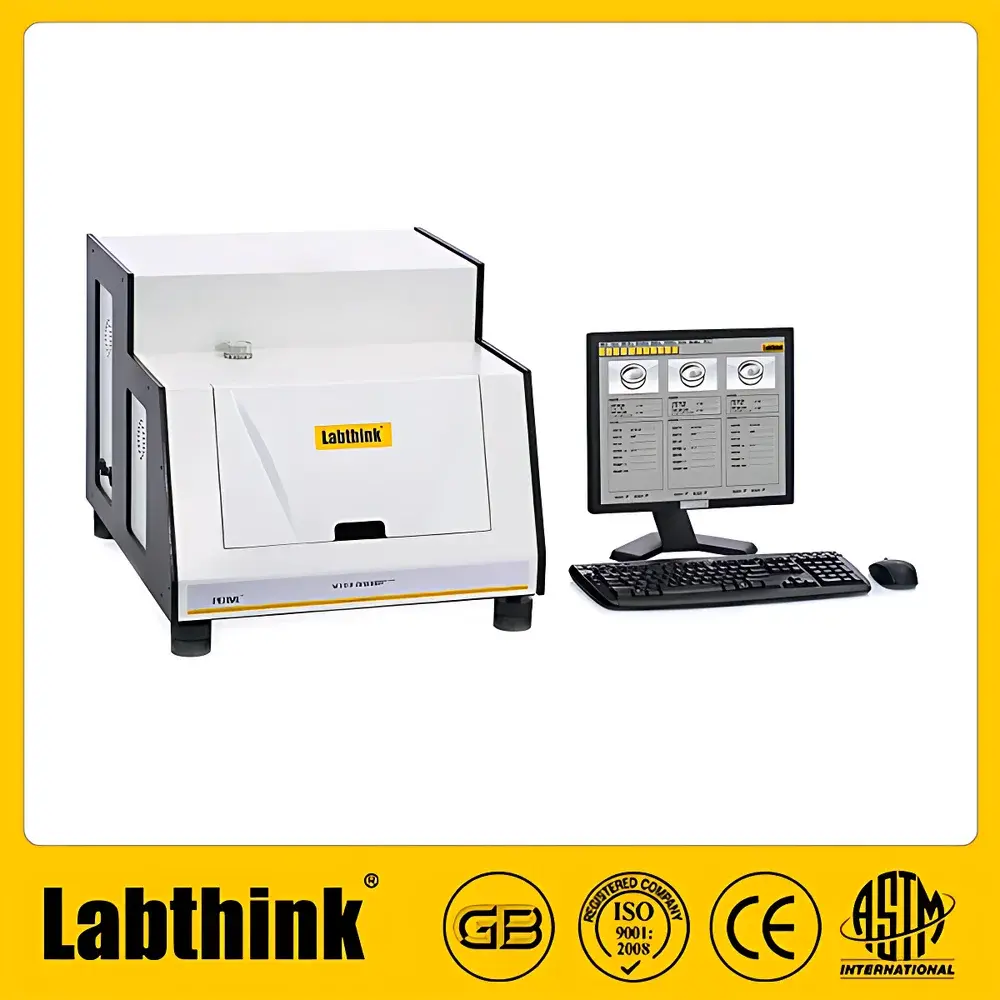
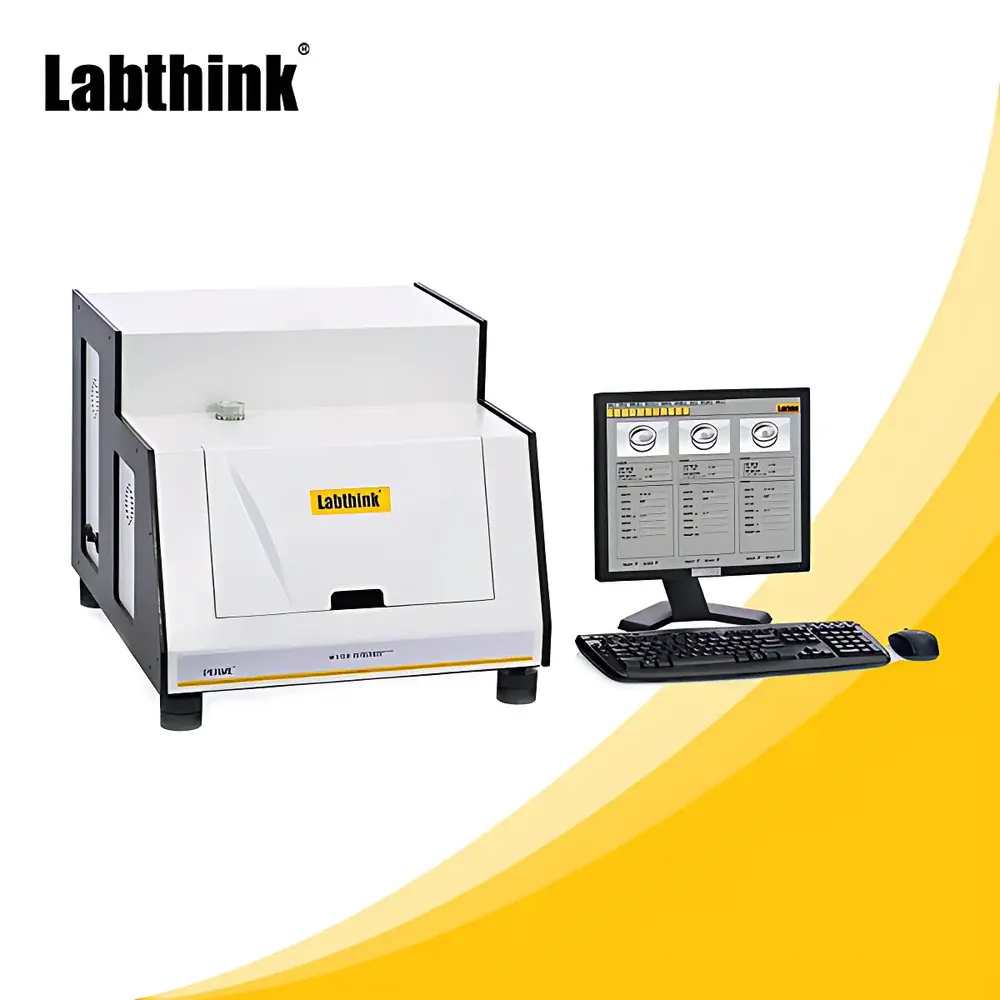
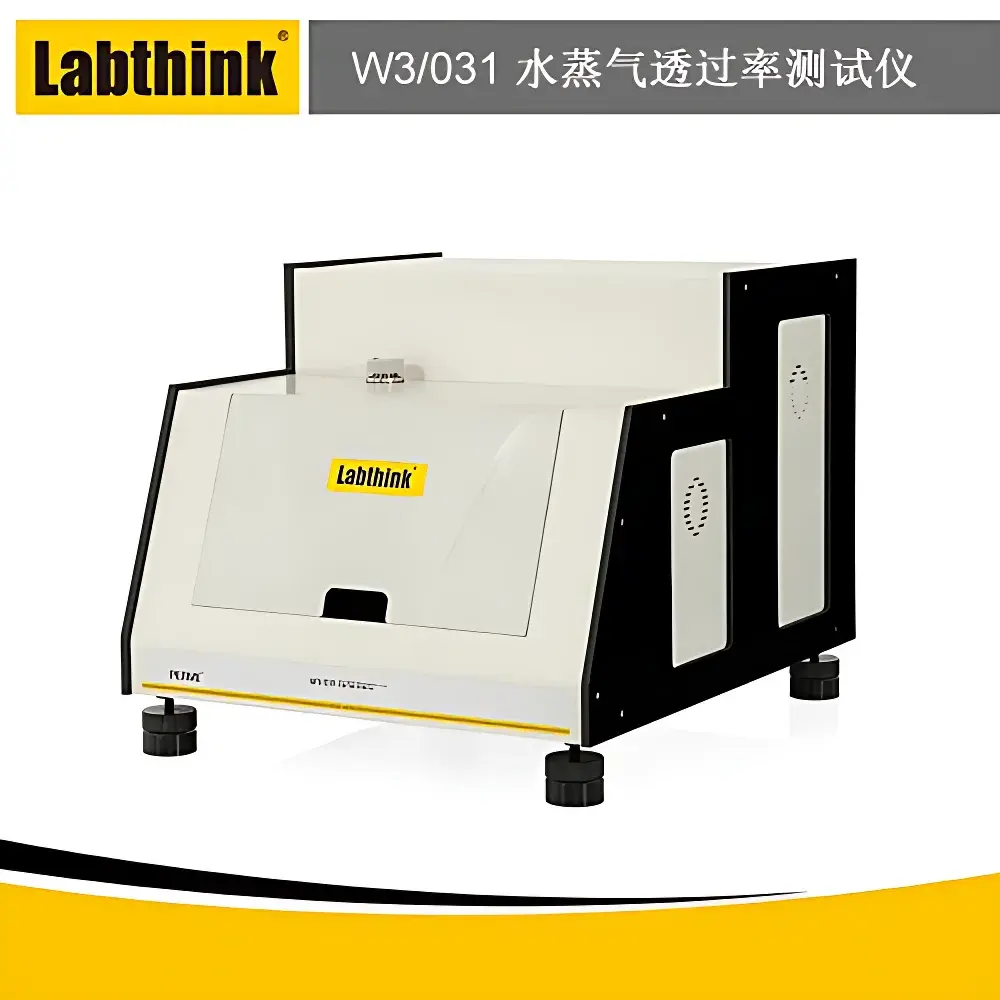
Labthink W3/031 Gravimetric Cup Method Water Vapor Transmission Rate (WVTR) Tester
| Brand | Labthink |
|---|---|
| Model | W3/031 |
| Origin | Shandong, China |
| Manufacturer Type | Direct Manufacturer |
| Country of Origin | China |
| Price Range | USD 14,000 – 72,000 (based on configuration and regional duties) |
| Test Principle | Gravimetric cup method (weight gain/loss measurement) |
| Test Range | 0.1–10,000 g/m²·24h |
| Sample Quantity | 1–3 independent cups |
| Test Accuracy | ±0.01 g/m²·24h |
| System Resolution | 0.0001 g |
| Temperature Control Range | 15–55 °C |
| Temp. Stability | ±0.1 °C |
| Humidity Control Range | 10–98 %RH (standard 90 %RH) |
| RH Stability | ±1 %RH |
| Sweep Air Velocity | 0.5–2.5 m/s (optional) |
| Test Area | 33 cm² |
| Max. Sample Thickness | ≤3 mm |
| Sample Diameter | Φ74 mm |
| Chamber Volume | 27 L |
| Power Supply | 220 VAC 50 Hz / 120 VAC 60 Hz |
| Net Weight | 83 kg |
| Dimensions (L×W×H) | 580×680×470 mm |
Overview
The Labthink W3/031 Gravimetric Cup Method Water Vapor Transmission Rate (WVTR) Tester is a precision-engineered instrument designed for quantitative determination of water vapor permeation through planar materials—including films, laminates, coatings, and rigid substrates—used in construction waterproofing membranes, flexible packaging, pharmaceutical blister foils, and barrier-coated electronics. It operates on the standardized gravimetric cup method (also known as the desiccant or moisture gain method), wherein a conditioned test specimen seals a permeation cup containing either desiccant (dry side) or saturated salt solution (controlled RH side). Under defined temperature and relative humidity gradients across the specimen, water vapor diffuses through the material and alters the mass of the cup assembly over time. The WVTR is calculated from the linear slope of mass change versus time, normalized to test area and expressed in g/m²·24h. This principle is thermodynamically grounded, traceable to SI mass units, and inherently compliant with fundamental diffusion theory for steady-state vapor transport.
Key Features
- Triple independent test stations: Three sealed permeation cups operate simultaneously under identical environmental conditions, enabling parallel evaluation of replicate samples or multi-material comparison without cross-contamination or sequential delay.
- Precision microbalance integration: Equipped with a high-stability, temperature-compensated analytical balance (0.0001 g resolution) mounted on a vibration-damped platform within a thermally isolated chamber, ensuring metrological integrity during long-duration gravimetric monitoring (up to 168 h).
- Active dual-zone climate control: Independent PID-regulated heating and humidification systems maintain uniform, stable test conditions across the entire chamber volume (27 L), with temperature stability of ±0.1 °C and RH stability of ±1 %RH at setpoints between 10–98 %RH.
- Embedded Linux-based controller: Replaces legacy microcontroller architectures with a real-time embedded computing platform running deterministic task scheduling, enabling synchronized data acquisition, environmental feedback loops, and fail-safe error handling.
- Modular gas management: Integrated air drying unit with automatic regenerative desiccant filter ensures consistent dew point control; optional compressed air supply (0.6 MPa, Φ4 mm PU tubing interface) supports purge flow regulation (0.5–2.5 m/s) for boundary layer control per ASTM E96 Annex A4.
Sample Compatibility & Compliance
The W3/031 accommodates circular specimens up to Φ74 mm and thicknesses ≤3 mm—suitable for bituminous membranes, PVC geomembranes, polyolefin roofing sheets, aluminized PET laminates, and silicone-coated release liners. Its mechanical design conforms to ISO 2528:2019, ASTM E96/E96M-23, GB/T 1037–2021, and JIS Z0208:2015 dimensional and sealing requirements. All operational parameters—including temperature ramp profiles, RH step transitions, and mass sampling intervals—are programmable and logged with timestamped metadata, supporting audit readiness for GLP-compliant laboratories. Data records meet FDA 21 CFR Part 11 criteria when used with validated Lystem™ software configurations, including electronic signatures, audit trails, and role-based access control.
Software & Data Management
Control and analysis are executed via Labthink’s Lystem™ v3.x software suite, deployed on an integrated industrial-grade LCD workstation. The interface provides real-time visualization of mass drift curves, environmental parameter trends, and statistical summaries (mean, SD, CV%, linearity R²). Automated pass/fail evaluation against user-defined specification limits is supported. Raw data export complies with ASTM E1447 and ISO/IEC 17025:2017 requirements—CSV, PDF, and XML formats include full traceability: instrument ID, operator, calibration certificate IDs, environmental logs, and raw mass vs. time arrays. When deployed in networked environments, Lystem™ enables centralized database synchronization across multiple W3/031 units, facilitating cross-site method transfer, inter-laboratory comparison studies, and enterprise-level quality dashboarding.
Applications
- Construction materials: Quantifying moisture barrier efficacy of self-adhesive polymer-modified bitumen (PMB) membranes, TPO single-ply roofing, and spray-applied liquid waterproofing elastomers.
- Pharmaceutical packaging: Validating WVTR performance of cold-form blister lidding foils (e.g., Alu-Alu, Alu-PVC) per USP and EP 2.6.12.
- Food packaging R&D: Benchmarking high-barrier metallized CPP films, SiOx-coated PET, and ethylene-vinyl alcohol (EVOH) coextrusions under accelerated aging protocols.
- Electronics encapsulation: Assessing moisture ingress resistance of conformal coatings (acrylic, urethane, parylene) applied to PCB assemblies.
- Regulatory submission support: Generating GLP-auditable datasets for FDA 510(k), CE marking (MDR Annex I, Section 10.5), and China NMPA registration dossiers.
FAQ
What standards does the W3/031 fully support out-of-the-box?
The system is pre-configured for ASTM E96 (desiccant and water methods), ISO 2528, GB/T 1037, and JIS Z0208, with built-in test templates, default environmental profiles, and calculation algorithms aligned to each standard’s clause-specific requirements.
Can the W3/031 test rigid substrates like fiber-cement board or gypsum wallboard?
Yes—when used with optional custom cup adapters and perimeter sealing fixtures, it accommodates non-flexible specimens up to 3 mm thickness; edge-sealing with paraffin wax or low-permeability epoxy is recommended per ASTM D1653 Annex A2.
Is external compressed air mandatory for operation?
No—ambient air may be used with the internal drying module; however, regulated compressed air (0.6 MPa) is required for precise sweep velocity control in high-accuracy or low-RH testing per ASTM E96 Method B.
How often must the balance be calibrated?
Initial calibration is performed at factory using NIST-traceable weights; field verification is recommended before each test series using the supplied 10 g and 100 g certified calibration masses, with documented results archived in the Lystem™ audit trail.
Does the system support 21 CFR Part 11 compliance?
Yes—when operated with validated Lystem™ software, configured user roles, electronic signatures, and enabled audit trail logging, the complete system satisfies Part 11 requirements for electronic records and signatures in regulated environments.
Related Products







