
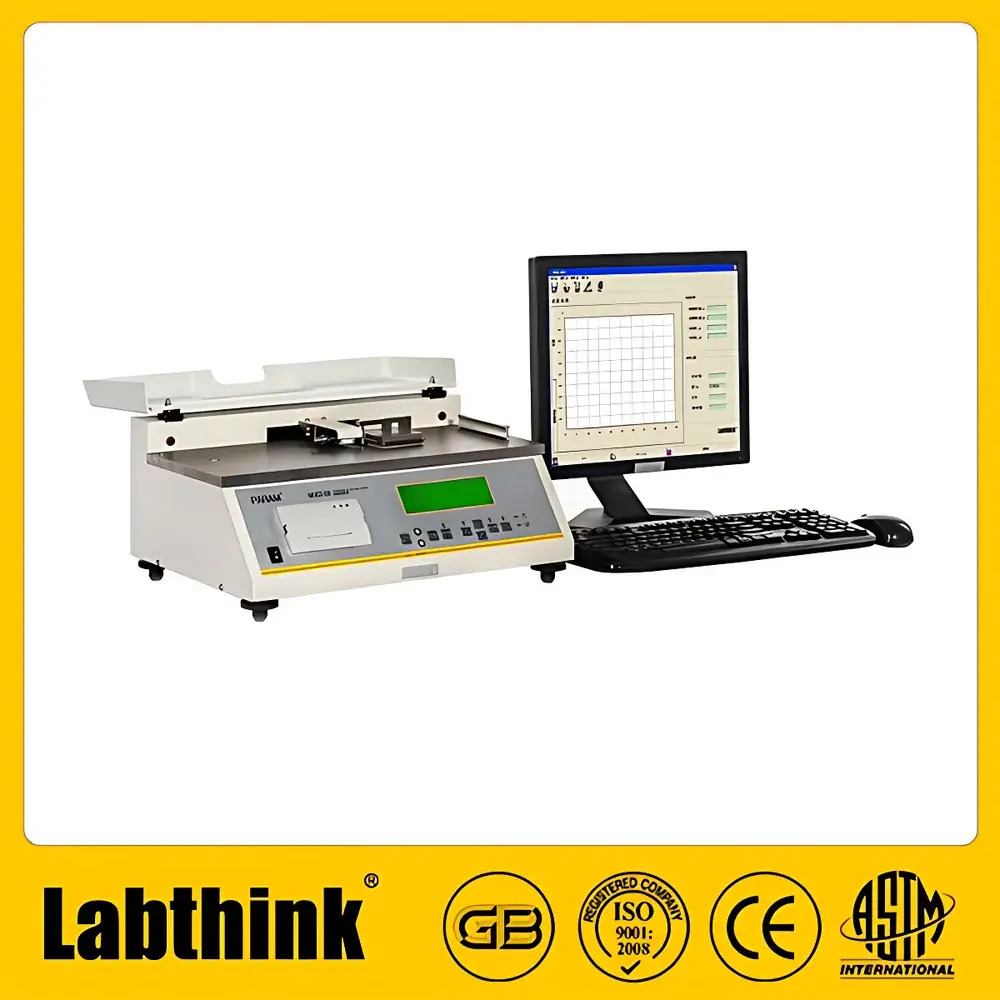
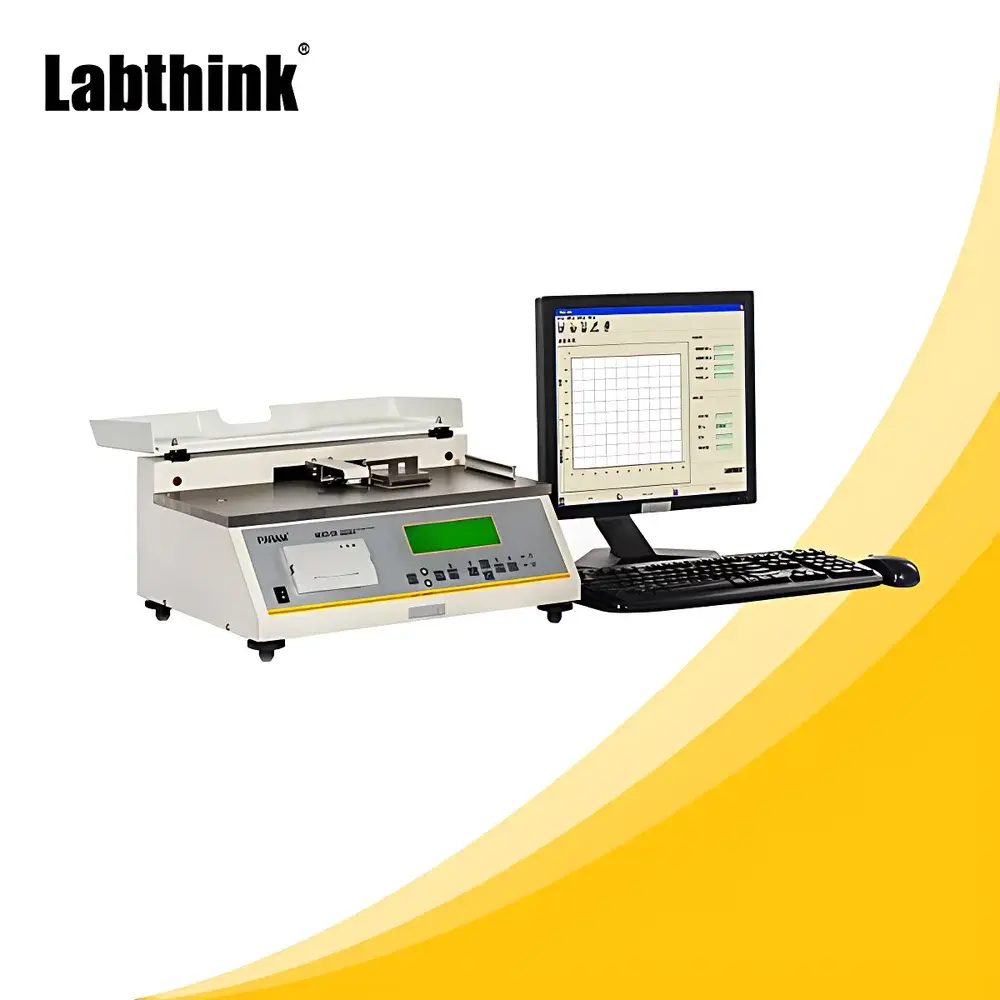
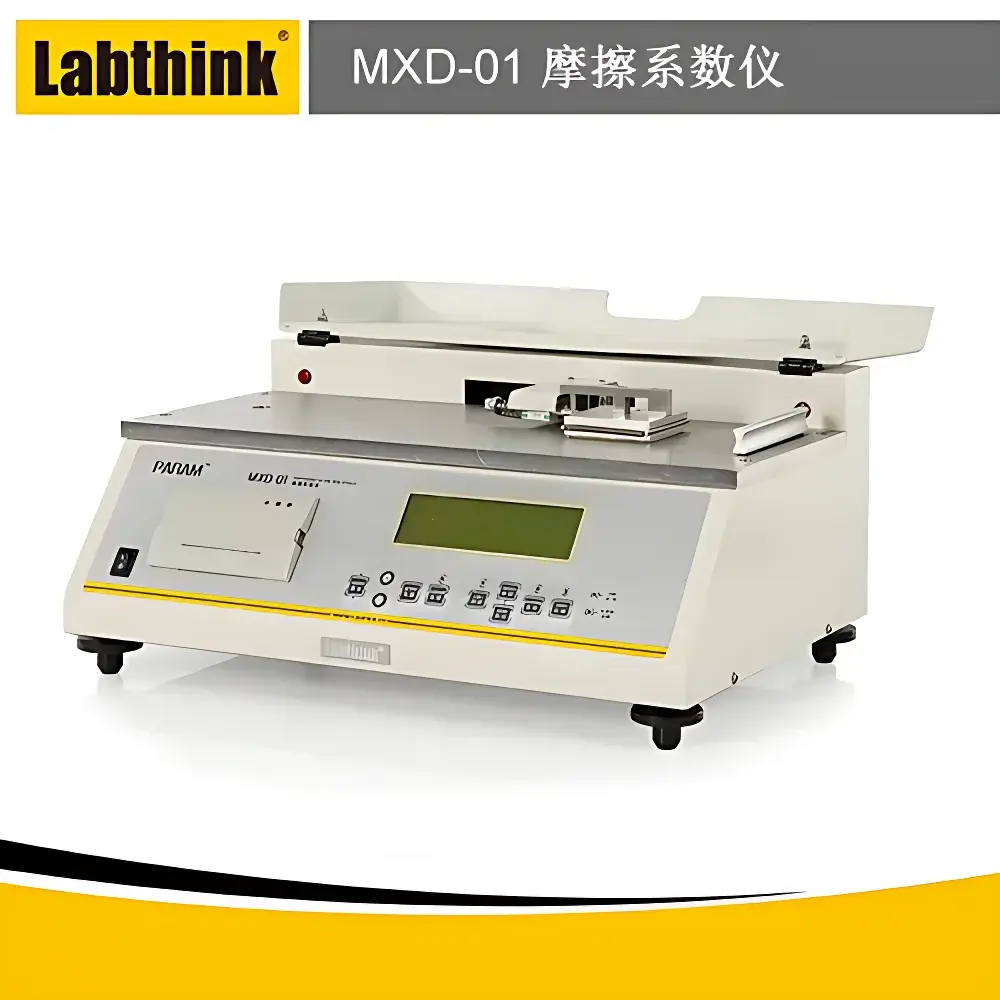
Labthink MXD-01 Coefficient of Friction Tester for Packaging Films
| Brand | Labthink |
|---|---|
| Origin | Shandong, China |
| Manufacturer | Labthink Instruments Co., Ltd. |
| Model | MXD-01 |
| Load Range | 0–5 N |
| Accuracy Class | Class 1 |
| Travel Distance | 10 mm + 60 mm |
| Slider Mass Options | 200 g, 500 g (1000 g optional) |
| Test Speed | 100 mm/min |
| Temperature Range | 10–40 °C |
| Relative Humidity Range | 20–70 %RH |
| Power Supply | 220 VAC 50 Hz / 120 VAC 60 Hz |
| Dimensions (L×W×H) | 470 × 310 × 200 mm |
| Net Weight | 31 kg |
| Compliance | GB 10006, ISO 8295 |
Overview
The Labthink MXD-01 Coefficient of Friction Tester is an electromechanical instrument engineered for precision measurement of static and kinetic coefficients of friction (COF) in flexible packaging materials and related substrates. It operates on the fundamental principle of horizontal pull testing, where a standardized slider is drawn across a stationary sample surface at a controlled velocity (100 mm/min), while force transducers capture the peak (static) and sustained (kinetic) resistance to motion. This methodology conforms rigorously to ASTM D1894 and ISO 8295—international standards widely adopted in packaging R&D, quality control, and regulatory validation workflows. Designed specifically for the packaging industry, the MXD-01 delivers repeatable, traceable COF data critical for evaluating slip performance, optimizing film processing (e.g., high-speed filling, sealing, and stacking), and ensuring functional compatibility between laminated layers, coatings, and additives such as爽滑剂 (slip agents) or anti-block agents.
Key Features
- Simultaneous dual-mode measurement: automatic acquisition and differentiation of static (μs) and kinetic (μk) coefficients under programmable dwell time and linear displacement profiles.
- Digital microprocessor control with intuitive PVC membrane keypad and backlit LCD display—no PC dependency for routine operation.
- Magnetically neutralized test platform and slider assembly: all metallic components undergo certified demagnetization and residual magnetism verification (<0.2 mT), minimizing electromagnetic interference with force-sensing elements.
- Modular slider system: standard 200 g and 500 g sliders included; optional 1000 g unit and custom-mass sliders (e.g., 100 g, 1 kg) available for specialized applications including medical tubing or textured composites.
- Integrated thermal and hygroscopic environmental monitoring: real-time logging of ambient temperature (10–40 °C) and relative humidity (20–70 %RH) ensures test condition traceability per ISO 291 and ASTM D618.
- RS232 serial interface compliant with EIA/TIA-232-E specifications, enabling bidirectional communication with external PCs for automated data export and remote calibration verification.
Sample Compatibility & Compliance
The MXD-01 supports a broad spectrum of planar and quasi-planar specimens defined in ISO 8295 Annex A and GB 10006 Clause 5. Validated material categories include biaxially oriented polypropylene (BOPP), cast polypropylene (CPP), polyethylene (PE), polyester (PET), aluminum foil, metallized films, paperboard, corrugated board, nonwovens, rubber sheets, coated textiles, and composite laminates used in pharmaceutical blister packaging and food-grade pouches. For medical device applications, it accommodates flat sections of silicone-coated catheters, PTFE-lined tubing, and hydrophilic polymer films per ISO 10993-1 biocompatibility evaluation protocols. All test procedures align with Good Manufacturing Practice (GMP) documentation requirements, supporting audit-ready records including operator ID, timestamped environmental logs, and raw force-vs.-displacement curves.
Software & Data Management
Optional Lystem™ Laboratory Data Sharing System provides full GLP-compliant data governance: electronic signatures, role-based access control, versioned method templates, and 21 CFR Part 11–ready audit trails. The software performs statistical analysis per ISO 5725-2, calculating repeatability (r), reproducibility (R), confidence intervals (95 % CI), and outlier detection using Grubbs’ test. Automated “stick-slip” event recognition identifies intermittent adhesion transitions—critical for diagnosing surface heterogeneity in corona-treated or plasma-modified films. Export formats include CSV, PDF test reports (with embedded metadata), and XML for integration into enterprise LIMS platforms.
Applications
- Quantifying slip agent efficacy during blown-film extrusion process development.
- Validating consistency of surface treatment (e.g., flame, corona, or plasma) across production batches.
- Assessing COF stability under accelerated aging conditions (e.g., 40 °C/75 %RH for 14 days).
- Comparing frictional behavior of mono-layer vs. co-extruded structures in retortable pouches.
- Supporting FDA submission dossiers for primary packaging materials used in injectables or inhalation products.
- Evaluating tactile perception of cosmetic packaging films—correlating μs/μk ratios with consumer handling feedback.
FAQ
Does the MXD-01 comply with FDA or EU MDR requirements for medical packaging validation?
Yes—the instrument’s design, calibration traceability (NIST-traceable load cells), and optional Lystem™ software support compliance with ISO 11607-1, MDD Annex I, and FDA Guidance for Industry on Container Closure Systems.
Can the MXD-01 measure friction between two moving surfaces (e.g., film-to-film)?
No—it implements the standard fixed-substrate configuration per ISO 8295. For film-on-film testing, Labthink recommends the MXD-02 dual-station variant with independent motion control.
Is calibration certification included with shipment?
Each unit ships with a factory calibration report referencing ISO/IEC 17025-accredited standards; on-site verification services and annual recalibration are available through Labthink’s global service network.





