
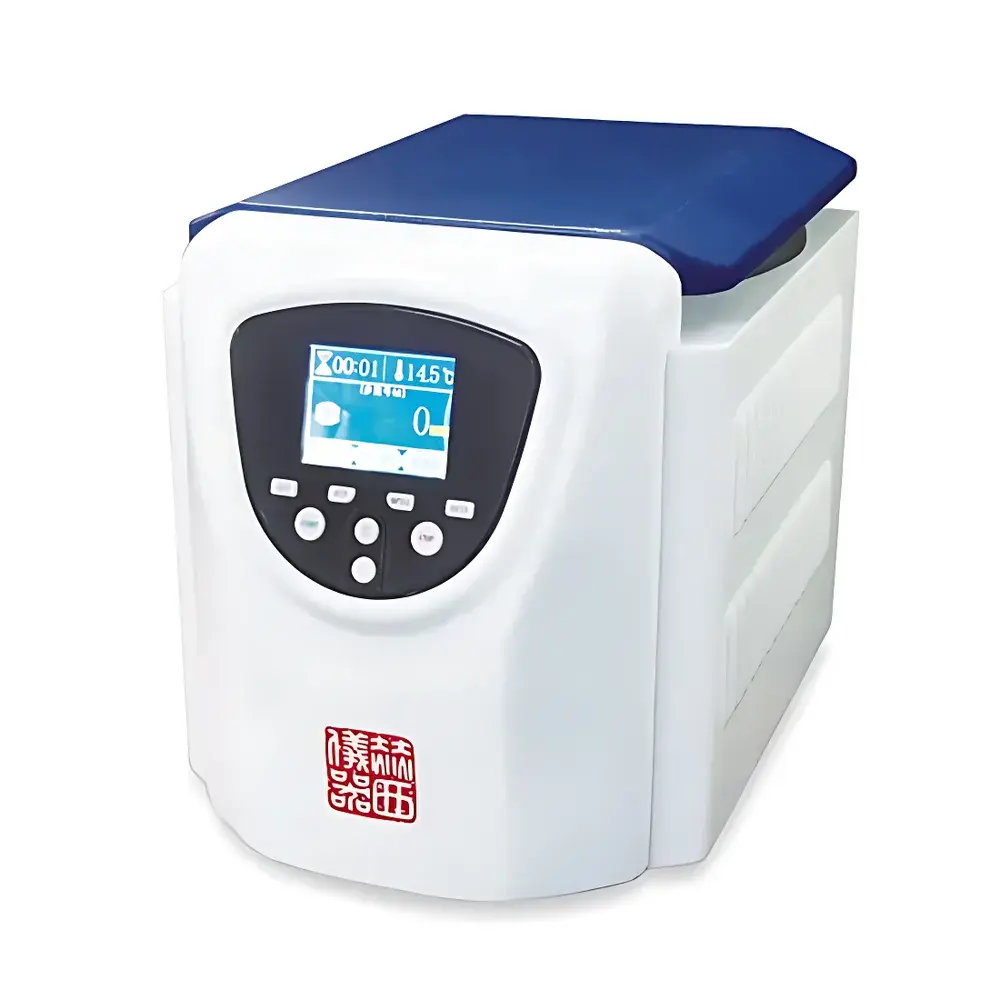
Herxi TD4 Dental Centrifuge
| Brand | Herxi |
|---|---|
| Origin | Hunan, China |
| Model | TD4 |
| Instrument Type | Benchtop Centrifuge |
| Speed Range | 0–3100 rpm |
| Max RCF | 2600 × g |
| Max Capacity | 8 × 20 mL |
| Rotor Configuration | Fixed-angle rotor |
| Control System | Microprocessor-controlled with TFT color touch panel |
| Drive Motor | Brushless DC inverter motor |
| Acceleration/Deceleration | Programmable ramp profiles |
| Noise Level | ≤60 dB(A) |
| Dimensions (L×W×H) | 380 × 260 × 310 mm |
| Net Weight (with rotor) | 17 kg |
| Power Supply | AC 220 V, 50 Hz |
| Operating Environment | 5–40 °C, ≤80% RH, non-corrosive/non-explosive atmosphere |
| Safety Features | Interlocked motorized lid, automatic imbalance detection, real-time RCF calculation, parameter memory storage |
| Pre-set Programs | 4 dedicated CGF/A-PRF/i-PRF/PGRF protocols |
| Speed Accuracy | ±30 rpm |
Overview
The Herxi TD4 Dental Centrifuge is a benchtop, microprocessor-controlled centrifuge engineered specifically for clinical oral and maxillofacial applications requiring precise, reproducible separation of autologous blood components. It operates on the principle of sedimentation-based differential centrifugation—leveraging controlled rotational force (RCF) to stratify whole venous blood into functionally distinct layers: platelet-poor plasma (PPP), platelet-rich plasma (PRP), leukocyte- and growth factor–enriched fibrin matrix (CGF), and red blood cell (RBC) fractions. Unlike general-purpose laboratory centrifuges, the TD4 integrates programmable multi-step deceleration profiles essential for CGF (Concentrated Growth Factors) preparation—a clinically validated biomaterial used in guided bone regeneration, socket preservation, soft-tissue augmentation, and aesthetic facial rejuvenation. Its design prioritizes operational safety, acoustic containment, and compliance with routine clinical workflow constraints—including compact footprint, low thermal load, and silent operation under continuous use.
Key Features
- Brushless DC inverter motor delivering high torque at low noise (≤60 dB[A]) and eliminating carbon brush wear or particulate contamination—critical for sterile clinical environments.
- Four pre-configured, one-touch centrifugation protocols optimized for dental regenerative workflows: CGF-S1 (variable-speed gradient protocol), A-PRF-S2, i-PRF-S3, and PGRF-S4—each calibrated to published clinical centrifugation parameters for fibrin architecture integrity.
- TFT true-color capacitive touch interface with intuitive navigation, real-time RCF calculation, and automatic parameter recall across sessions.
- Integrated mechanical damping system with self-balancing capability, minimizing vibration during acceleration/deceleration—even with minor tube weight discrepancies.
- Electromechanical lid lock with active interlock: centrifugation initiates only when lid is fully engaged and sealed; immediate rotor stop upon lid opening.
- Rigid steel chassis with electrostatic powder coating ensures structural rigidity, chemical resistance to disinfectants (e.g., 70% ethanol, sodium hypochlorite), and long-term dimensional stability.
- Programmable ramp control enables precise modulation of deceleration rate—essential for preserving the viscoelastic fibrin network in CGF clots without mechanical disruption.
Sample Compatibility & Compliance
The TD4 accepts standard conical-bottom 10–20 mL glass or polymer blood collection tubes (e.g., Vacutainer®-compatible formats) using its fixed-angle rotor (8 × 20 mL capacity). It supports all major autologous blood-derived biomaterials used in dentistry: CGF, A-PRF (Advanced Platelet-Rich Fibrin), i-PRF (injectable PRF), and PGRF (Plasma-Growth Regeneration Fibrin). While not certified as a medical device under FDA 510(k) or CE IVD directives, the TD4 meets fundamental electrical safety requirements per IEC 61010-1 and mechanical safety per ISO 13485-aligned manufacturing practices. Its operating parameters align with peer-reviewed methodologies cited in journals such as Clinical Oral Investigations and Journal of Oral Implantology, supporting GLP-compliant documentation when integrated into institutional SOPs.
Software & Data Management
The TD4 employs embedded firmware—not external PC software—for protocol execution and parameter logging. All four factory-set programs store speed, time, acceleration, and deceleration settings in non-volatile memory. Each run logs timestamp, selected program ID, final RCF, and rotor temperature (monitored via internal thermistor). No data export functionality is provided; however, the device supports manual recordkeeping compatible with paper-based or electronic quality management systems (QMS) used in dental clinics and ambulatory surgical centers. Audit trails are maintained through operator-initiated program selection—no user authentication or electronic signature capability is included, consistent with Class I non-invasive equipment classification.
Applications
- Preparation of CGF membranes and plugs for ridge preservation following tooth extraction.
- Isolation of A-PRF clots for sinus lift augmentation and peri-implant defect repair.
- Generation of i-PRF supernatant for intrasulcular injection in periodontal therapy.
- Processing of PGRF scaffolds for craniofacial bone grafting adjuncts.
- Supporting research-grade separation of exosomes and microparticles from platelet lysates in academic oral biology labs.
- On-site processing in mobile dental units or satellite clinics where space, power, and noise constraints limit equipment options.
FAQ
What is the maximum relative centrifugal force (RCF) achievable with the TD4?
The TD4 delivers a maximum RCF of 2600 × g at 3100 rpm with the standard 20 mL fixed-angle rotor.
Can the TD4 be used for non-dental applications such as serum separation or cell pelleting?
Yes—it is technically capable of standard low-speed separations (e.g., serum/plasma isolation at 1500–2500 rpm); however, its rotor geometry and protocol library are optimized for fibrin matrix formation, not high-throughput clinical chemistry workflows.
Does the TD4 comply with FDA 21 CFR Part 11 requirements?
No—the TD4 does not include electronic records, audit trails, or user access controls required for Part 11 compliance; it is intended for use in environments where manual documentation suffices.
How often does the rotor require calibration or maintenance?
The brushless motor and solid-state electronics require no scheduled maintenance; periodic visual inspection of rotor threads and lid seal integrity is recommended every 6 months or after 500 runs.
Is the TD4 suitable for use in ISO Class 5 cleanrooms?
While not rated for cleanroom certification, its low particle generation (no carbon brushes), minimal heat dissipation (<5 °C ambient rise), and smooth surface finish make it compatible with controlled clinical environments when operated behind laminar airflow hoods.



