
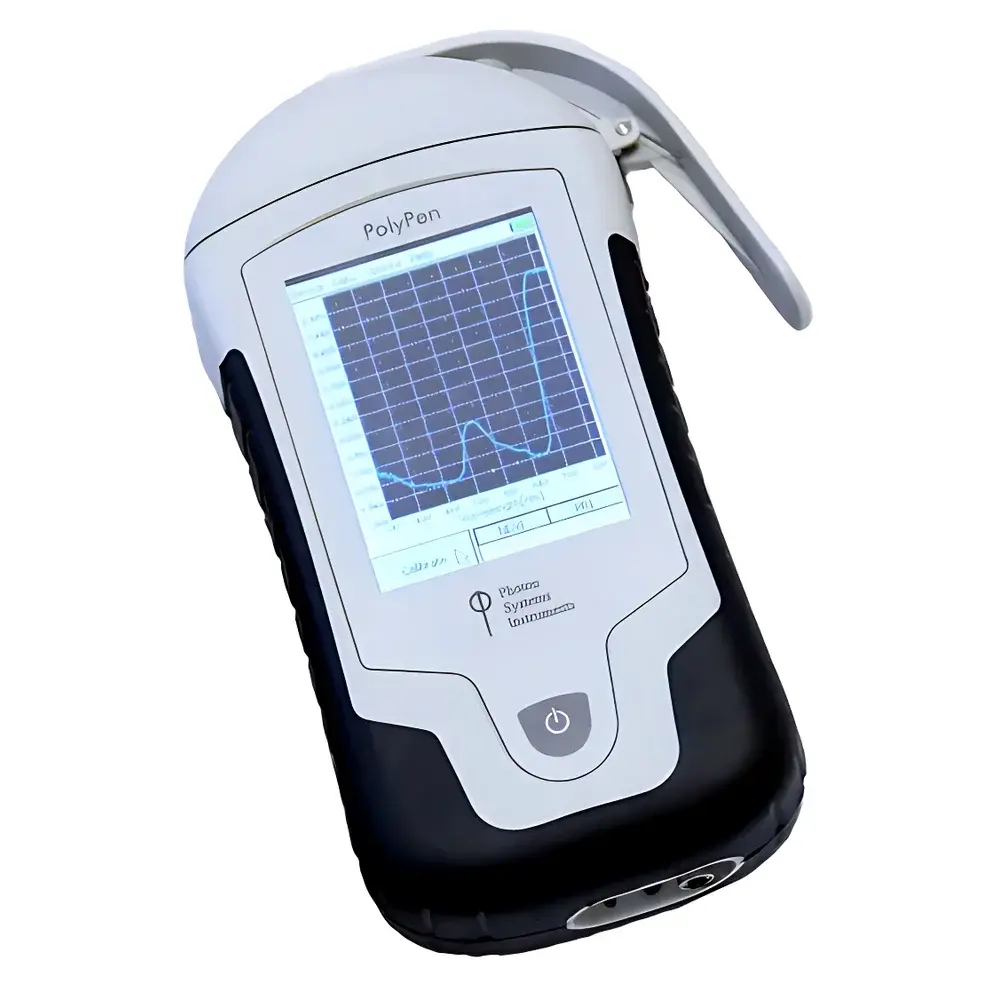
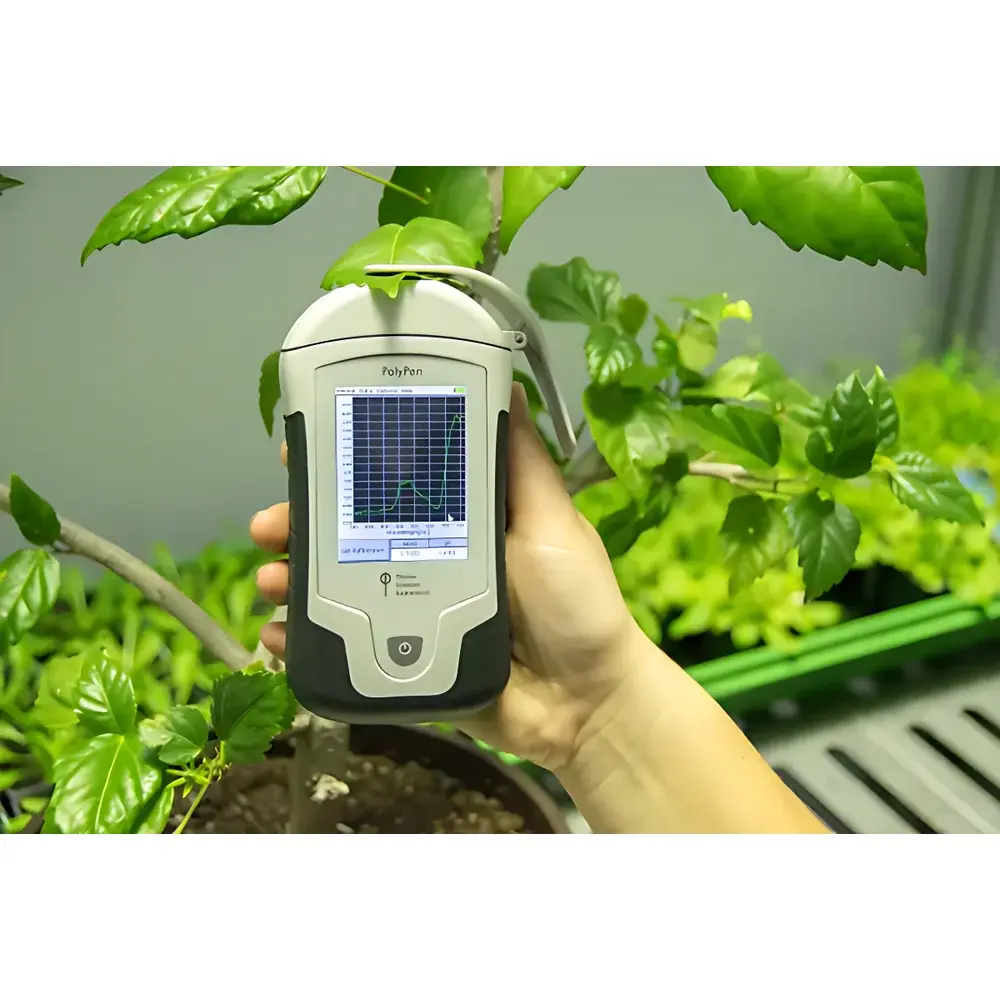
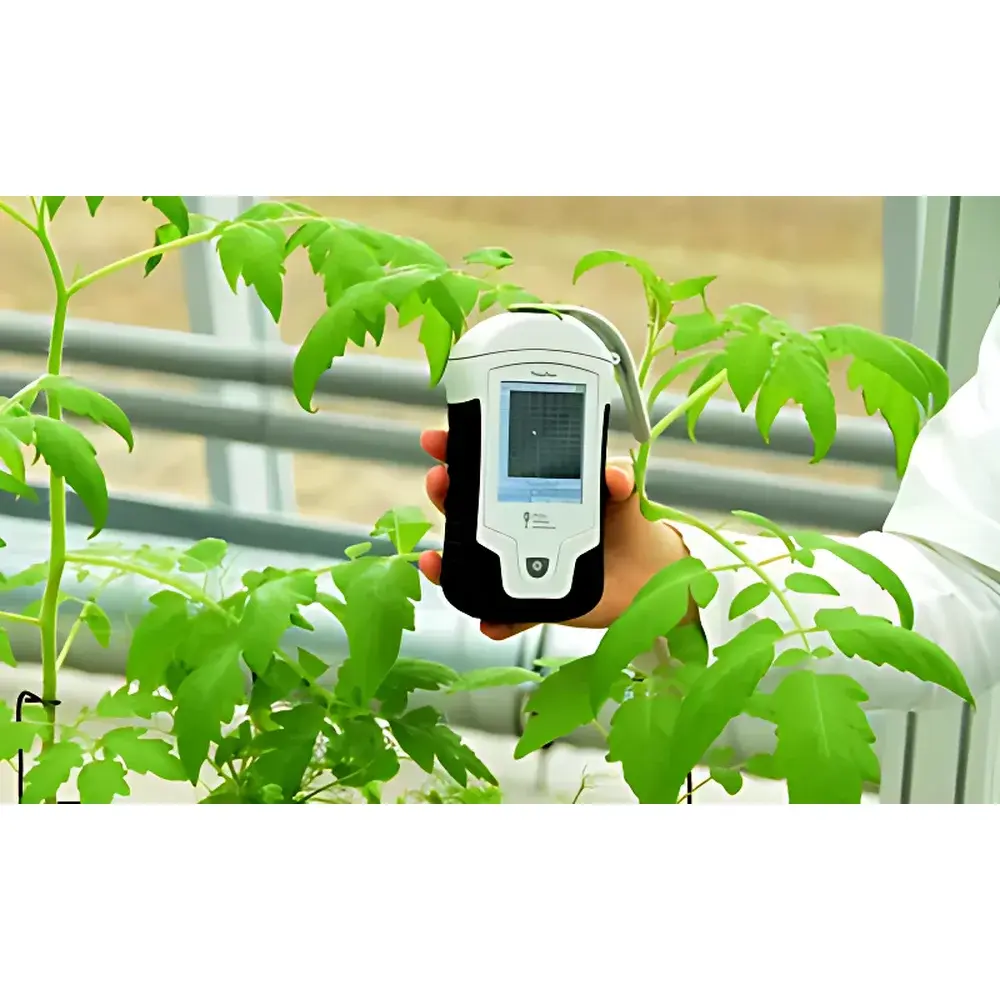
PolyPen RP-410 Handheld Plant Reflectance Spectrometer
| Brand | PSI (Czech Republic) |
|---|---|
| Origin | Czech Republic |
| Model | PolyPen RP-410 |
| Spectral Range (UVIS) | 380–790 nm |
| Spectral Range (NIR) | 640–1050 nm |
| Spectral Resolution (FWHM) | 8 nm |
| Stray Light | –30 dB |
| Optical Aperture | 7 mm |
| Scan Time | ~100 ms |
| Display | 240 × 320 pixel color touchscreen (65,535 colors) |
| Memory | 32 MB (≥8,000 spectra) |
| ADC | 16-bit |
| Dynamic Range | 1:4,300 (high gain), 1:13,000 (low gain) |
| GPS | Integrated |
| Connectivity | USB + Bluetooth |
| Power | Rechargeable Li-ion battery |
| Battery Life | Up to 48 h continuous operation |
| Dimensions | 150 × 75 × 40 mm |
| Weight | 300 g |
| Enclosure | Splash-resistant housing |
| Operating Temperature | 0–50 °C |
| Storage Temperature | –20–70 °C |
| Calibration Standard (optional) | >99% Lambertian reflectance, UV–VIS–NIR flat-field (±1%) |
Overview
The PolyPen RP-410 Handheld Plant Reflectance Spectrometer is an engineered field-deployable instrument designed for rapid, non-destructive acquisition of leaf-level spectral reflectance across the ultraviolet-visible-near-infrared (UV–VIS–NIR) range. Based on a stabilized xenon flash lamp light source (380–1050 nm) and a high-fidelity linear CCD array spectrometer, the device operates on the principle of contact-based, double-beam relative reflectance measurement—comparing sample reflectance against an integrated reference standard within the same optical path and temporal frame. This architecture ensures high reproducibility under variable ambient lighting conditions and eliminates reliance on external calibration targets during routine measurements. The PolyPen RP-410 is optimized for plant physiological phenotyping, enabling real-time quantification of pigment composition, photosynthetic capacity, and stress-induced biochemical shifts through spectral signature analysis. Its compact form factor, onboard processing, and self-contained power system make it suitable for longitudinal monitoring in greenhouse, nursery, field plot, and natural ecosystem settings—without requiring tethering to a laptop or external power infrastructure.
Key Features
- Integrated dual-spectral configuration: UVIS channel (380–790 nm) and NIR channel (640–1050 nm), each with 8 nm full-width-at-half-maximum (FWHM) spectral resolution and <–30 dB stray light rejection.
- Non-invasive leaf clip with built-in calibrated reference tile—enabling automatic dark-current and white-reference correction prior to each measurement cycle.
- Onboard calculation engine supporting 24 pre-programmed vegetation indices (e.g., NDVI, PRI, MCARI, OSAVI, ZMI, GM1/GM2) and user-defined index formulas via editable coefficient tables.
- Real-time visualization of spectral curves and index values on a 240 × 320 pixel full-color resistive touchscreen with intuitive icon-driven interface.
- Embedded GPS module synchronized with each spectrum capture, enabling georeferenced spectral database construction compatible with GIS workflows.
- 32 MB internal flash memory capable of storing over 8,000 full-spectrum acquisitions with metadata (timestamp, GPS coordinates, index values, operator ID).
- USB 2.0 and Bluetooth 4.2 dual-mode communication for data export, firmware updates, and remote parameter configuration using Windows XP or later.
Sample Compatibility & Compliance
The PolyPen RP-410 is validated for use with intact, flattened leaves from herbaceous and woody angiosperms and gymnosperms—including but not limited to Arabidopsis thaliana, Oryza sativa, Betula pendula, Prunus dulcis, and Brassica rapa. Its 7 mm optical aperture accommodates typical leaf lamina thicknesses (up to 0.8 mm) without compression artifacts. The instrument complies with IEC 60529 IPX4 splash resistance standards and meets CE marking requirements for electromagnetic compatibility (EMC Directive 2014/30/EU) and low-voltage safety (LVD Directive 2014/35/EU). While not certified for GMP/GLP-regulated clinical trials, its traceable calibration workflow—supported by optional NIST-traceable 99% diffuse reflectance standard—facilitates adherence to ISO 17025-compliant laboratory practices when used in research-grade plant phenotyping protocols.
Software & Data Management
The PolyPen Control Suite (v3.2+) provides comprehensive post-acquisition analysis capabilities on Windows platforms. Raw spectral data are stored in open-format ASCII (.txt) and Excel-compatible (.csv) files, preserving wavelength-resolved radiance, reflectance, and derived indices. The software supports batch processing of geotagged datasets, spectral smoothing (Savitzky–Golay), baseline correction, and export of XY plots in publication-ready SVG/PNG formats. Audit trails—including operator login, firmware version, calibration timestamp, and GPS fix quality—are embedded in metadata headers to support FAIR (Findable, Accessible, Interoperable, Reusable) data principles. Firmware updates preserve backward compatibility with legacy measurement files and include enhanced noise-reduction algorithms for low-light conditions.
Applications
- Early detection of biotic stressors (e.g., almond red leaf blotch, rice blast, powdery mildew) via spectral shifts in carotenoid-to-chlorophyll ratios and epidermal structural changes.
- Quantitative assessment of nitrogen status through correlations between R750/R550 (GM1), R680/R430 (NPCI), and tissue Kjeldahl-N measurements.
- Monitoring photoprotective dynamics via PRI (Photochemical Reflectance Index) kinetics under controlled light ramping protocols.
- High-throughput screening of crop germplasm for drought tolerance using OSAVI and TCARI stability across diurnal cycles.
- Validation of airborne/satellite-derived vegetation indices by establishing ground-truth spectral libraries with sub-leaf spatial resolution.
- Longitudinal tracking of senescence progression in perennial species using NPQI (Normalized Phaeophytinization Index) and SRPI (Simple Ratio Pigment Index) time-series models.
FAQ
Does the PolyPen RP-410 require external calibration before each use?
No—its integrated leaf clip contains a factory-calibrated reference tile; automatic dark and white reference acquisition occurs immediately before each measurement.
Can the instrument operate under direct sunlight?
Yes—the xenon flash illumination dominates ambient irradiance, enabling consistent measurements even at solar zenith angles below 30°.
Is spectral data export compatible with R or Python analysis pipelines?
Yes—ASCII-formatted spectral files contain header metadata and tab-delimited columns, enabling seamless ingestion into pandas DataFrames or R data.tables.
What is the minimum leaf area required for reliable measurement?
A minimum of 0.4 cm² (e.g., 2 mm × 20 mm strip) is recommended to fully cover the 7 mm aperture and avoid edge diffraction effects.
How is instrument accuracy verified over time?
Users may perform periodic validation using the optional NIST-traceable 99% reflectance standard; deviation thresholds (>±1.5% reflectance error at 550 nm) trigger recalibration alerts in the software.





