
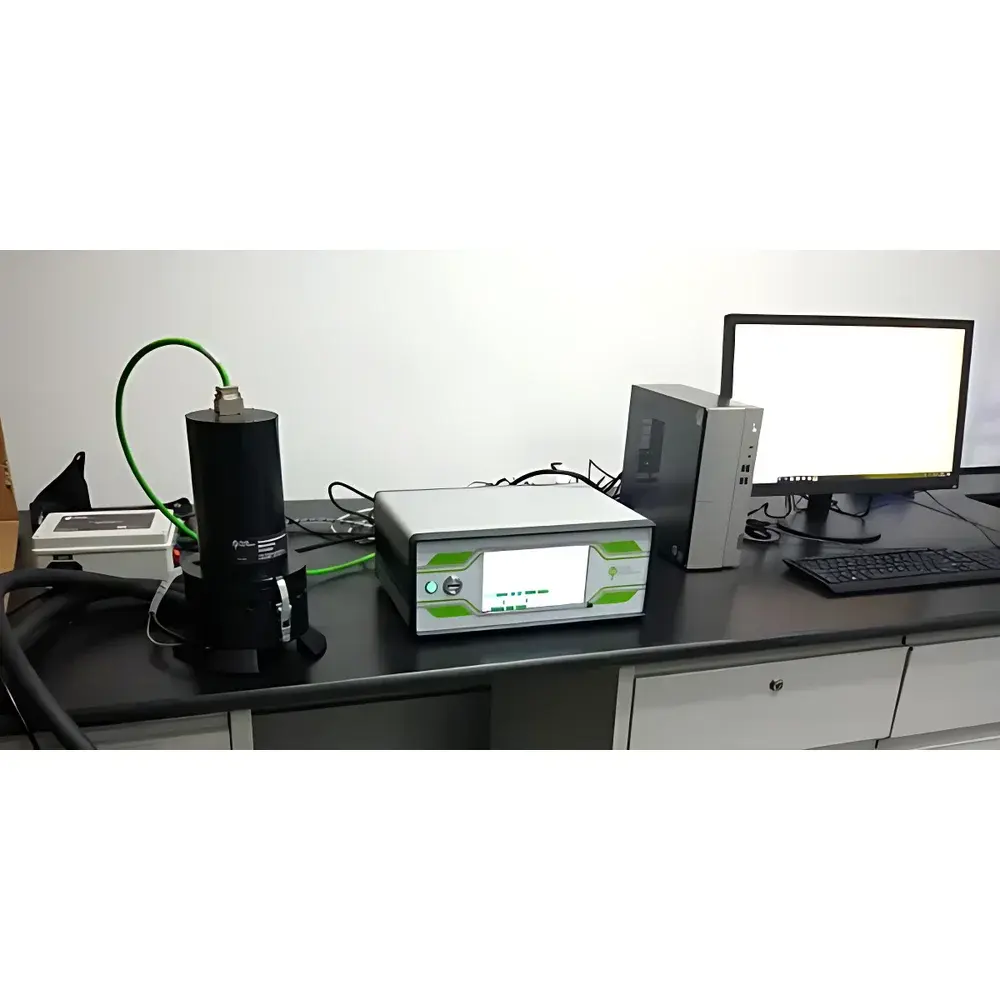
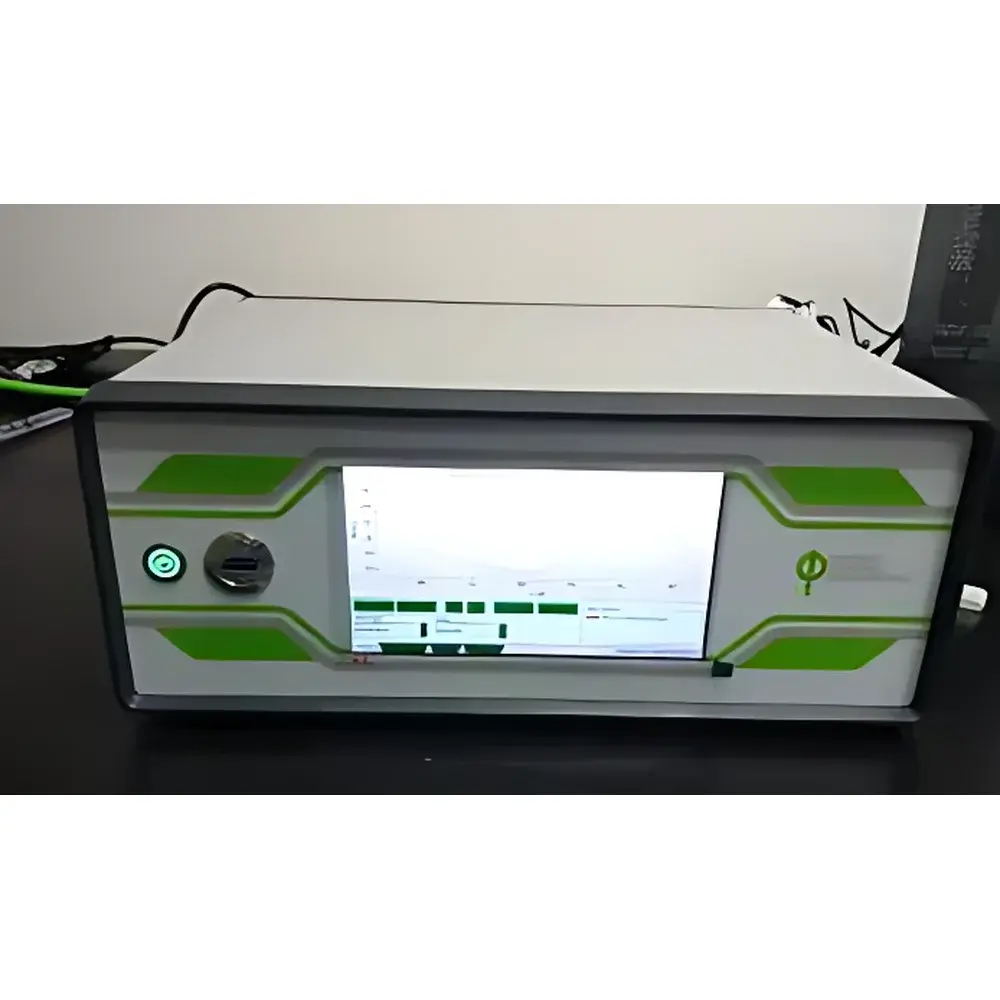
PSI TL6000 Plant Thermoluminescence Measurement System
| Brand | PSI |
|---|---|
| Origin | Czech Republic |
| Model | TL6000 |
| Temperature Range (TL6000/ET) | −100 °C to +200 °C |
| Temperature Range (TL6000/ST) | −25 °C to +70 °C |
| Heating Rate | 0.1–1.8 °C/s (linear) |
| Excitation Pulse | 627 nm, ≤250,000 μmol·m⁻²·s⁻¹ (single-turnover flash) |
| Detection Range | 300–900 nm |
| Sensor | Software-controlled photomultiplier tube (PMT) |
| Sampling Interval | ≥100 ms |
| Sample Holder | Gold-plated copper disc (14 mm or 22 mm diameter) |
| Compliance | GLP-ready data logging, ASTM E1647-compliant thermal control architecture |
| Software | FluorWin 3.7 (RS232/USB interface, programmable experiment scripting) |
Overview
The PSI TL6000 Plant Thermoluminescence Measurement System is a purpose-built, research-grade instrument engineered for quantitative thermoluminescence (TL) analysis of photosystem II (PSII) in intact plant tissues, isolated thylakoids, chloroplasts, and microalgal suspensions. It operates on the physical principle of thermally stimulated luminescence: following cryogenic trapping of photoinduced charge-separated states (e.g., S2QA−, S3QB−) via a saturating single-turnover flash (627 nm, <5 μs), controlled linear heating releases stored energy as photons—yielding temperature-resolved TL glow curves. These curves encode quantitative information on the activation energies, stability, and recombination kinetics of electron carriers within PSII’s donor and acceptor sides. Unlike fluorescence-based assays, TL provides direct access to redox-state-specific charge recombination pathways, enabling mechanistic interrogation of oxygen-evolving complex (OEC) integrity, QB-site functionality, lumenal pH gradients, and S-state transitions—without chemical perturbation or sample destruction.
Key Features
- Two configuration options: TL6000/ST (Peltier + water cooling; −25 °C to +70 °C) and TL6000/ET (resistive heating + liquid nitrogen cooling; −100 °C to +200 °C), supporting both low-temperature trap characterization and high-temperature S-state decay analysis.
- Precise linear temperature ramping (0.1–1.8 °C/s) with real-time feedback control, ensuring reproducible thermal profiles critical for Arrhenius-based kinetic modeling.
- High-intensity, spectrally defined LED excitation source (λmax = 627 nm) delivering calibrated single-turnover flashes up to 250,000 μmol·m⁻²·s⁻¹ and actinic illumination up to 2,000 μmol·m⁻²·s⁻¹.
- Low-noise, software-gain-adjustable photomultiplier tube (PMT) with broad spectral response (300–900 nm) and 100 ms minimum sampling resolution—optimized for weak, transient TL signals.
- Gold-plated copper sample holder (14 mm or 22 mm diameter) ensuring uniform thermal conduction and minimal background interference.
- Integrated overheat protection, ambient light shielding, and programmable thermal hold modes—including manual isothermal stabilization for dark-adaptation or pre-flash conditioning.
Sample Compatibility & Compliance
The TL6000 accommodates diverse biological matrices: fresh or frozen leaf discs (e.g., Arabidopsis thaliana, rice, tobacco), lyophilized algal pellets (Chlorella, Synechocystis), purified chloroplasts, and detergent-isolated thylakoid membranes. Its non-invasive measurement protocol preserves native membrane architecture and redox poise—enabling longitudinal studies under biotic (pathogen, herbicide) or abiotic (drought, chilling, high-light) stress regimes. The system supports GLP-compliant workflows: FluorWin 3.7 enforces electronic audit trails, user-access controls, and timestamped raw-data export (ASCII/CSV). Thermal calibration follows traceable protocols aligned with ASTM E1647 (Standard Practice for Calibration of Thermoluminescent Dosimeters), while signal acquisition adheres to IUPAC-recommended definitions for TL peak deconvolution and kinetic parameter extraction.
Software & Data Management
FluorWin 3.7 provides a deterministic, script-driven experimental environment. Users define multi-step protocols—including dark adaptation, pre-illumination sequences, flash timing, ramp rate, dwell temperatures, and detector gain—via an embedded programming language compatible with standard IEEE 488.2 command syntax. All parameters are logged with metadata (date, operator ID, instrument firmware version, calibration coefficients). Real-time curve visualization on the integrated color display allows immediate quality assessment. Post-acquisition, the software enables baseline correction, peak integration (Gaussian/Lorentzian fitting), derivative analysis, and comparative overlay of multiple TL traces. Export formats include PNG/SVG for publication figures and structured text files for downstream statistical analysis (R, Python, MATLAB).
Applications
- Quantitative assessment of PSII donor-side stability via B-band (≈30 °C) and Q-band (≈5 °C) amplitude ratios—correlating with OEC manganese cluster integrity.
- Discrimination of QB-site inhibitors (e.g., DCMU, atrazine) by characteristic suppression of the main TL band (≈45 °C) and emergence of altered peaks (e.g., C-band at ≈15 °C).
- Mapping lumenal pH shifts under light/dark transitions using the temperature shift of the main TL peak (ΔT ≈ 0.5 °C per 0.1 pH unit).
- Resolving S-state distribution dynamics through oscillatory TL patterns induced by repetitive flash trains—enabling non-invasive monitoring of OEC turnover kinetics.
- Characterizing cold- or heat-induced uncoupling of electron transfer via changes in TL peak width, asymmetry, and activation energy (Ea) derived from variable-heating-rate experiments.
- Validating genetic modifications (e.g., psbP, psbY knockouts) by quantifying deviations in TL band profiles relative to wild-type controls—supporting structure-function studies published in Plant Physiology, Photosynthesis Research, and Biochimica et Biophysica Acta.
FAQ
What distinguishes thermoluminescence from chlorophyll fluorescence in PSII analysis?
Thermoluminescence detects photons emitted during thermal recombination of *trapped* charge pairs (e.g., S2/QA−), providing direct insight into redox thermodynamics and energy barriers. Fluorescence reflects *radiative decay* of excited singlet states and is sensitive to quenching but not directly to specific electron carrier stabilities.
Can the TL6000 be used with intact leaves, or is isolation required?
Intact leaf discs (0.5–1.0 mm thickness) are fully compatible. Rapid freezing in liquid nitrogen followed by mounting on the gold sample holder preserves physiological state without extraction artifacts.
How is temperature calibration validated across the full −100 °C to +200 °C range?
Calibration uses NIST-traceable Pt100 sensors and reference materials with known phase-transition temperatures (e.g., CO2 sublimation at −78.5 °C, ice point at 0 °C, KNO3 transition at 130 °C), verified during factory acceptance testing and recommended annually.
Does FluorWin 3.7 support compliance with FDA 21 CFR Part 11?
While FluorWin 3.7 implements core ALCOA+ principles (Attributable, Legible, Contemporaneous, Original, Accurate), full Part 11 compliance requires site-specific validation documentation and integration with a qualified electronic signature infrastructure—not provided out-of-the-box.
What maintenance is required for the liquid nitrogen cooling module?
The LN2 delivery system employs stainless-steel vacuum-jacketed lines and a solenoid valve with fail-safe closure. Routine checks include dewar fill level, pressure regulator function, and condensate trap cleaning—typically performed quarterly by trained personnel.
Related Products




