
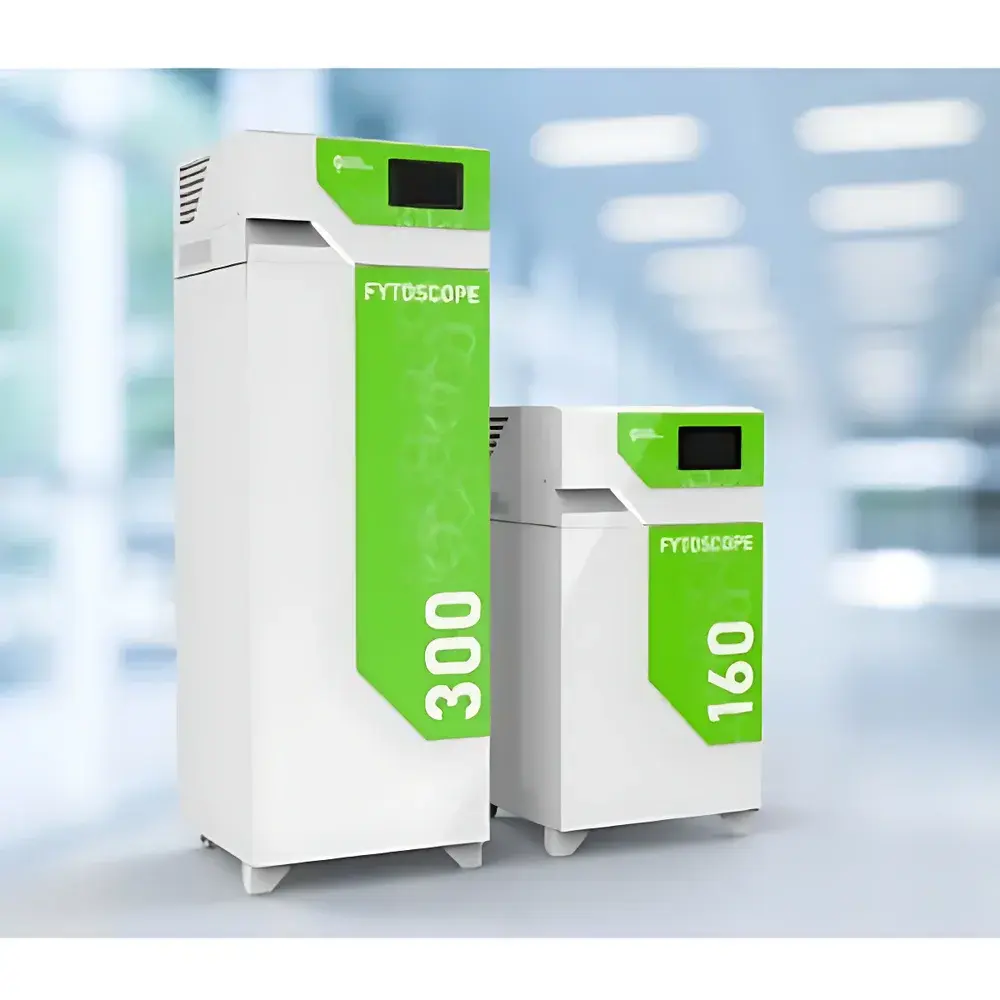
PSI FytoScope LED Plant Growth Chamber
| Brand | PSI |
|---|---|
| Origin | Czech Republic |
| Model | FytoScope FS160 / FS300 |
| Internal Volume | 163 L (FS160) / 307 L (FS300) |
| Temperature Range | 10–45 °C |
| Operating Ambient | 10–35 °C |
| Illumination | White + 735 nm Far-Red LEDs |
| Max Photosynthetic Photon Flux Density (PPFD, at 30 cm) | Top Light — 500 µmol/m²·s (upgradable to 1500 µmol/m²·s) |
| Lighting Layers | FS160 — 2 layers (1 top + 1 bottom) |
| Cultivation Area | 0.38 m² (FS160) / 0.75 m² (FS300) |
| Shelf Dimensions | 48.5 × 38.5 cm |
| Airflow Rate | 450 L/h |
| Refrigerant | R290 (A3 class, non-ozone-depleting) |
| Internal Dimensions (W×D×H) | FS160 — 51 × 45 × 71 cm |
| External Dimensions (W×D×H) | FS160 — 60 × 62 × 114 cm |
| Control Interface | 7″ color capacitive touchscreen |
| Programmable Protocols | Up to 100 user-defined programs with time-resolved control of temperature, spectral composition, and PPFD profiles including diurnal cycles, rapid light fluctuations, and spatial light gradients |
| Data Logging | Real-time acquisition and on-screen visualization of environmental parameters |
Overview
The PSI FytoScope LED Plant Growth Chamber is an engineered environmental control system designed for high-fidelity plant phenotyping, controlled-environment physiology, and reproducible in vitro culture. Unlike conventional growth chambers relying on fluorescent or HID lighting, the FytoScope employs a fully programmable, spectrally tunable LED array—combining broad-spectrum white light with discrete 735 nm far-red emitters—to replicate biologically relevant photobiological conditions. Its closed-loop thermoelectric and compressor-based cooling architecture (using eco-friendly R290 refrigerant) ensures stable temperature regulation across the full operational range of 10–45 °C, while maintaining low thermal load on samples. The chamber’s modular vertical illumination design—featuring independently addressable top and multi-layer bottom light panels—enables precise photon delivery across heterogeneous sample arrays without cross-layer interference. This architecture supports both uniform irradiance distribution and spatially resolved light gradient experiments, making it suitable for studies requiring strict environmental reproducibility under GLP-compliant workflows.
Key Features
- Full-spectrum LED lighting system with independent white + 735 nm far-red channel control, enabling phytochrome-mediated signaling studies and shade-avoidance response modeling.
- Two scalable configurations: FS160 (163 L, dual-layer lighting) and FS300 (307 L, quad-layer lighting), optimized for benchtop space efficiency without compromising cultivation area (0.38 m² and 0.75 m² respectively).
- 7-inch capacitive touchscreen interface with intuitive graphical programming environment supporting up to 100 custom environmental protocols—including circadian rhythm simulation, transient light pulses (<1 s resolution), and ramped PPFD gradients.
- Active air circulation (450 L/h) with laminar flow design minimizes thermal and humidity stratification, ensuring homogeneity across all shelf levels per ISO 22028-1 guidelines for controlled-environment testing.
- R290 refrigerant-based cooling system compliant with EU F-Gas Regulation (EU No 517/2014) and aligned with global phaseout timelines for high-GWP hydrofluorocarbons.
- Real-time data acquisition with timestamped logging of temperature, PPFD, and spectral duty cycle; exportable in CSV format for integration with LIMS or statistical analysis platforms.
Sample Compatibility & Compliance
The FytoScope accommodates diverse botanical specimens—from Petri dish–based callus cultures and agar plates to potted seedlings (up to 30 cm height in FS300) and hydroponic trays. Its standardized shelf dimensions (48.5 × 38.5 cm) support common growth containers (e.g., 100 mm Petri dishes, 12-well plates, 10 × 10 cm pots) without mechanical obstruction. All internal surfaces are constructed from non-reactive, autoclavable-grade stainless steel and powder-coated aluminum, facilitating decontamination between experimental runs. The system meets IEC 61000-6-3 (EMC emission) and IEC 61000-6-2 (immunity) standards. While not certified as medical devices, its environmental stability and audit-ready data logging align with Good Laboratory Practice (GLP) requirements per OECD Series on Principles of Good Laboratory Practice and FDA 21 CFR Part 11 for electronic records where local validation protocols are implemented.
Software & Data Management
The embedded firmware provides deterministic real-time control via a deterministic scheduler—ensuring microsecond-level timing fidelity for light pulse sequences and temperature ramping. Environmental parameters are logged at user-selectable intervals (1 s to 60 min) and visualized as interactive time-series plots directly on the touchscreen. Data exports include metadata headers (protocol ID, operator ID, timestamp, sensor calibration IDs) to support traceability. The system supports optional Ethernet/Wi-Fi connectivity for remote monitoring and integration into institutional IoT infrastructure. Software updates are delivered via signed firmware packages validated using SHA-256 checksums and RSA-2048 signatures to prevent unauthorized modification—meeting baseline cybersecurity requirements outlined in NIST SP 800-160 Vol. 1 for resilient scientific instrumentation.
Applications
- Controlled-environment phenotyping for QTL mapping and genome-wide association studies (GWAS), particularly under dynamic light–temperature stress combinations.
- Photomorphogenesis research involving phyB, phyA, and cryptochrome signaling pathways through precise far-red:white light ratio modulation.
- High-throughput screening of abiotic stress tolerance (drought, heat, elevated CO₂) with synchronized diel cycles mimicking field-relevant photoperiods.
- In vitro tissue culture optimization, including somatic embryogenesis and meristem propagation, where spectral quality directly influences organogenesis efficiency.
- Climate change impact simulation—e.g., accelerated generation studies under projected 2050+ temperature and irradiance scenarios defined by IPCC AR6 WGII datasets.
FAQ
Does the FytoScope support third-party sensor integration?
Yes—via RS-485 Modbus RTU and analog 0–10 V inputs, enabling connection to external CO₂ analyzers, relative humidity probes, or PAR quantum sensors for closed-loop environmental feedback.
Can light intensity be calibrated per shelf layer?
Yes—each LED panel includes factory-calibrated photodiode feedback, and users may perform on-site PPFD verification using NIST-traceable handheld meters; calibration offsets are stored per channel in non-volatile memory.
Is the system compatible with automated robotic handling systems?
The FytoScope features standardized mounting rails and API-accessible status registers (via optional RESTful HTTP interface), supporting integration with liquid handlers, gantry robots, and conveyor-based phenotyping platforms.
What is the mean time between failures (MTBF) for the LED modules?
Based on accelerated life testing per IES LM-80 and TM-21 protocols, the white LED arrays exhibit >50,000 hours L70 lifetime at 25 °C ambient; far-red emitters exceed 60,000 hours under equivalent conditions.
How is software validation handled for regulated environments?
PSI provides a configurable IQ/OQ documentation package—including test scripts, acceptance criteria, and evidence templates—aligned with ASTM E2500 and Annex 11 principles for computerized system validation in GxP settings.
Related Products



