
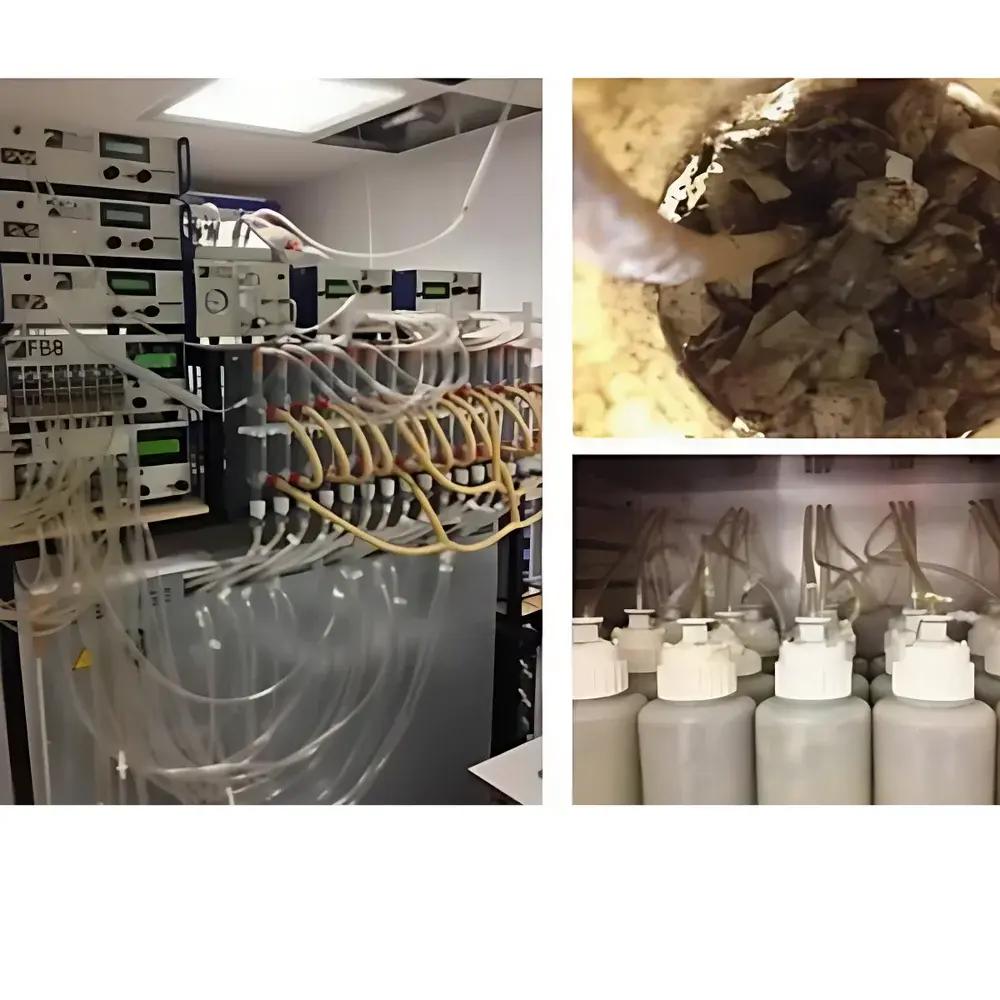
Sable Dynamic Respirometry System for Soilless Cultivation and Compost Biodegradation Assessment
| Brand | Sable |
|---|---|
| Origin | USA |
| Distributor Type | Authorized Distributor |
| Import Status | Imported |
| Model | DR4-Series Dynamic Respirometer |
| Pricing | Upon Request |
Overview
The Sable DR4-Series Dynamic Respirometry System is an engineered platform for high-fidelity, real-time quantification of aerobic microbial metabolic activity in heterogeneous organic matrices—including soilless cultivation substrates, compost, bio-based growing media, biodegradable waste, and rhizosphere-adjacent samples. Grounded in standardized respirometric principles (ASTM D5338, ISO 14855-1, CEN/TS 16115), the system measures oxygen consumption (O2), carbon dioxide evolution (CO2), water vapor production (H2O), and optionally methane (CH4) under controlled gas flow, temperature, and humidity conditions. Unlike static headspace or closed-chamber methods, the DR4 employs true dynamic airflow—delivering continuous, regulated aeration directly into the sample matrix via diffusion-enhanced chamber design. This ensures stoichiometric oxygen supply to support sustained microbial respiration across variable substrate reactivity levels, enabling robust discrimination of biological stability, decomposition kinetics, and microbial community functional capacity.
Key Features
- True dynamic respirometry architecture: Airflow diffuses through the substrate bed—not merely across headspace—mimicking natural aeration in horticultural and composting systems (Aspray et al., Waste Management, 2015).
- Configurable multi-channel operation: Standard 8-channel configuration (1 baseline + 7 sample channels); scalable to 16 or 24 channels via modular gas-switching units with <50 ms switching latency.
- High-resolution dual-gas analysis: Fuel-cell O2 sensor (0–100% range, ±0.1% accuracy, 0.0001% resolution) and dual-wavelength NDIR CO2 analyzer (0–5%, ±1% of reading, 1 ppm resolution, <0.5 s response).
- Integrated environmental control: Optional temperature-regulated incubation chamber (±0.2 °C stability), RH-300 capacitive hygrometer (0–100% RH, ±1% accuracy), and optional CH4 module (0–10%, 1 ppm resolution, pressure-compensated IR detection).
- STP-corrected mass flow control: Dual-range digital mass flow controller (0–2000 mL/min or 0–5000 mL/min), auto-compensated for T & P, delivering volumetric flow at standard temperature and pressure (0 °C, 101.325 kPa).
- Modular chamber compatibility: Standard 500 mL borosilicate glass respiration chambers; customizable volumes (100–2000 mL) and materials (glass, stainless steel, inert polymer) to accommodate particulate, fibrous, or slurry-phase samples.
Sample Compatibility & Compliance
The DR4 system accommodates diverse sample formats relevant to circular agriculture and waste valorization: peat-free substrates (coir, wood fiber, bark), anaerobically digested residues, green compost, hydroponic root exudate matrices, and formulated biopolymer blends. It supports method validation per ISO 14855-1 (determination of ultimate aerobic biodegradability), ASTM D5338 (compostability of plastics), and EN 13432 Annex E (biological stability testing). Data acquisition meets GLP audit requirements, with timestamped, calibrated analog inputs (8 × ±5.12 V, 16-bit ADC), dedicated thermistor channels (–5 to 60 °C), and full traceability of sensor calibration logs, flow setpoints, and environmental metadata. All firmware and software comply with FDA 21 CFR Part 11 electronic record and signature requirements when configured with audit trail and user access controls.
Software & Data Management
Sable RespiroSoft v4.2 provides end-to-end experimental workflow management—from protocol definition (gas sequence, flow rate ramps, dwell times) to real-time visualization of O2/CO2 differentials, respiratory quotient (RQ = CO2/O2), and cumulative mineralization curves. Raw data are stored in HDF5 format with embedded metadata (sensor IDs, calibration dates, chamber assignments). Batch processing tools enable normalization to dry mass, organic carbon content, or surface area. Export modules generate CSV, Excel, and MATLAB-compatible files; integrated Python API supports custom modeling (e.g., first-order decay fitting, Arrhenius activation energy estimation). Audit trails log all parameter changes, user actions, and instrument state transitions—essential for regulatory submissions and inter-laboratory reproducibility studies.
Applications
- Biological stability assessment of soilless growing media for vertical farms and plant factories, including coir, wood fiber, and digestate-based formulations.
- Compost maturity evaluation per PAS 100 and EU Fertilising Products Regulation (EU) 2019/1009 criteria.
- Carbon flux quantification in rhizosphere microcosms and soil mesocosms under controlled O2 gradients.
- Formulation screening for biodegradable mulches, seed coatings, and controlled-release nutrient carriers.
- Microbial inoculant efficacy testing in horticultural substrates and land remediation matrices.
- Research on substrate–microbe–nutrient interactions, including nitrogen immobilization dynamics and priming effects.
FAQ
What distinguishes dynamic respirometry from static headspace analysis?
Dynamic respirometry maintains continuous, controlled gas exchange across the sample, enabling steady-state respiration measurement and avoiding O2 depletion artifacts common in closed systems.
Can the system quantify respiratory quotient (RQ) in real time?
Yes—simultaneous high-frequency O2 and CO2 measurements allow second-by-second RQ calculation, supporting substrate utilization pathway inference (e.g., carbohydrate vs. lipid metabolism).
Is the DR4 compliant with international compost stability standards?
It implements core measurement protocols aligned with ISO 14855-1, ASTM D5338, and the UK’s WRAP Compost Quality Protocol, with configurable test durations (up to 28 days) and temperature profiles (20–55 °C).
How is temperature uniformity ensured across multiple chambers?
Optional forced-air incubation chambers provide ±0.2 °C spatial uniformity over 8–16 chamber positions; each chamber’s internal temperature is independently logged via dedicated thermistor inputs.
Can data be exported for statistical modeling in R or Python?
Yes—HDF5 and CSV exports include metadata headers; RespiroSoft’s Python SDK enables direct integration with scikit-learn, statsmodels, and pandas for kinetic modeling and multivariate analysis.
Related Products







