
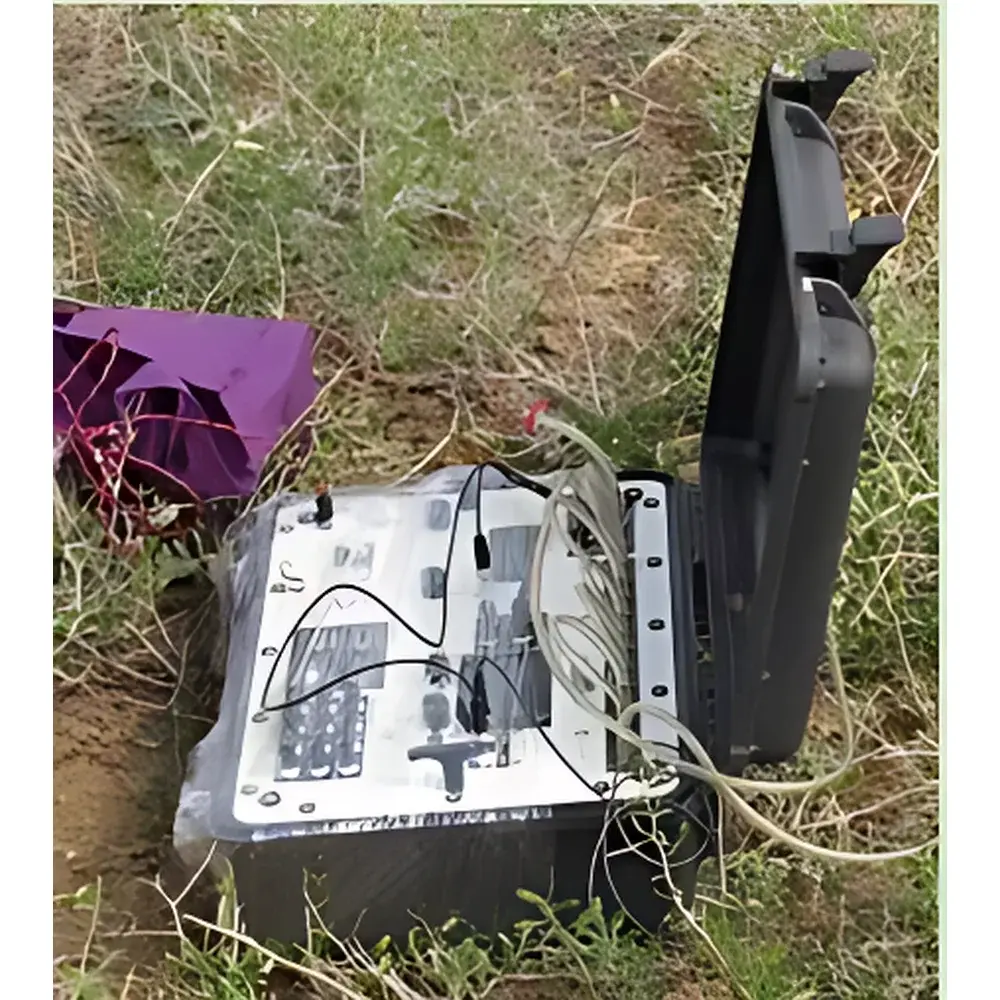
SoilBox Portable Soil Respiration Measurement System
| Origin | USA |
|---|---|
| Manufacturer Type | Distributor |
| Origin Category | Imported |
| Model | SoilBox |
| Price | Upon Request |
Overview
The SoilBox Portable Soil Respiration Measurement System is an integrated, field-deployable gas flux analyzer engineered for high-precision, simultaneous quantification of CO2, O2, and (in FMS configuration) H2O concentrations in soil-atmosphere and water-atmosphere boundary layers. It operates on the principle of dynamic closed-chamber or open-path gas exchange measurement, where sampled air is sequentially routed through calibrated gas analyzers—each employing industry-standard detection technologies: dual-wavelength non-dispersive infrared (NDIR) for CO2, electrochemical fuel-cell sensing for O2, and thin-film capacitive sensing for water vapor. This multi-gas, multi-parameter architecture enables direct calculation of respiratory quotient (RQ = CO2 production / O2 consumption), a critical ecophysiological indicator of substrate quality, microbial community composition (autotrophic vs. heterotrophic dominance), and redox status—particularly essential in waterlogged environments such as peatlands, tidal marshes, and flooded rice paddies where O2 availability governs CH4 production pathways and carbon turnover kinetics.
Key Features
- Simultaneous, real-time measurement of CO2 (0–5% range, <1 s response time, 0.1 ppm resolution) and O2 (1–100%, 0.001% resolution, <0.1% accuracy) with cross-gas interference immunity
- Dual operational modes: closed-chamber (for cumulative efflux estimation) and open-flow (for steady-state flux determination); configurable for flow-injection sampling
- Two system configurations: FGA (CO2/O2 only, 2-channel data acquisition) and FMS (CO2/O2/H2O, 14-channel DAQ, built-in baseline switching module)
- FMS model includes automated baseline referencing—periodic alternation between ambient air and chamber headspace to correct for analyzer drift and improve long-term flux accuracy per ASTM D6584 and ISO 16634 protocols
- Integrated microprocessor-controlled mass flow regulation (10–2000 mL/min, ±2% accuracy, 0.1 mL/min resolution) using thermal feedback loop—not mechanical rotameters—to ensure pressure- and temperature-independent flow stability
- Onboard dual-line LCD display with backlight; real-time visualization of RH, dew point, CO2, O2, flow rate, temperature, and barometric pressure
- Expandable architecture: optional 8-way multiplexer enables concurrent monitoring across up to 8 chambers; compatible with external CH4 analyzer (NDIR, 0–10%, 1 ppm resolution)
Sample Compatibility & Compliance
The SoilBox accommodates diverse biogeochemical interfaces—including mineral soils, organic-rich peat, submerged sediments, landfill cover soils, animal burrows, and floating aquatic chambers—with interchangeable aluminum alloy respiration chambers (20 cm i.d. × 20 cm h). Its low-thermal-mass design minimizes chamber-induced temperature artifacts during extended deployments. All gas sensors are factory-calibrated traceable to NIST standards and maintain stability under variable ambient conditions (−5 to +60 °C, 0–100% RH). The system supports GLP-compliant data integrity: onboard timestamps, sensor diagnostics logs, and hardware-level audit trails meet FDA 21 CFR Part 11 requirements when paired with validated software. It adheres to ISO/IEC 17025 analytical validation principles for environmental gas flux measurement and aligns with IPCC Tier 2 methodology for soil carbon inventory reporting.
Software & Data Management
Data acquisition is managed via embedded firmware supporting user-defined logging intervals from 0.1 s to 1 h. FMS stores up to 8,000 data points internally; transfer to PC occurs via USB in seconds. Raw sensor outputs (analog voltage, digital serial) are timestamped and compensated for temperature (−5 to +60 °C, ±0.2 °C absolute accuracy) and barometric pressure (75–125 kPa, ±1 kPa). Optional ruggedized field laptop (N450 CPU, sunlight-readable touchscreen, GPS geotagging) enables real-time visualization, chamber scheduling, and on-site QA/QC. Export formats include CSV and Excel-compatible .xls; post-processing scripts support RQ, Q10, and temperature-normalized flux derivation per Arrhenius-based models (e.g., Lloyd & Taylor 1994). Software complies with FAIR data principles and integrates with FluxNet-compatible metadata schemas.
Applications
- Quantification of heterotrophic vs. autotrophic soil respiration components using RQ and light/dark chamber comparisons
- Wetland carbon cycling studies: O2 profiling at sediment-water interfaces to constrain CH4 oxidation zones and anaerobic methanogenesis rates
- Landfill gas emission monitoring (CO2, CH4, O2) under EPA Method TO-15 and ISO 14064-2 verification frameworks
- In situ assessment of soil health indicators: microbial metabolic activity (RQ), thermal sensitivity (Q10), and responses to agrochemical stressors
- Ecosystem-scale net ecosystem exchange (NEE) partitioning via transparent/non-transparent chamber pairs
- Soil fauna respiration assays for ecotoxicological screening (e.g., pesticide impact on Collembola or earthworm metabolism)
- Long-term climate change experiments requiring autonomous, multi-point soil flux networks
FAQ
What distinguishes the FGA and FMS configurations?
The FGA is a compact, two-gas (CO2/O2) unit with dual analog inputs and no baseline correction. The FMS adds H2O analysis, 14-channel DAQ, automated baseline switching, 8-way multiplexing capability, and internal pressure/temperature compensation.
Can SoilBox measure methane without external hardware?
No—CH4 analysis requires an externally connected NDIR analyzer; the base system does not integrate CH4 sensing.
Is the system suitable for submerged measurements?
Yes—floating chamber variants are available for water-surface gas exchange; standard chambers operate in saturated soils and shallow inundated plots.
How is temperature sensitivity addressed in flux calculations?
All models include thermistor probes (±0.2 °C accuracy) and barometric sensors; firmware applies real-time temperature and pressure corrections to gas concentration and flow rate values before flux integration.
Does the system support regulatory reporting standards?
Yes—it meets technical specifications referenced in IPCC 2006 Guidelines, ASTM D6584 (soil gas sampling), and ISO 16634 (greenhouse gas flux measurement), and supports audit-ready data export for GHG inventories.
Related Products







