
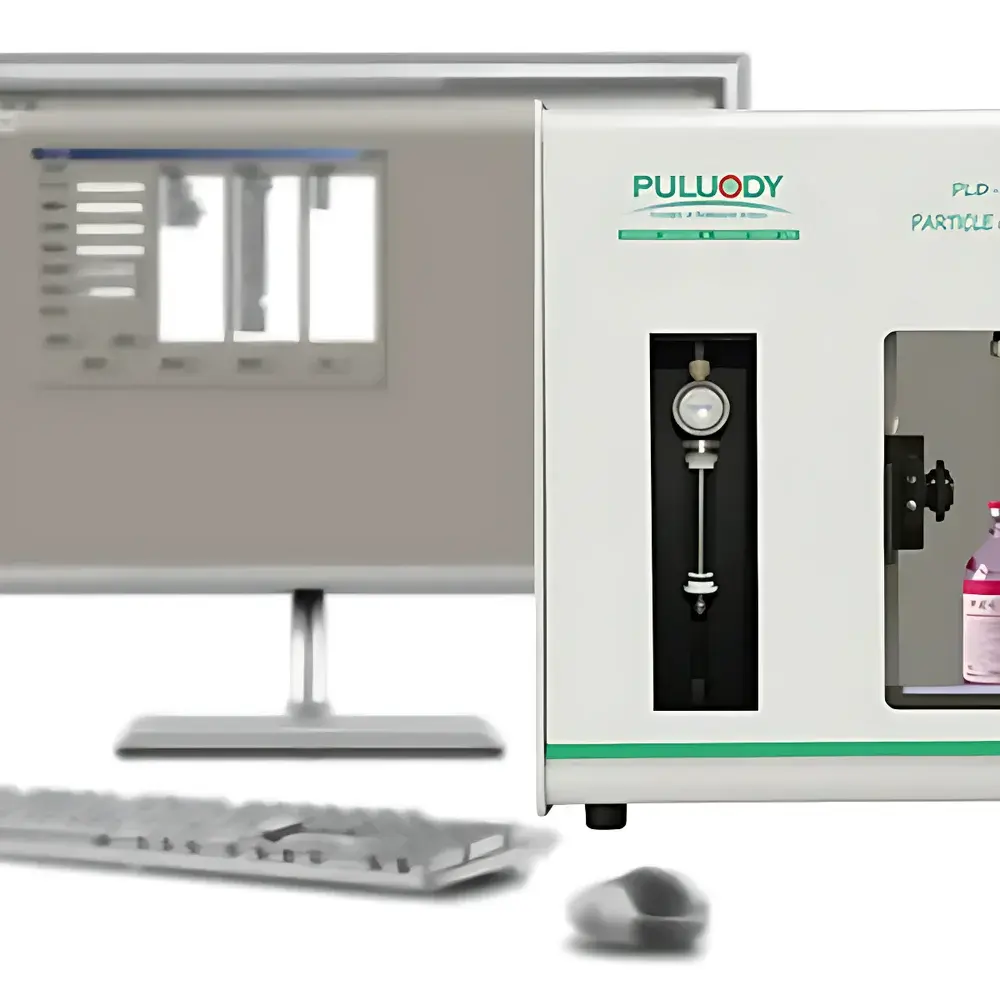
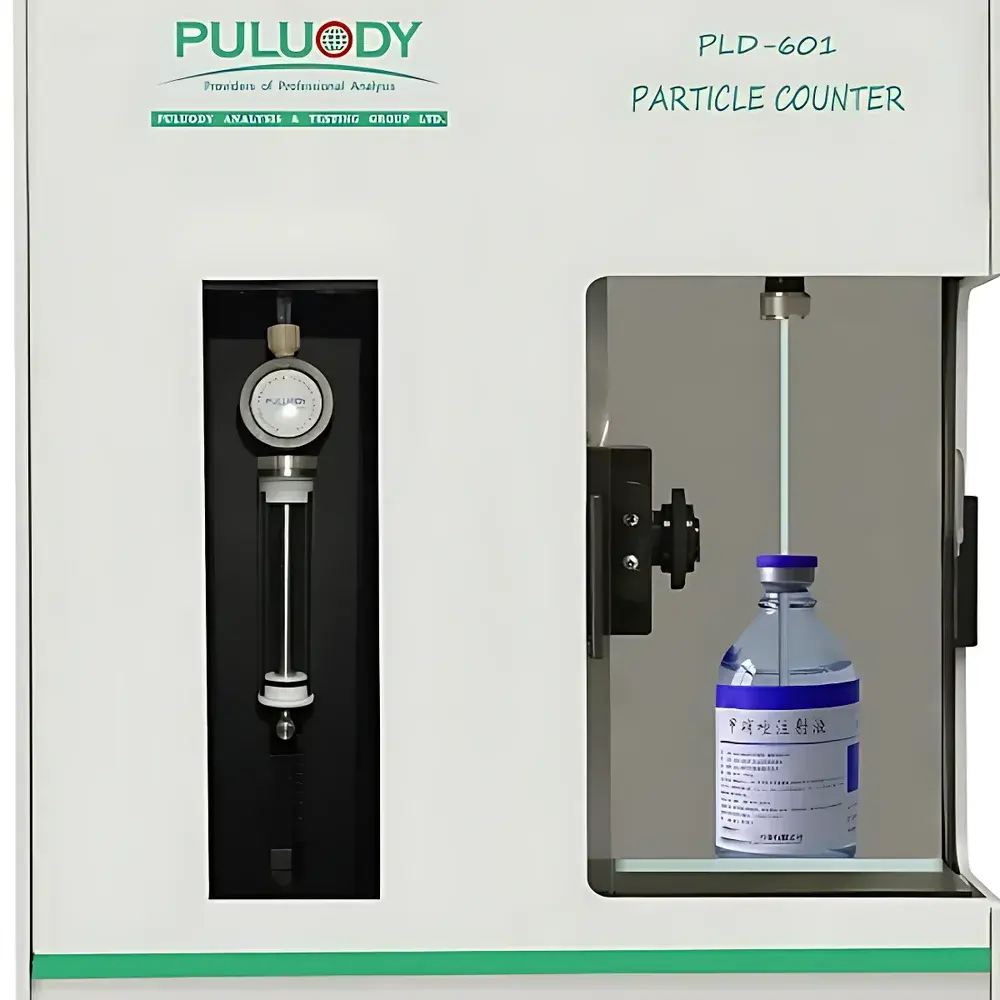
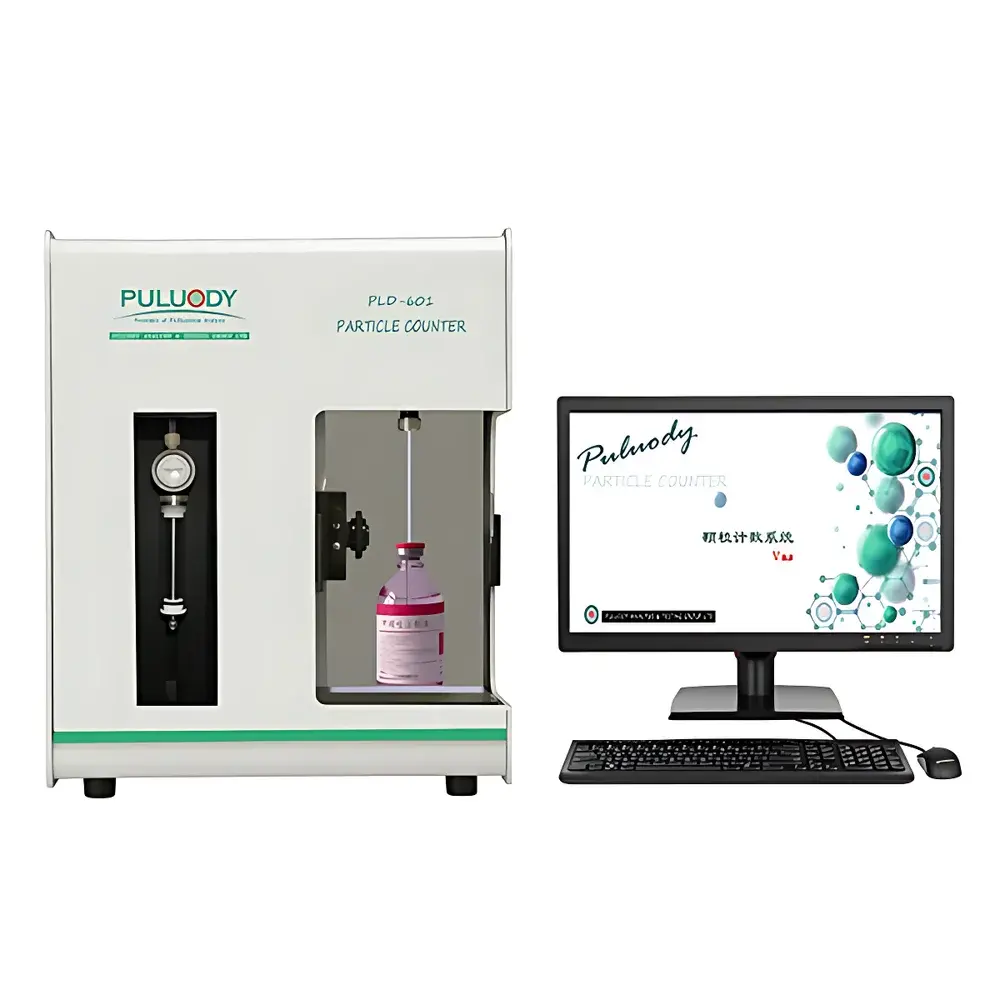
PULUODY PLD-601X Insoluble Particle Analyzer for Small-Volume Parenterals
| Brand | PULUODY |
|---|---|
| Origin | Shaanxi, China |
| Manufacturer Type | Authorized Distributor |
| Country of Origin | China |
| Model | PLD-601X |
| Price | USD 26,500 (FOB) |
Overview
The PULUODY PLD-601X Insoluble Particle Analyzer for Small-Volume Parenterals is a regulatory-grade optical particle counter engineered for quantitative detection and size-resolved enumeration of insoluble particulate matter in injectable pharmaceutical products. It operates on the principle of dual-laser near-forward light scattering with narrow-beam illumination—enabling high-sensitivity detection of particles from 0.1 µm to 450 µm in liquid suspensions. Designed to meet the stringent requirements of pharmacopoeial monographs—including USP , USP , Ph. Eur. 2.9.19, JP 6.07, and ChP 2015/2020 General Chapter 0903—the instrument delivers trace-level particle counting performance essential for quality control laboratories supporting GMP-compliant manufacturing, stability studies, and extractables/leachables assessments.
Key Features
- Dual-laser narrow-beam optical sensor (8th-generation PULUODY proprietary design) optimized for low-background noise and high signal-to-noise ratio across submicron to coarse particle ranges
- Dual-precision fluidic control system integrating a calibrated positive-displacement piston pump and ultra-stable electromagnetic flow regulation, ensuring volumetric accuracy better than ±1% and repeatability <±5% (typ.)
- 1000-channel high-resolution pulse-height analysis architecture, supporting user-defined channel configurations (e.g., 4, 8, 16, 32, 64, 128, or full 1000 bins) with adjustable threshold settings per channel
- Regulatory-compliant software platform (V8.9 Integrated Edition) featuring five-tier user permission management, electronic signatures, full audit trail, automatic data backup/recovery, and power-fail recovery
- FDA 21 CFR Part 11–compliant architecture with immutable audit logs, time-stamped event records, and cryptographic hash validation of raw measurement files
- Touchscreen HMI with bilingual (English/Chinese) interface, configurable report templates, and real-time visualization of particle concentration, size distribution, and cumulative counts
Sample Compatibility & Compliance
The PLD-601X supports direct analysis of diverse parenteral formulations without filtration or dilution, including but not limited to: sterile aqueous solutions (e.g., saline, dextrose), lyophilized powders reconstituted in WFI, concentrated injectables, ophthalmic solutions, vaccines, bulk active pharmaceutical ingredients (APIs), medical device extracts, infusion sets, IV filters, and pharmaceutical packaging leachates. It complies with ISO 21501-4:2018 for calibration verification using NIST-traceable polystyrene latex (PSL) standards or certified reference materials aligned with JJG 1061–2010. Instrument qualification documentation supports IQ/OQ/PQ protocols per ASTM E2454 and ICH Q5C guidelines. Calibration services are available through CNAS-accredited laboratories, including the National Northwest Metrology Testing Center and the No. 116 Calibration Station of the State Administration of Science, Technology and Industry for National Defense.
Software & Data Management
The V8.9 analytical software suite provides full lifecycle data governance—from acquisition and processing to reporting and archival. Raw pulse data are stored in encrypted binary format with metadata embedding (operator ID, timestamp, method parameters, environmental conditions). All user actions—including method edits, result approvals, and report exports—are logged with immutable timestamps and digital signatures. The system supports GLP/GMP-aligned workflows with configurable retention policies, automated PDF report generation (per USP/ChP template structures), and export to CSV, Excel, or LIMS-compatible XML formats. Audit trails are exportable as standalone PDFs with digital signature validation and SHA-256 integrity checksums.
Applications
- Pharmaceutical QC: Routine batch release testing of small-volume injectables (≤100 mL), filter integrity verification, and post-filtration particle load assessment
- Medical device evaluation: Quantitative assessment of particulate shedding from syringes, stoppers, tubing, and IV connectors per ISO 8536-4 and GB 8368
- Water purity monitoring: Particle contamination profiling in purified water (PW), water for injection (WFI), and ultrapure water (UPW) systems used in biomanufacturing
- Semiconductor process control: Slurry cleanliness verification in CMP applications and wafer rinse water analysis
- Chemical & cosmetic R&D: Nanoparticle dispersion stability studies, inkjet formulation screening, and surfactant efficacy evaluation
- Environmental & industrial hygiene: Monitoring of cleaning agent residuals, lubricant degradation products, and airborne particle deposition in controlled environments
FAQ
Does the PLD-601X comply with FDA 21 CFR Part 11 requirements?
Yes—the system implements role-based access control, electronic signatures, tamper-evident audit trails, and data integrity safeguards fully aligned with Part 11 Subpart B.
Can the instrument be validated for GMP use?
Yes—it supports IQ/OQ/PQ documentation packages and integrates with standard qualification protocols per ASTM E2500 and EU Annex 15.
What calibration standards are supported?
Certified PSL spheres per ISO 21501-4, NIST SRM 1963, and national metrological standards (JJG 1061–2010) are supported; third-party calibration certificates are available from CNAS-accredited labs.
Is the software compatible with LIMS integration?
Yes—XML and CSV export modes support seamless bidirectional data exchange with major LIMS platforms via secure SFTP or API interfaces.
What is the minimum detectable particle size under standard operating conditions?
0.1 µm (c) with optional configuration; typical operational lower limit is 1.0 µm per pharmacopoeial compliance mode, with enhanced sensitivity achievable via custom optical alignment and background suppression protocols.




