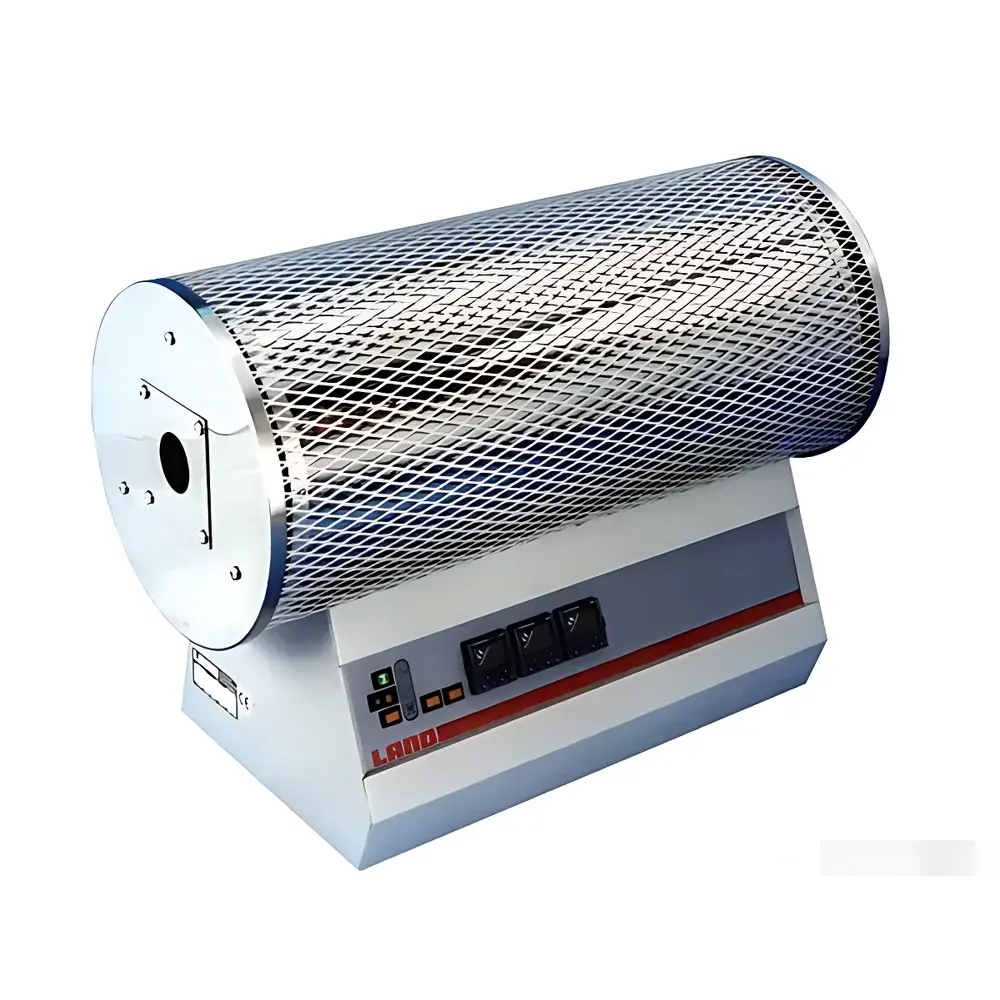
LAND P1200B High-Temperature Blackbody Radiation Source
| Brand | LAND |
|---|---|
| Origin | United Kingdom |
| Model | P1200B |
| Temperature Range | 150–1150 °C |
| Cavity Diameter | 50 mm |
| Cavity Depth | 400 mm |
| Emissivity | 0.998 |
| Temperature Stability | ±0.2 °C over 60 min |
| Temperature Uniformity | < ±0.15% t across central 40 mm of 50 mm cavity |
| Heating Rate | ~2 h to reach 1000 °C |
| Controller | Eurotherm PID with N-type Thermocouple |
| Power Supply | 220–240 V, 50–60 Hz |
Overview
The LAND P1200B High-Temperature Blackbody Radiation Source is a precision-calibrated reference standard engineered for primary and secondary calibration of infrared radiation thermometers (IRTs), thermal imagers, and radiometric sensors operating in the mid- to long-wave infrared spectral bands. Designed and manufactured by AMETEK LAND—a UK-based leader in non-contact temperature measurement since 1947—the P1200B employs a high-emissivity, isothermal cylindrical cavity heated via resistive elements and controlled using a Eurotherm PID controller with N-type thermocouple feedback. Its operational principle follows Planck’s law of blackbody radiation, providing traceable, spectrally stable, and spatially uniform radiant exitance across its defined temperature range of 150 °C to 1150 °C. The device serves as a primary transfer standard in national metrology institutes (NMIs), accredited calibration laboratories, and industrial metrology centers—particularly those supporting steelmaking, aerospace component testing, glass manufacturing, and high-temperature process validation where ISO/IEC 17025 compliance and traceability to SI units are mandatory.
Key Features
- High emissivity cavity (ε = 0.998) achieved through optimized geometry, surface finish, and internal baffling—validated per ASTM E1256 and ISO 18434-1
- Exceptional temperature stability: ±0.2 °C over any 60-minute interval at setpoint, enabling low-uncertainty calibration sessions
- Uniformity specification: < ±0.15% of reading across the central 40 mm segment of the 50 mm-diameter × 400 mm-deep cavity—verified via multi-point thermocouple mapping during factory acceptance testing
- Robust thermal architecture with dual-zone heating and active thermal shielding to minimize axial and radial gradients
- Integrated Eurotherm 3500-series controller with programmable ramp/soak profiles, real-time data logging, and RS485 Modbus RTU interface for system integration
- Compliance-ready design: supports audit trails, user access levels, and configuration lockout—facilitating alignment with ISO/IEC 17025:2017 clause 7.8.2 and FDA 21 CFR Part 11 requirements when used with validated software environments
Sample Compatibility & Compliance
The P1200B accommodates standard infrared sensor apertures up to Ø45 mm, making it compatible with handheld pyrometers, fixed-mount IRTs, and cooled/uncooled thermal imaging systems. Its cavity geometry conforms to the effective aperture definition specified in IEC 62906-2-2 and supports both spot-size ratio (SSR) verification and field-of-view (FOV) characterization. All units ship with a UKAS-accredited calibration certificate (traceable to NPL), including full uncertainty budgets per ISO/IEC Guide 98-3 (GUM). The system meets mechanical and electrical safety requirements per IEC 61010-1 and electromagnetic compatibility standards EN 61326-1. It is routinely deployed in GLP- and GMP-regulated environments—including steel continuous casting lines and heat-treatment furnace qualification—where documented calibration intervals and change control procedures are enforced.
Software & Data Management
While the P1200B operates autonomously via its front-panel interface, optional integration with LAND’s CalSoft™ calibration management suite enables automated calibration sequences, report generation (PDF/CSV), and electronic record retention. CalSoft supports configurable pass/fail criteria per point, uncertainty propagation modeling, and export of metadata compliant with ISO/IEC 17025 clause 7.7. Audit logs capture operator ID, timestamp, setpoint, actual cavity temperature, stability duration, and deviation from nominal—supporting full traceability for regulatory inspections. When connected to enterprise LIMS or MES platforms via OPC UA or Modbus TCP, the system contributes to digital calibration workflows aligned with Industry 4.0 metrology frameworks.
Applications
- Primary calibration of radiation thermometers against national standards (e.g., NIST, PTB, NPL)
- Validation and periodic verification of infrared cameras used in predictive maintenance programs
- Temperature scale dissemination in regional metrology institutes and third-party calibration labs
- Development and verification of emissivity correction algorithms for high-temperature process monitoring
- Supporting ISO 50001 energy management audits requiring calibrated thermal measurement infrastructure
- Research applications in combustion diagnostics, ceramic sintering kinetics, and refractory material testing
FAQ
What is the recommended recalibration interval for the P1200B?
Typical recalibration is performed annually; however, frequency must be risk-assessed per ISO/IEC 17025:2017 clause 7.8.3, considering usage intensity, environmental conditions, and criticality of measurements.
Can the P1200B be used for spectral responsivity testing?
Yes—when coupled with a monochromator and calibrated reference detector, it functions as a stable broadband source for relative spectral response characterization in the 1–14 µm range.
Does the system include uncertainty analysis for each calibration point?
Yes—each UKAS certificate includes expanded uncertainty (k=2) derived from Type A (repeatability) and Type B (reference standard, stability, uniformity, emissivity) components per GUM guidelines.
Is remote operation supported out of the box?
Standard hardware includes RS485 Modbus RTU; Ethernet connectivity and SCADA integration require optional communication modules and configuration support.
How is cavity emissivity verified and maintained over time?
Emissivity is validated during initial calibration using the comparison method per ASTM E1933 and monitored via periodic cavity inspection and reflectance measurement—no user-serviceable parts affect emissivity under normal operating conditions.