
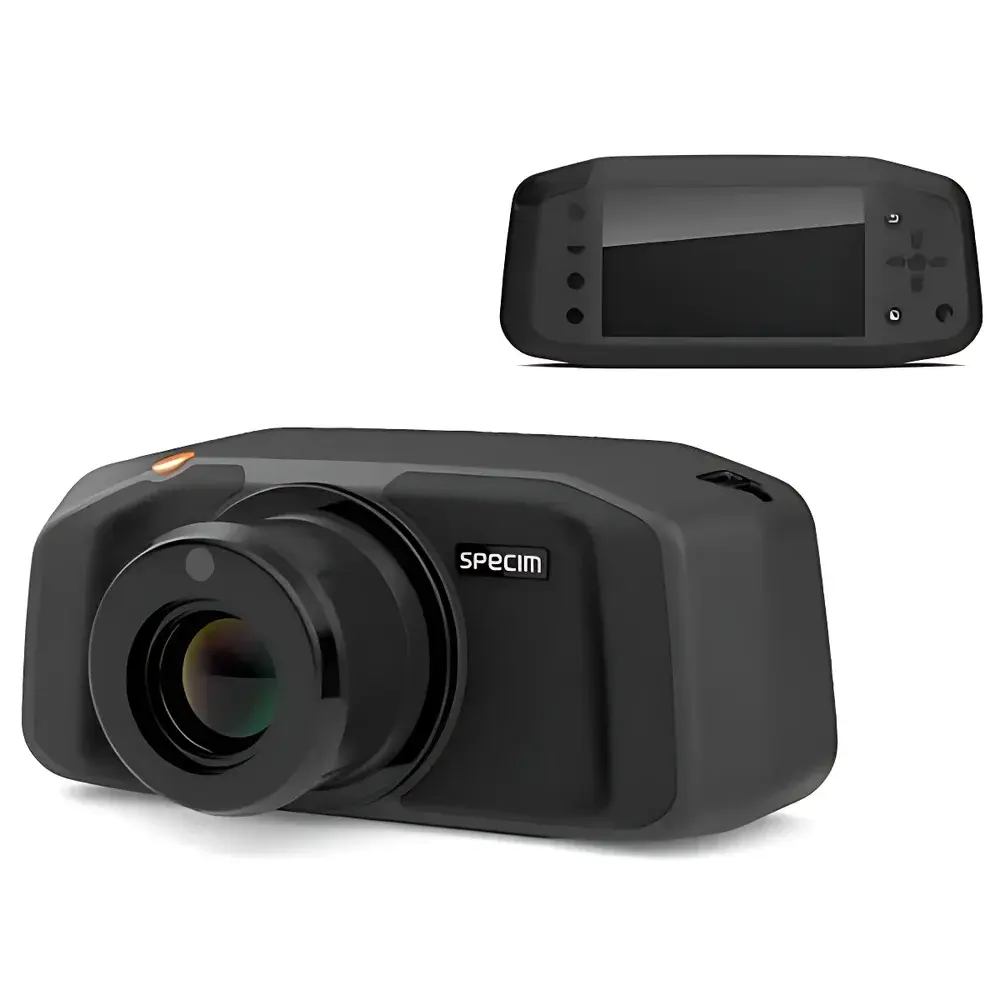
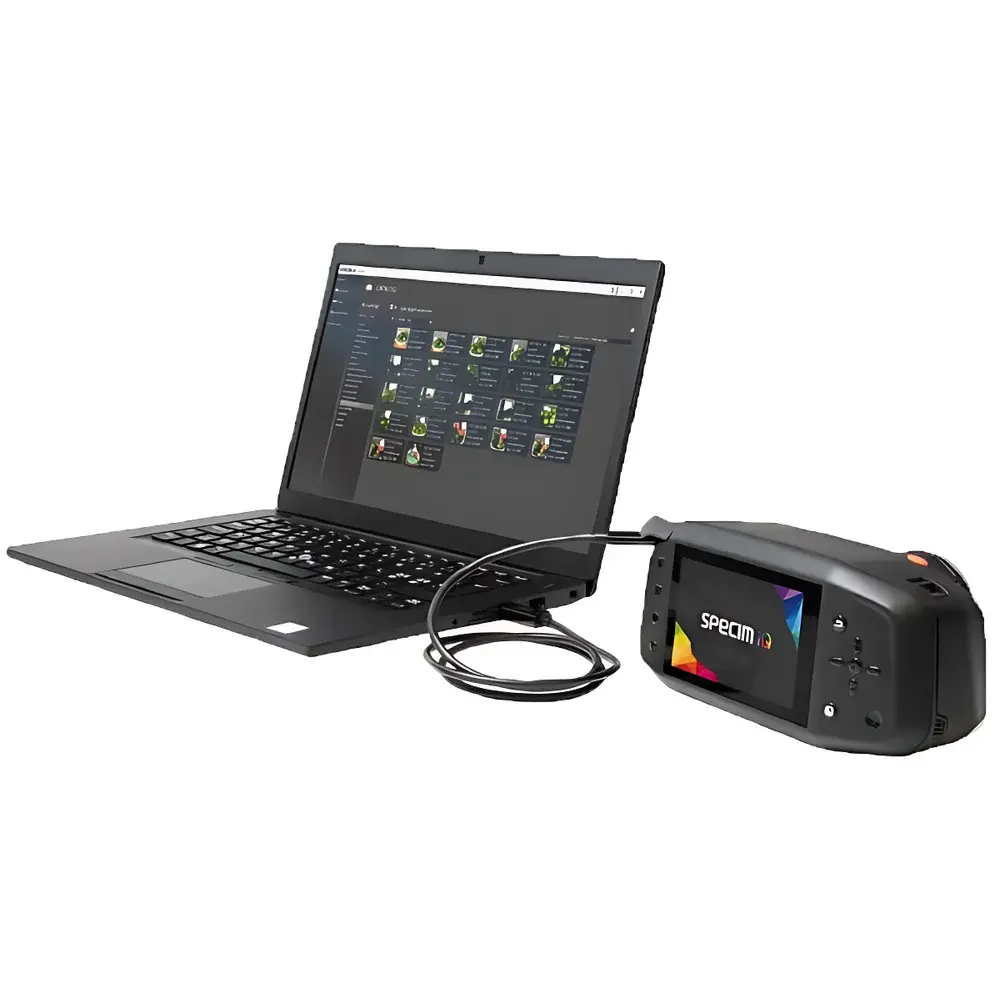
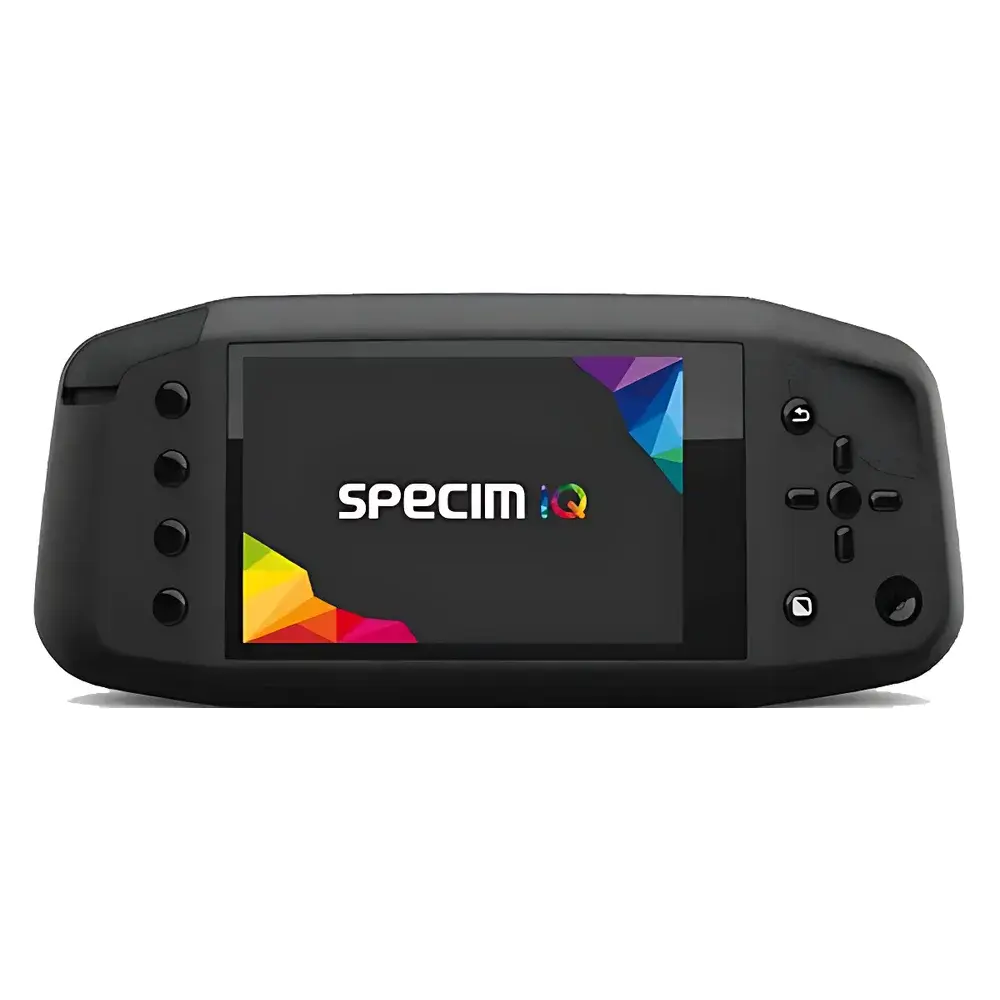
Specim IQ Handheld Hyperspectral Imaging Camera
| Brand | SPECIM |
|---|---|
| Origin | Finland |
| Model | Specim IQ Handheld Hyperspectral Imaging Camera |
| Spectral Range | 400–1000 nm |
| Spectral Resolution (FWHM) | 7 nm |
| Spatial Resolution | 512 × 512 pixels |
| Field of View (TFOV) | 31° × 31° |
| Instantaneous Field of View (IFOV) | 512 pixels |
| Frame Rate | 15 fps |
| Imaging Principle | Push-broom with integrated binary optics |
| Platform Compatibility | Ground-based and airborne operation |
| Detector Type | CMOS (VNIR) |
| Spectral Bands | 204 (binning options: 2× and 3×) |
| Peak SNR | >400:1 |
| Minimum Object Distance | 150 mm |
| Aperture | f/1.7 |
| Onboard Storage | 32 GB SD card |
| Battery | 5200 mAh Li-ion (26650) |
| Operating Temperature | 0–40 °C |
| Operating Humidity | ≤95% non-condensing |
| Data Format | ENVI-compatible Specim data cube (.hdr/.raw) |
| Built-in GPS | Yes |
| Display | 4.3" touchscreen + 13 physical buttons |
| Interface | USB Type-C, Wi-Fi |
| Dimensions | 207 × 91 × 74 mm (lens length: 125.5 mm) |
| Weight | 1.3 kg |
Overview
The Specim IQ Handheld Hyperspectral Imaging Camera is a fully integrated, field-deployable VNIR (400–1000 nm) hyperspectral system engineered for scientific-grade spectral imaging in both laboratory and real-world environments. Unlike conventional multispectral or RGB cameras, the Specim IQ employs push-broom scanning architecture combined with proprietary binary optical components to acquire full hyperspectral datacubes—each containing spatial (512 × 512 pixels) and spectral (204 bands at 7 nm FWHM resolution) information—in a single static measurement. This eliminates the need for mechanical scanning stages or relative motion between camera and target, enabling rapid, repeatable acquisition under variable lighting and terrain conditions. Its embedded processing unit runs the Spectral Angle Mapper (SAM) algorithm natively, allowing pixel-level material identification and classification without external computing hardware. Designed for operational robustness, the system operates across ambient temperatures from 0 °C to 40 °C and supports georeferenced data capture via integrated GPS—ensuring each spectral cube carries precise positional metadata compliant with GIS workflows and multi-sensor fusion protocols.
Key Features
- Self-contained hyperspectral imaging platform: integrates optical acquisition, on-device computation, visualization, and storage—no external PC required during field operation
- Real-time spectral analysis using embedded SAM algorithm; results rendered directly on the 4.3-inch capacitive touchscreen with intuitive UI navigation
- Push-broom architecture with fixed-focus binary optics enables high-fidelity spectral sampling without moving parts—ideal for handheld, drone-mounted, or tripod-based deployment
- Geotagged data acquisition: built-in GPS stamps every hyperspectral cube with WGS84 coordinates, supporting reproducible field surveys and integration with GIS platforms such as ArcGIS or QGIS
- Dual connectivity: remote control and data transfer via USB Type-C or IEEE 802.11 b/g/n Wi-Fi, facilitating seamless integration into automated workflows or centralized monitoring systems
- Configurable spectral binning (2× and 3×) allows trade-offs between signal-to-noise ratio and spectral sampling density depending on application requirements
- ENVI-compatible data output (.hdr/.raw) ensures interoperability with industry-standard spectral analysis software including ENVI, MATLAB, Python (scikit-learn, spectral), and commercial chemometric packages
Sample Compatibility & Compliance
The Specim IQ is optimized for reflectance-based measurements of solid and semi-solid samples—including vegetation canopies, soil surfaces, biological tissues, painted materials, and industrial composites—at working distances from 150 mm to infinity. Its f/1.7 aperture and high quantum efficiency CMOS detector deliver strong performance under natural daylight, LED illumination, or controlled lab lighting. The system meets CE marking requirements for electromagnetic compatibility (EMC Directive 2014/30/EU) and low-voltage safety (LVD Directive 2014/35/EU). While not certified for medical device use per ISO 13485 or FDA 21 CFR Part 820, its data structure and metadata schema align with FAIR (Findable, Accessible, Interoperable, Reusable) principles and support GLP-compliant documentation when paired with validated SOPs and audit trails.
Software & Data Management
The Specim IQ ships with firmware-hosted user interface software that enables creation and deployment of custom analysis apps—such as plant pigment index calculators, mineral detection thresholds, or defect segmentation routines—without coding expertise. All acquired data are stored in standard ENVI format with embedded header metadata describing acquisition time, GPS coordinates, exposure settings, and calibration status. The onboard 32 GB SD card supports up to ~100 full-resolution scans per charge cycle. For extended deployments, users may export raw cubes via USB or Wi-Fi to network-attached storage or cloud repositories. The system does not enforce proprietary encryption or vendor lock-in; all data files are readable using open-source libraries (e.g., GDAL, Spectral Python) and conform to HDF5 and GeoTIFF extension conventions where applicable.
Applications
- Ecological phenotyping: quantification of chlorophyll content, water stress indices (NDWI, PRI), and species discrimination in field botany and agricultural monitoring
- Wildlife and behavioral ecology: non-invasive assessment of animal coloration patterns, camouflage efficacy, and thermal regulation strategies—as demonstrated in peer-reviewed studies published in Molecular Biology and Evolution
- Forensic material analysis: differentiation of ink types, document aging, paint layers, and counterfeit product identification based on spectral fingerprinting
- Food quality inspection: detection of surface contamination, bruising, ripeness, and adulteration in fruits, grains, and processed foods
- Mineralogical mapping: identification of iron oxides, clays, and carbonates in geological outcrops and core samples
- Educational research: hands-on instruction in spectroscopy, remote sensing fundamentals, and machine learning for spectral classification
FAQ
Does the Specim IQ require external calibration before each measurement?
No. The system includes factory-applied radiometric and spectral calibration coefficients stored in firmware. Users may perform optional dark current and white reference acquisitions in-field to compensate for ambient light changes.
Can the Specim IQ be mounted on UAVs or drones?
Yes. Its compact form factor (207 × 91 × 74 mm), lightweight design (1.3 kg), and vibration-tolerant optical architecture make it suitable for integration onto small-to-medium UAV platforms. Payload compatibility must be verified against the drone’s payload capacity, power interface, and gimbal stabilization capabilities.
Is the GPS module accurate enough for geospatial analysis?
The integrated GPS provides sub-5-meter horizontal accuracy under open-sky conditions. For applications requiring centimeter-level precision, users may post-process position data using differential correction services (e.g., NTRIP, RTK) or fuse with external GNSS receivers.
What spectral preprocessing steps are supported onboard?
The device performs automatic dark current subtraction and flat-field correction. Radiometric calibration to reflectance units requires external reference panel capture prior to sample measurement.
How is data security handled during wireless transmission?
Wi-Fi communication uses WPA2-PSK encryption by default. No authentication tokens or credentials are stored on the device beyond initial setup; all sessions terminate upon disconnection unless explicitly configured for persistent access.
Related Products





