
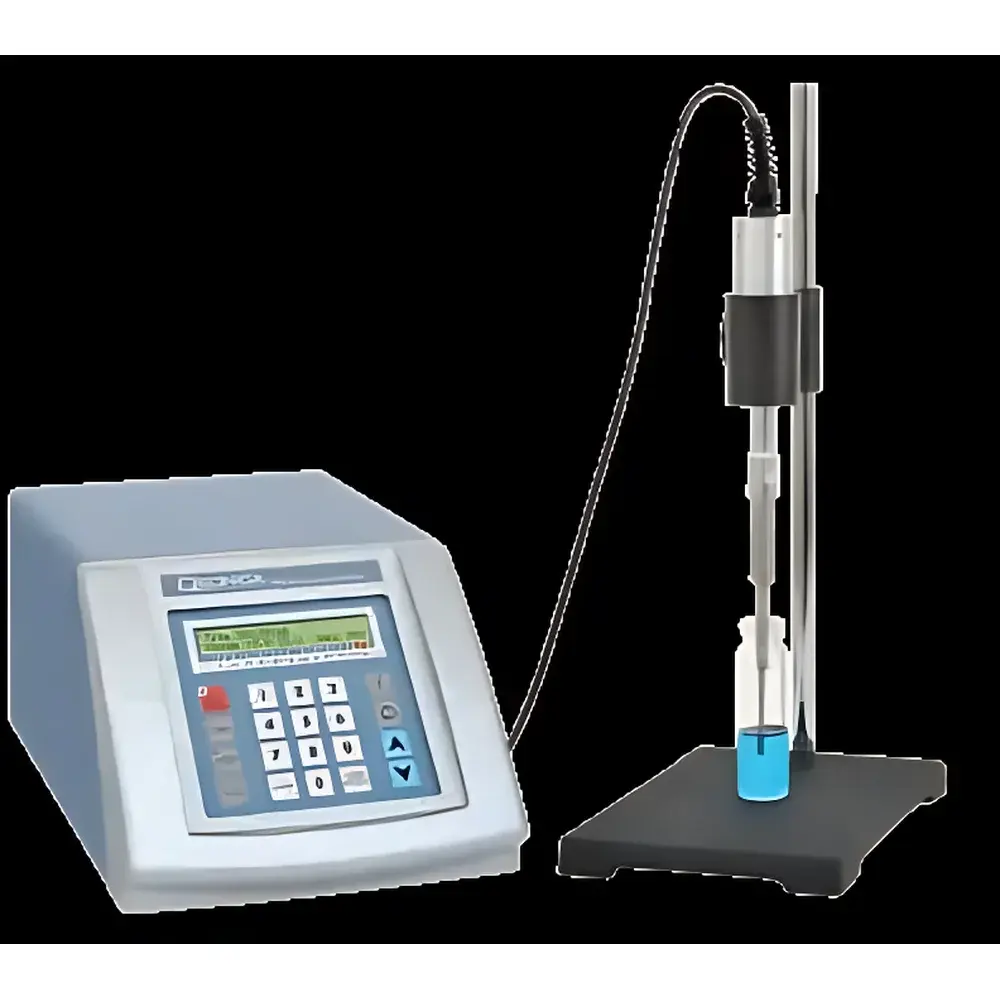
Qsonica Q125 Benchtop Ultrasonic Cell Disruptor
| Brand | Qsonica LLC |
|---|---|
| Origin | USA |
| Model | Q125 |
| Instrument Type | Ultrasonic Cell Disruptor |
| Maximum Output Power | 125 W |
| Operating Frequency | 20 kHz |
| Adjustable Pulse Duration | 1 s – 60 s |
| Sample Volume Range | 0.2–50 mL |
| Dimensions (W × D × H) | 20.3 × 35 × 14.6 cm |
| Standard Probe | 1/8" (3.2 mm) tapered microtip |
| Optional Accessories | Non-contact cup horn (Cat. #4608), 8-position probe holder (Cat. #4602), Acoustic Enclosure (Cat. #432A) |
Overview
The Qsonica Q125 Benchtop Ultrasonic Cell Disruptor is an engineered solution for controlled, reproducible lysis of biological cells and subcellular structures in research and quality control laboratories. It operates on the principle of high-intensity ultrasonic cavitation—generating rapid pressure fluctuations in liquid media that induce formation, growth, and violent collapse of microscopic vapor bubbles. This process delivers localized shear forces sufficient to disrupt membranes, solubilize inclusion bodies, fragment chromatin, and disperse aggregated proteins or nanoparticles. Designed for benchtop use in biosafety level 1 and 2 environments, the Q125 delivers consistent energy input across small-volume samples without requiring cryogenic cooling or chemical reagents—making it ideal for preserving native protein conformation, enzymatic activity, and epitope integrity during sample preparation.
Key Features
- Compact footprint (20.3 × 35 × 14.6 cm) optimized for shared lab spaces and biosafety cabinets
- Fixed-frequency 20 kHz transducer with 125 W nominal output power and digital amplitude control (0–100% in 1% increments)
- Pulse mode operation with programmable on/off intervals from 1 second to 60 seconds—critical for thermal management during sensitive extractions
- Interchangeable probe system supporting three standard tip diameters: 2 mm (0.2–5 mL), 3.2 mm (0.5–15 mL), and 6.4 mm (5–50 mL), each calibrated for defined acoustic intensity profiles
- Integrated safety interlock preventing activation unless probe is properly seated and torque-locked into the converter
- Optional acoustic enclosure (Cat. #432A) reduces ambient noise to <65 dB(A) and contains aerosolized biohazards during open-vessel sonication
Sample Compatibility & Compliance
The Q125 accommodates a broad range of biological matrices including bacterial cultures (E. coli, Bacillus spp.), yeast suspensions (S. cerevisiae), mammalian cell lines (HEK293, CHO), plant tissue homogenates, and viral lysates. Its non-contact cup horn accessory (Cat. #4608) enables containment of hazardous or volatile samples—compatible with dual 1.5 mL microcentrifuge tubes or single 15 mL conical tubes—eliminating cross-contamination and minimizing operator exposure. The system meets IEC 61000-6-3 (EMC emissions) and IEC 61000-6-2 (immunity) standards. When used with validated protocols and audit-trail-enabled software (via optional Qsonica PC Interface), it supports GLP-compliant documentation for QC workflows aligned with ISO/IEC 17025 and FDA 21 CFR Part 11 requirements.
Software & Data Management
While the Q125 operates via intuitive front-panel controls, optional connectivity through USB or RS-232 enables integration with Qsonica’s Q-Connect software for remote parameter logging, time-stamped run history export (CSV), and multi-user access control. Each session records amplitude setting, pulse duration, total active time, and real-time temperature alerts (when paired with external probe thermocouples). Audit trails are immutable and timestamped to UTC, satisfying traceability requirements for regulated biomanufacturing and clinical assay development.
Applications
- Preparative lysis for recombinant protein purification from E. coli inclusion bodies
- Nucleic acid shearing prior to NGS library construction (ChIP-seq, ATAC-seq)
- Liposome and exosome disruption for cargo release profiling
- Emulsification of lipid-based drug delivery systems
- Dispersion of carbon nanotubes or metal oxide nanoparticles in aqueous buffers
- Routine homogenization of tissue biopsies for biomarker extraction under denaturing or native conditions
FAQ
Is the Q125 suitable for GMP-regulated environments?
Yes—when deployed with documented SOPs, calibrated probes, and Q-Connect software for electronic recordkeeping, it fulfills instrumentation qualification criteria per Annex 11 and USP Analytical Instrument Qualification.
Can the same probe be used across different sample volumes?
No—probe selection must match volume and viscosity to maintain consistent energy density; using an oversized probe in low-volume samples risks overheating and foaming.
Does the system require routine calibration?
Transducer output is factory-calibrated; however, users should verify amplitude accuracy annually using a calibrated hydrophone or calorimetric method per ASTM E2810.
What maintenance is required for long-term reliability?
Routine inspection of probe threads and converter coupling surface for pitting or erosion; replacement of worn titanium probes every 100–200 hours of cumulative use depending on duty cycle and sample composition.
Is third-party validation support available?
Qsonica provides IQ/OQ templates and technical consultation for installation and operational qualification in pharmaceutical and academic settings.
Related Products




