
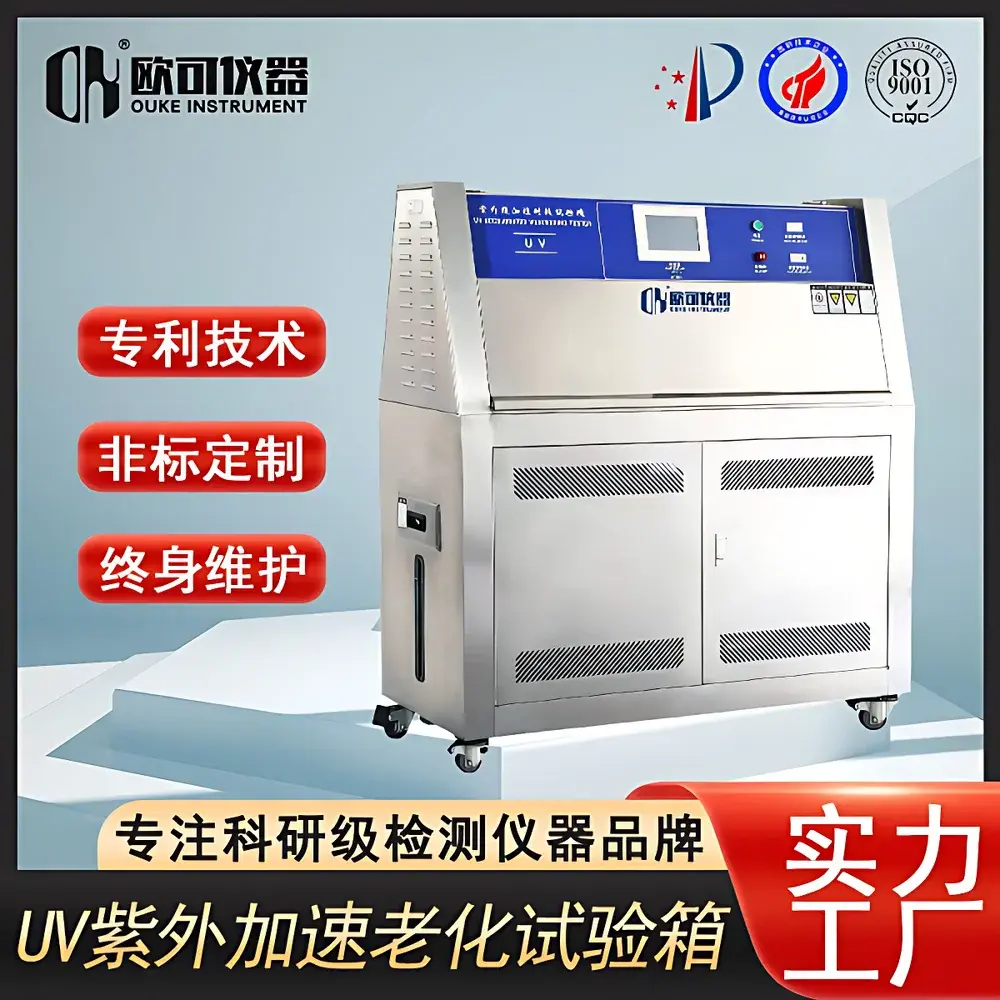
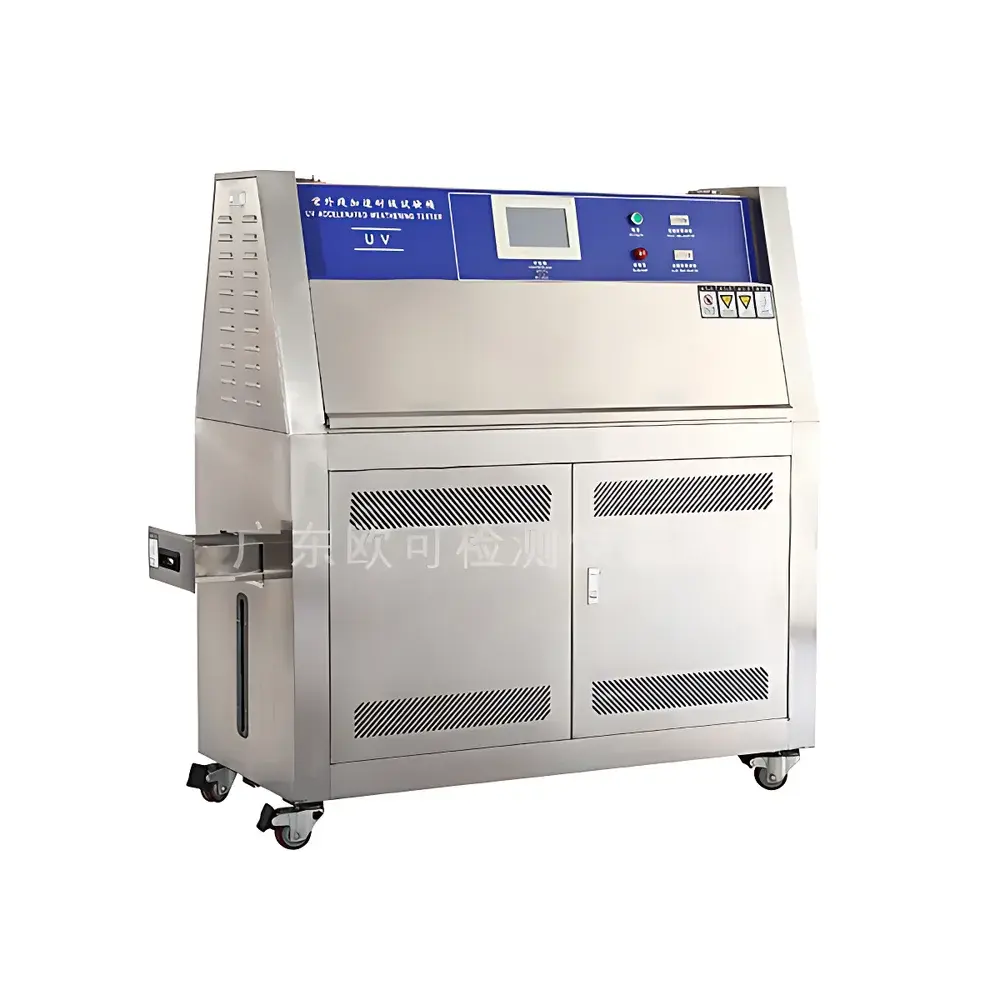
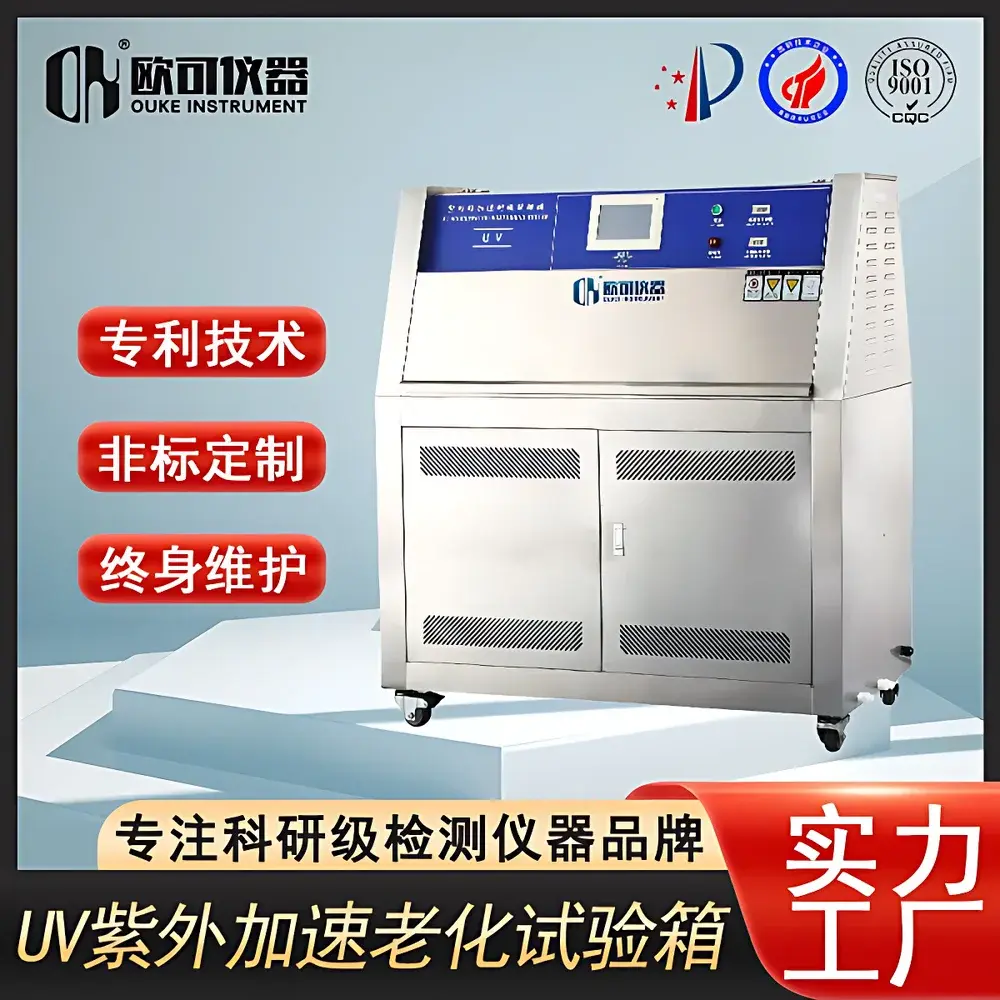
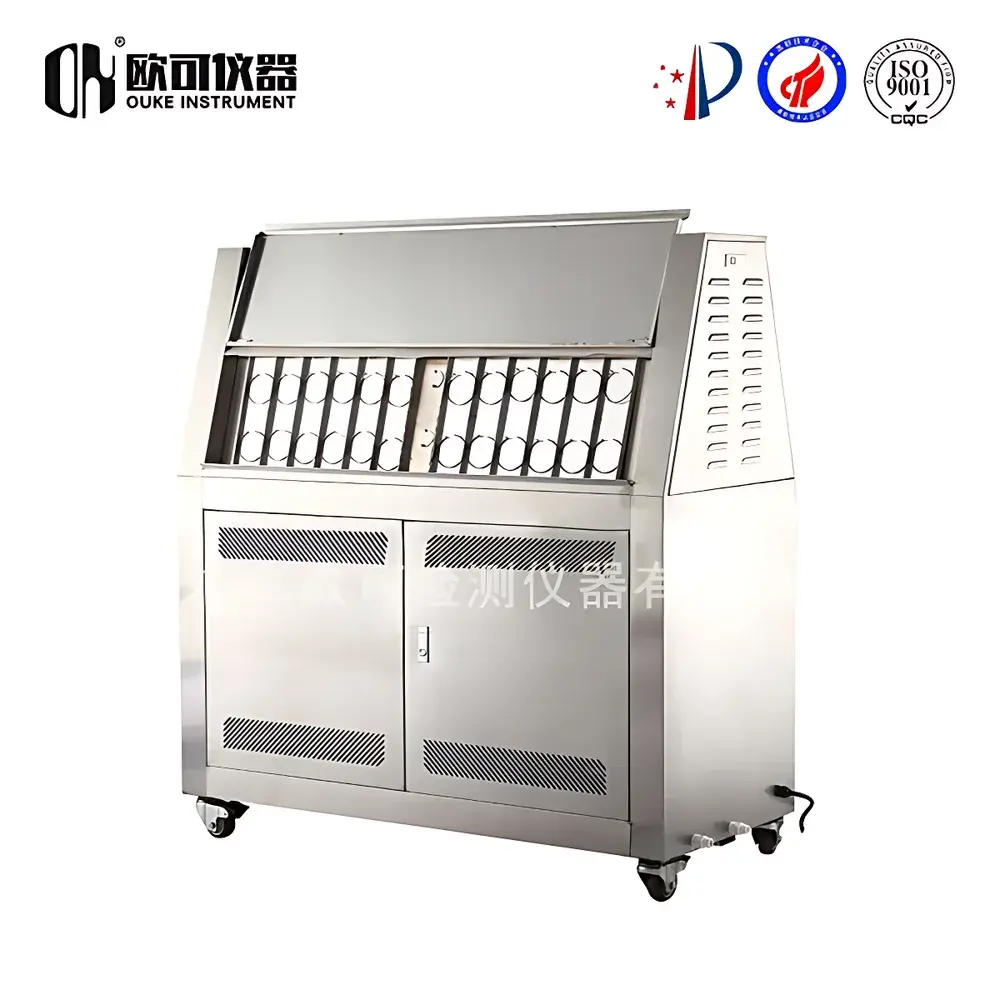
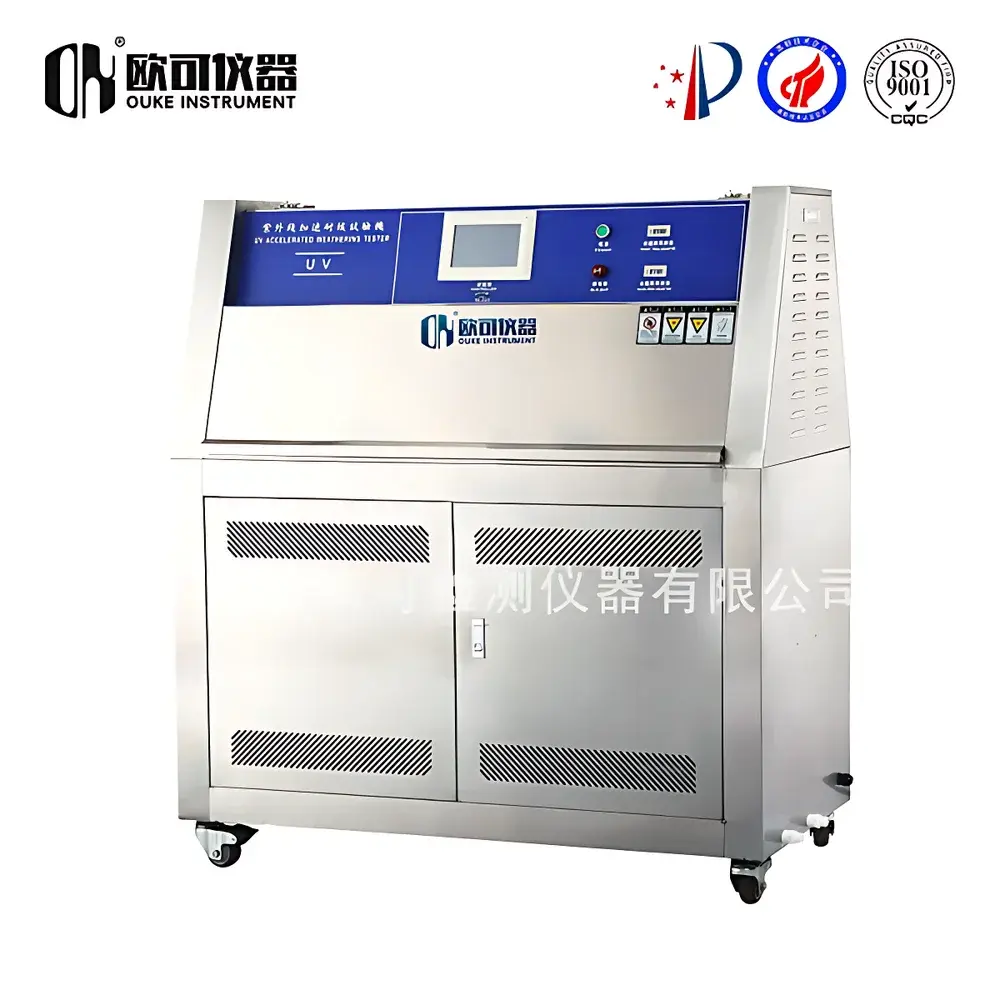
OK UV-290.12 Advanced Fluorescent UV Accelerated Weathering Test Chamber
| Brand | OK Instruments |
|---|---|
| Origin | Guangdong, China |
| Manufacturer Type | Direct Manufacturer |
| Model | OK-UV-290.12 |
| Humidity Range | ≥95% RH (chamber internal humidity) |
| UV Lamp Power | 40 W per lamp |
| Irradiance Range | 0.72 W/m² @ 340 nm |
| Exposure Time | 1–9999 h (programmable) |
| Irradiation Temperature Range | RT to 70 °C (black panel temperature) |
| UV Wavelength Range | 280–400 nm |
| Chamber Internal Dimensions (L×W×H) | 1170 × 400 × 400 mm |
Overview
The OK UV-290.12 Advanced Fluorescent UV Accelerated Weathering Test Chamber is an engineered environmental simulation system designed to replicate the photochemical degradation mechanisms induced by solar ultraviolet radiation in outdoor service conditions. It operates on the principle of controlled fluorescent UV exposure—leveraging standardized UVA-340 and UVB-313 lamp spectra—to accelerate material aging through three physicochemically distinct phases: UV irradiation (photo-oxidative chain scission), condensation (hydrolytic stress via dew formation), and optional water spray (mechanical erosion and thermal shock). Unlike full-spectrum xenon arc testers, this chamber isolates and intensifies the 280–400 nm UV band—the primary driver of polymer backbone cleavage, pigment fading, and surface embrittlement—enabling rapid, repeatable, and standards-compliant evaluation of non-metallic materials including coatings, plastics, elastomers, textiles, and photovoltaic encapsulants.
Key Features
- Fluorescent UV lamp array with dual-wavelength compatibility: UVA-340 (315–400 nm) for realistic outdoor simulation and UVB-313 (280–315 nm) for accelerated screening—lamp type selectable per test protocol.
- Precision black panel temperature control (RT to 70 °C) using PID auto-tuning algorithm; accuracy ±1 °C—critical for correlating irradiance dose with thermal activation energy of degradation reactions.
- Integrated condensation system: heated water reservoir generates uniform dew film on specimen surfaces during dark cycles, simulating nocturnal moisture exposure per ISO 4892-3 and ASTM G154.
- Optional programmable spray module: adjustable pressure (0.05–0.2 MPa), intermittent/continuous modes, and deionized water compatibility—enables IEC 61215-compliant wet/dry cycling for PV backsheet qualification.
- Multi-segment programmable controller (PLC + 7″ color touchscreen): supports up to 100-step cycles combining UV, condensation, and spray phases; real-time data logging with timestamped event tracking.
- Optimized sample mounting: adjustable angle (0°–45°) aluminum frame accommodating standard 75 × 150 mm specimens; uniform irradiance distribution verified per ASTM G151 calibration procedures.
Sample Compatibility & Compliance
The OK UV-290.12 accommodates flat, rigid, or semi-flexible specimens up to 4 mm thickness—including coated metal panels, injection-molded plastic coupons, woven fabrics, leather substrates, and laminated photovoltaic films. All internal surfaces are electropolished stainless steel (AISI 304) to resist corrosion from condensate and spray residues. The system is fully compliant with internationally recognized accelerated weathering standards: ISO 4892-3 (Plastics—Methods of exposure to laboratory light sources—Part 3: Fluorescent UV lamps), ASTM G154 (Standard Practice for Operating Fluorescent Ultraviolet (UV) Lamp Apparatus for Exposure of Non-Metallic Materials), GB/T 16422.3 (Chinese national equivalent), and industry-specific protocols including SAE J2020 (automotive exterior materials) and IEC 61215-2 (photovoltaic module qualification). Black panel thermometer compliance ensures traceable measurement of surface-relevant thermal load—not ambient air temperature—thereby satisfying GLP audit requirements for QC laboratories.
Software & Data Management
The embedded control firmware supports automated test execution, real-time monitoring of irradiance (via integrated UV sensor), black panel temperature, chamber humidity (≥95% RH), and cycle phase status. All operational parameters—including elapsed time, lamp-on hours, and fault logs—are stored internally with timestamping and exportable via USB interface in CSV format. Optional Ethernet connectivity enables remote supervision and integration into enterprise LIMS or MES platforms. Audit trails meet FDA 21 CFR Part 11 requirements for electronic records and signatures when configured with user-level access control and password-protected parameter modification. Calibration certificates for black panel thermometers and irradiance sensors are provided with initial commissioning and recommended annually per ISO/IEC 17025 guidelines.
Applications
This chamber serves as a core reliability validation tool across multiple industrial R&D and quality assurance workflows. In coatings development, it quantifies gloss retention, color shift (ΔE*), chalking, and adhesion loss per ISO 11507 for automotive OEMs and architectural paint suppliers. For polymeric components—such as PVC window profiles, PP automotive bumpers, or EPDM roof membranes—it measures tensile strength decay, elongation-at-break reduction, and surface microcracking after defined UV-dose accumulation. Textile labs use it to assess colorfastness to light (ISO 105-B02) and dimensional stability under cyclic UV/humidity stress. Photovoltaic manufacturers rely on its IEC 61215-2 Section 10 UV preconditioning capability to verify EVA encapsulant yellowing resistance and backsheet delamination thresholds. Additionally, it supports formulation benchmarking, supplier qualification, and regulatory dossier preparation for CE, UL, and CCC certifications.
FAQ
What is the difference between UVA-340 and UVB-313 lamp spectra, and how do I select the appropriate one?
UVA-340 lamps emit primarily in the 315–400 nm range, closely matching terrestrial sunlight UV intensity below 360 nm—making them ideal for predictive long-term outdoor durability assessment. UVB-313 lamps deliver higher-energy photons (280–315 nm), inducing faster degradation but with reduced spectral fidelity; they are best suited for comparative screening of material variants during early-stage R&D.
Does this chamber support irradiance feedback control?
The OK UV-290.12 includes a calibrated UV sensor for manual irradiance verification; closed-loop irradiance regulation is available as a factory-installed option (OK-UV-290.12-IR-CTRL) to maintain constant 0.72 W/m² @ 340 nm despite lamp aging.
Can I validate test repeatability across multiple chambers or laboratories?
Yes—provided all units are calibrated against NIST-traceable reference standards and operated under identical setpoints (black panel temperature, irradiance, cycle timing), inter-laboratory correlation studies show ≤5% coefficient of variation for Δb* and gloss loss metrics per ASTM D7869.
Is condensation cycle mandatory, or can I run UV-only exposure?
While UV-only operation is technically possible, omission of condensation violates ISO 4892-3 Clause 7.2 and ASTM G154 Section 6.3, which require combined UV/moisture exposure to replicate field-relevant hydrolytic degradation pathways—especially critical for polyesters, polyurethanes, and acrylic coatings.
How often should UV lamps be replaced, and what calibration steps follow replacement?
Lamps must be replaced after 1,000–1,500 hours of cumulative operation. Post-replacement, irradiance must be re-verified using the built-in sensor and adjusted via lamp voltage tuning; black panel temperature calibration should also be repeated using a certified reference thermometer.



