
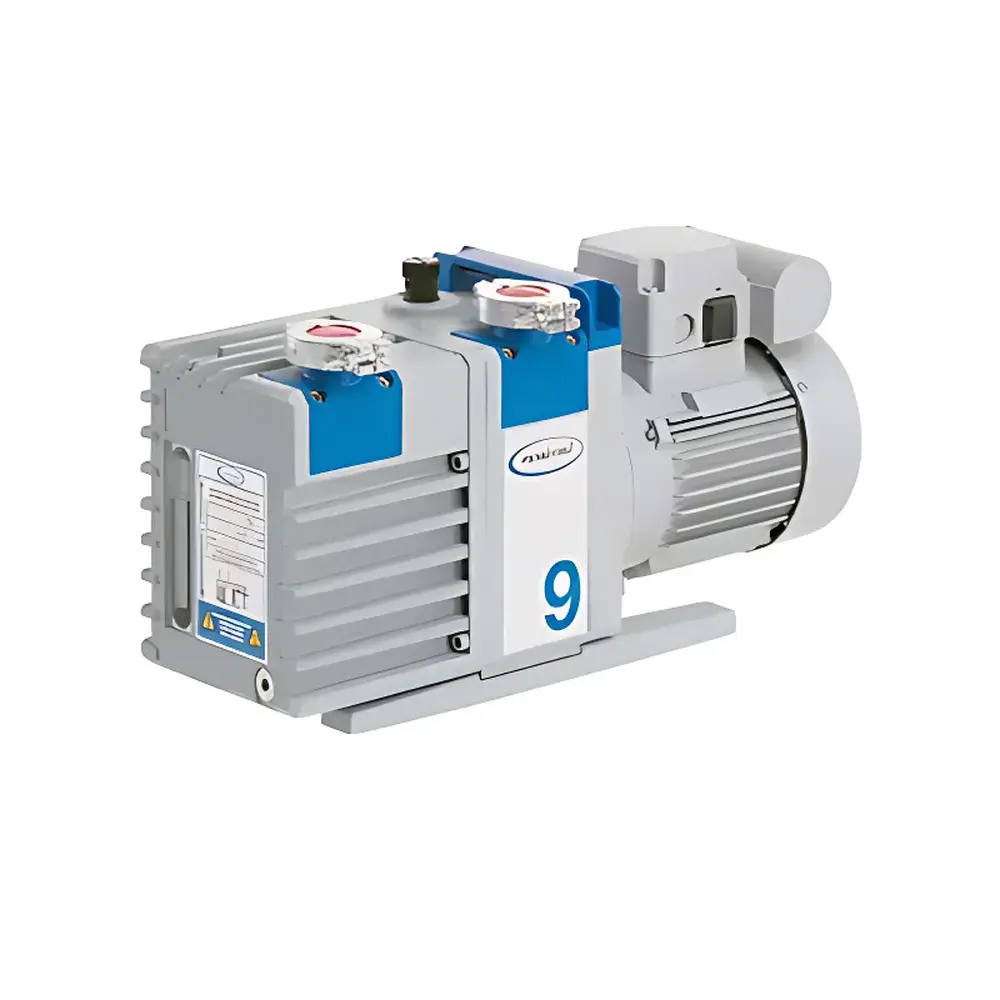
VACUUBRAND RZ 9 Dual-Stage Oil-Sealed Rotary Vane Vacuum Pump
| Brand | VACUUBRAND® |
|---|---|
| Origin | Germany |
| Manufacturer Type | Authorized Distributor |
| Origin Category | Imported |
| Model | RZ 9 |
| Pricing | Upon Request |
| Maximum Pumping Speed (50 Hz) | 8.9 m³/h |
| Ultimate Vacuum (without gas ballast) | 2 × 10⁻³ mbar |
| Ultimate Vacuum (with gas ballast) | 1 × 10⁻² mbar |
| Water Vapor Tolerance | 40 mbar |
| Oil Capacity (min/max, B-type oil) | 0.2 / 0.8 L |
| Inlet/Outlet Port | KF DN 25 |
| Dimensions (L × W × H) | 460 × 152 × 232 mm |
| Weight | 24.2 kg |
| Order No. | 698141 |
Overview
The VACUUBRAND RZ 9 is a dual-stage, oil-sealed rotary vane vacuum pump engineered for precision and reliability in demanding laboratory environments. Based on the fundamental principle of positive displacement—where rotating vanes trap and compress gas volumes between the rotor and stator chamber—the RZ 9 delivers consistent vacuum performance across a wide operational range. Its dual-stage configuration enables deeper ultimate vacuum levels compared to single-stage counterparts, making it suitable for applications requiring stable low-pressure conditions, including vacuum drying, freeze-drying, rotary evaporation, vacuum filtration, and inert atmosphere preparation. Designed and manufactured in Germany, the RZ 9 adheres to stringent EU machinery directives (2006/42/EC) and electromagnetic compatibility standards (2014/30/EU), ensuring robust mechanical integrity and electrical safety in continuous operation.
Key Features
- Dual-stage oil-sealed architecture: Achieves an ultimate vacuum of 2 × 10⁻³ mbar without gas ballast and maintains 1 × 10⁻² mbar with gas ballast activated—critical for solvent-laden or moisture-rich processes.
- Integrated oil circulation system: Features a dedicated internal oil pump that ensures uniform lubrication and thermal management, extending service intervals and reducing maintenance frequency.
- High-capacity oil reservoir: Accepts 0.2–0.8 L of VACUUBRAND B-type mineral oil, supporting extended operational cycles and minimizing downtime associated with oil replenishment.
- Optimized gas ballast design: Delivers high-flow vapor handling capability (up to 40 mbar water vapor partial pressure), enabling reliable operation during condensable vapor evacuation without oil degradation.
- Self-sealing shutdown behavior: Automatically isolates the inlet upon power-off, preserving system vacuum without requiring external check valves or anti-backstreaming hardware.
- Maintenance-friendly “telescope” housing: Allows rapid access to rotor, vanes, and oil sump—facilitating routine inspection, cleaning, and component replacement per GLP-compliant maintenance logs.
Sample Compatibility & Compliance
The RZ 9 is compatible with standard KF DN 25 vacuum tubing and flange systems, ensuring seamless integration with common laboratory vacuum manifolds, cold traps, and process vessels. It is certified for use with non-corrosive, non-explosive gases and vapors typical in organic synthesis, pharmaceutical development, and materials science workflows. While not rated for aggressive halogenated or acidic vapors (e.g., HCl, Cl₂), optional stainless-steel components and fluorinated elastomer seals are available through VACUUBRAND’s OEM service portfolio. The pump complies with ISO 8573-1:2010 Class 4 for compressed air purity (when used as a backing pump for high-vacuum systems) and meets CE marking requirements for laboratory equipment under Annex II of Directive 2014/35/EU (LVD). Its oil management protocol supports traceability in regulated environments where maintenance records must align with FDA 21 CFR Part 11 audit trail expectations.
Software & Data Management
The RZ 9 operates as a standalone mechanical device without embedded digital controls or firmware. However, it is fully compatible with third-party vacuum monitoring systems via analog 0–10 V or 4–20 mA output interfaces (available on optional sensor kits). When integrated into automated platforms—such as those governed by LabVIEW, DeltaV, or Siemens Desigo—the pump’s status (running/stopped), oil temperature, and inlet pressure can be logged, trended, and archived in accordance with ALCOA+ data integrity principles. VACUUBRAND provides comprehensive technical documentation—including exploded diagrams, torque specifications, and oil change SOP templates—in English and German, supporting IQ/OQ validation protocols required under GMP and ISO/IEC 17025 accreditation frameworks.
Applications
- Vacuum concentration and solvent removal in analytical sample preparation
- Backing pump for diffusion pumps, turbomolecular pumps, and cryopumps in high-vacuum systems
- Evacuation of gloveboxes and inert-atmosphere chambers prior to purging
- Supporting vacuum-assisted filtration in microbiology and environmental testing labs
- Operation with rotary evaporators (e.g., Buchi R-300, IKA RV 10) under variable load conditions
- Long-duration vacuum drying of hygroscopic powders, polymers, and ceramic precursors
FAQ
What type of vacuum oil is recommended for the RZ 9?
VACUUBRAND B-type mineral oil (Order No. 698100) is specifically formulated for this pump series and ensures optimal viscosity index, oxidation resistance, and vapor pressure characteristics.
Can the RZ 9 be operated continuously at its ultimate vacuum?
Yes—its dual-stage design and thermally stabilized housing permit uninterrupted operation at ≤2 × 10⁻³ mbar, provided ambient temperature remains within 15–35 °C and ventilation is unobstructed.
Is the RZ 9 suitable for pumping corrosive gases?
No—standard configuration uses nitrile rubber seals and mineral oil; exposure to halogens, strong acids, or ammonia requires custom sealing materials and synthetic lubricants, available upon engineering consultation.
How often should oil be changed under typical lab usage?
With average daily operation (4–6 h), oil replacement is recommended every 6–12 months—or sooner if discoloration, emulsification, or increased noise occurs—as documented in the user manual’s maintenance schedule.
Does the RZ 9 meet noise emission limits for open-lab environments?
At 1 m distance, sound pressure level is ≤54 dB(A), compliant with ISO 4871 and suitable for placement in shared laboratory spaces without acoustic enclosures.



