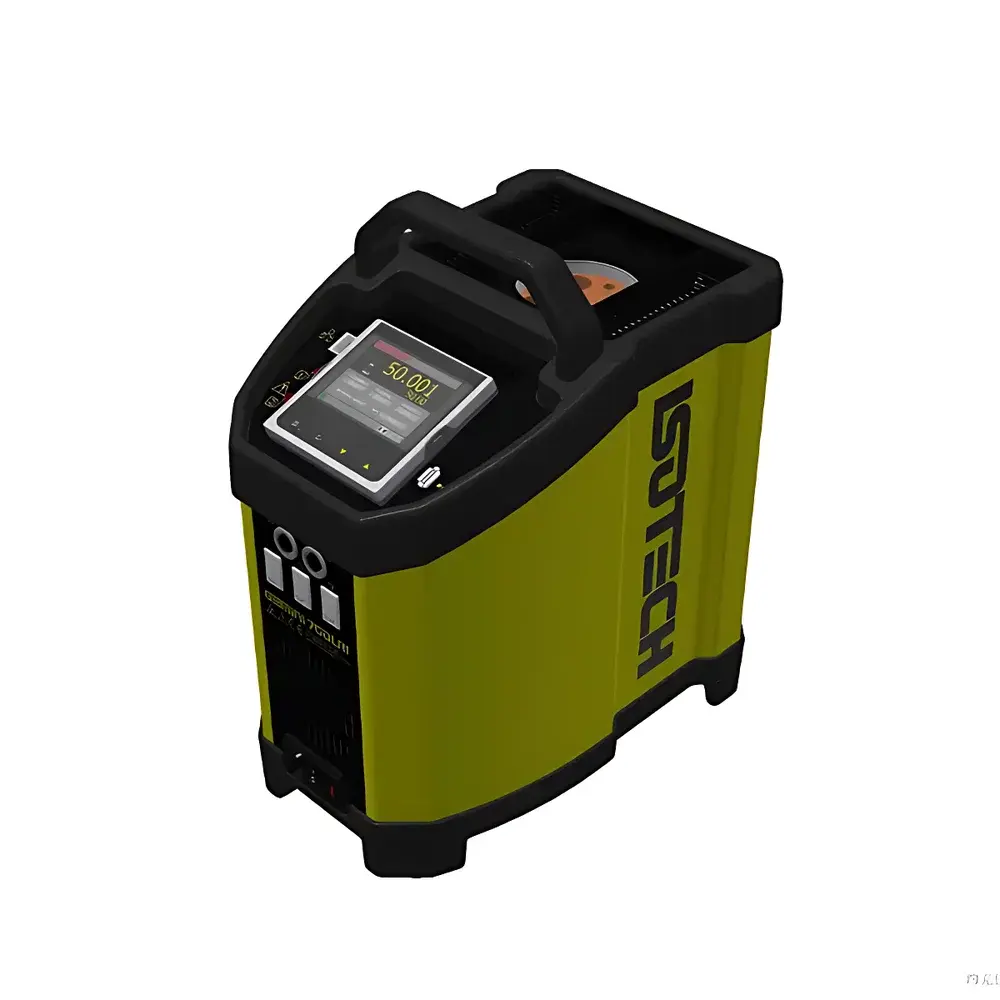
ISOTECH Pegasus4853 Multi-Function Dry-Block Calibrator
| Brand | ISOTECH |
|---|---|
| Origin | United Kingdom |
| Model | Pegasus4853 |
| Temperature Range | 150 °C to 1200 °C |
| Stability (30 min) | ±0.05 °C @ 150 °C, ±0.08 °C @ 1200 °C |
| Display Resolution | 0.01 °C (full scale) |
| Calibration Well Dimensions | Ø33.5 mm × 130 mm depth |
| Input Channels | 2 PRT, 3 thermocouple (E/J/K/N/R/S/T), 4–20 mA process signal, switch contact |
| CJC Accuracy | ±0.35 °C |
| Cooling Time | <50 min (1200 °C → 800 °C), <180 min (1200 °C → 200 °C) |
| Heating Rate | 25 °C/min |
| Power Supply | 220 VAC, 50/60 Hz, 800 W |
| Dimensions (H×W×D) | 384 × 212 × 312 mm |
| Weight | 13 kg |
| Interface | Ethernet + USB host port |
| Compliance | Designed for ISO/IEC 17025-compliant calibration workflows, supports audit-trail-capable data export per GLP/GMP requirements |
Overview
The ISOTECH Pegasus4853 Multi-Function Dry-Block Calibrator is a high-stability, laboratory- and field-deployable temperature calibration system engineered for metrological traceability in demanding industrial and regulatory environments. Operating on the principle of conductive heat transfer within a precisely machined metal block (Inconel 600 alloy), the Pegasus4853 achieves thermal equilibrium via PID-controlled resistive heating and active air-cooling. Its core architecture integrates a triple-channel independent temperature indicator—enabling simultaneous monitoring and verification of up to three sensors under identical thermal conditions—while maintaining full compliance with international calibration standards including ASTM E2877, IEC 60584, and ISO 17025 clause 6.5.2 for equipment suitability. The unit’s 130 mm deep, Ø33.5 mm well accommodates standard probe diameters (including 6 mm and 8 mm sheathed thermocouples and RTDs), and its 50 mm top insulation layer ensures surface temperatures remain below 50 °C during operation at 1200 °C—meeting EN 61010-1 safety requirements for operator protection.
Key Features
- Triple independent input channels: two platinum resistance thermometer (PRT) inputs and three thermocouple inputs (E, J, K, N, R, S, T types), plus dedicated 4–20 mA loop and switch-contact test capability
- High-resolution 0.01 °C display across full range (150–1200 °C), with configurable units (°C, °F, K)
- Thermal stability of ±0.05 °C over 30 minutes at 150 °C and ±0.08 °C at 1200 °C—validated per ISO 17025 internal verification protocols
- Integrated automatic temperature cycling: programmable ramp-soak sequences with user-defined dwell times and step increments
- Dual communication interface: Ethernet (TCP/IP) for remote control via web browser (B/S architecture) and USB host port for direct data export to FAT32-formatted flash drives
- Onboard non-volatile memory stores calibration logs, timestamps, operator IDs, and environmental metadata—supporting 21 CFR Part 11-compliant audit trails when used with validated software
Sample Compatibility & Compliance
The Pegasus4853 accommodates a broad spectrum of temperature sensors without requiring interchangeable inserts: bare-wire thermocouples (types E, J, K, N, R, S, T), 2-/3-/4-wire Pt100 and Pt1000 RTDs, miniature probes (down to Ø1.5 mm), and industrial process transmitters. Its standardized 4×8 mm calibration insert (80 mm depth) and main well geometry conform to EURAMET cg-18 and NIST SP 250-97 dimensional guidelines for dry-block comparators. All thermal performance specifications—including cold-junction compensation (CJC) accuracy of ±0.35 °C—are verified using NIST-traceable reference standards prior to shipment. The system is CE-marked and designed to support ISO/IEC 17025 accredited laboratories in fulfilling clause 6.4.10 (equipment validation) and clause 7.7 (measurement uncertainty evaluation).
Software & Data Management
The Pegasus4853 operates natively via embedded web server—accessible from any modern browser on desktop, tablet, or smartphone without client installation. Calibration sessions generate timestamped CSV files containing setpoint, actual block temperature, sensor readings, deviation values, and pass/fail status against user-defined tolerances. USB export preserves file integrity with SHA-256 checksums; data files include embedded metadata (instrument ID, firmware version, calibration date, operator login). When integrated with ISOTECH’s optional CalSuite Pro software (v3.2+), users can generate IQ/OQ documentation, automate uncertainty budgets per GUM (JCGM 100), and produce PDF reports compliant with FDA 21 CFR Part 11 Annex 11 requirements—including electronic signatures and immutable audit logs.
Applications
- Primary calibration of thermocouples and RTDs in pharmaceutical manufacturing (clean steam, autoclave, lyophilizer validation)
- In-situ verification of temperature sensors in oil & gas upstream instrumentation (wellhead controllers, downhole gauges)
- Periodic verification of furnace and oven temperature uniformity sensors per AMS2750E and CQI-9 heat-treat system audits
- Supporting ISO 13485 medical device production line qualification where temperature-critical processes require documented traceability
- Field service calibration of HVAC commissioning sensors, boiler controls, and food processing thermal mapping systems
FAQ
Does the Pegasus4853 support external reference probe input for comparison calibration?
Yes—it accepts two independent PRT inputs with built-in 4-wire measurement circuitry, enabling direct comparison against a certified reference standard (e.g., Fluke 724 or Hart 1595A) without additional hardware.
Can calibration records be exported in formats compatible with LIMS integration?
All exported CSV files follow ASTM E2500-19 structured metadata conventions and include column headers aligned with common LIMS ingestion schemas (e.g., LabWare, STARLIMS, Thermo Fisher SampleManager).
Is firmware update capability available over Ethernet?
Yes—secure firmware updates (signed binaries) are delivered via HTTPS through the embedded web interface, with rollback support and version history logging.
What is the recommended recalibration interval for metrological assurance?
ISOTECH recommends annual verification against a NIST-traceable reference standard; however, interval adjustments may be justified per ISO/IEC 17025 clause 6.5.2 based on usage frequency, thermal stress exposure, and historical performance trending.
Does the unit meet explosion-proof requirements for hazardous area use?
No—the Pegasus4853 is rated for general-purpose indoor use (IP20). For Zone 1/2 applications, it must be operated outside the hazardous zone with sensor leads routed through approved barriers.