
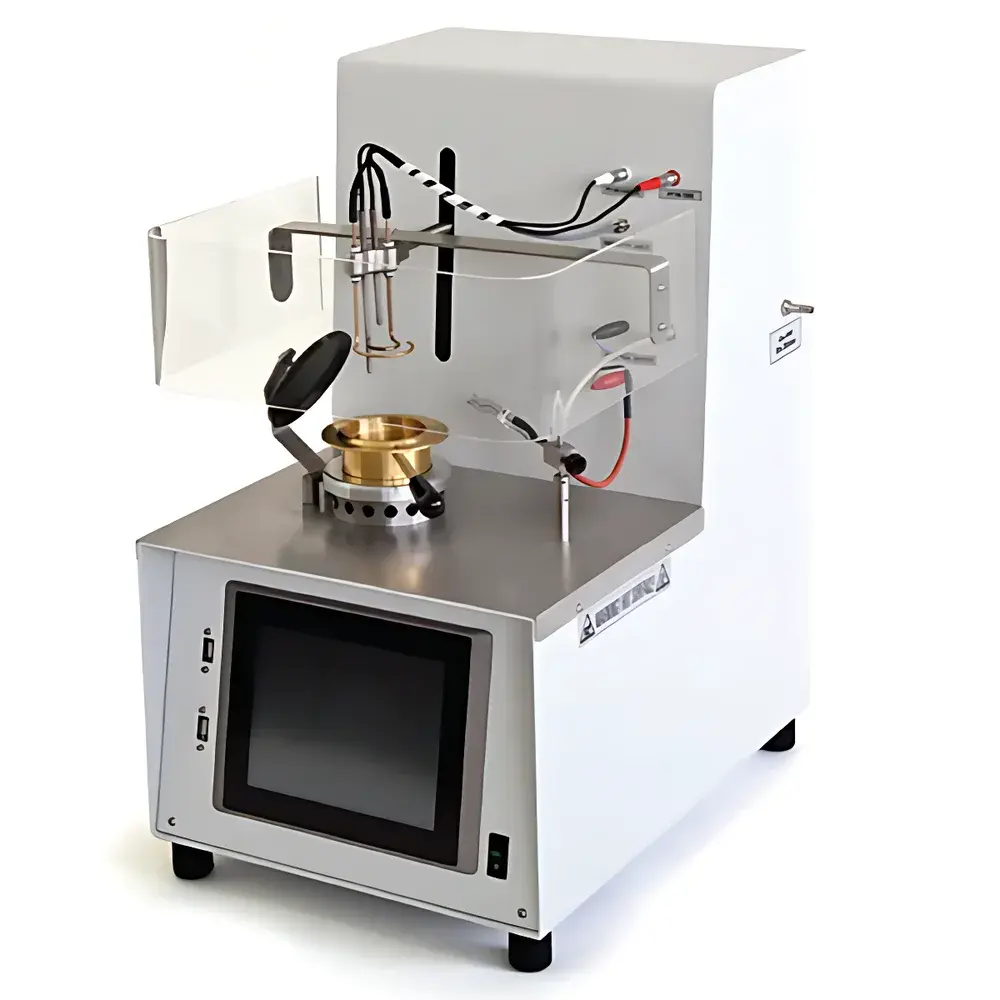
Ducom CFP Cleveland Open Cup Flash Point Tester
| Brand | Ducom |
|---|---|
| Origin | USA |
| Model | CFP |
| Test Method | Cleveland Open Cup (COC) |
| Operation Mode | Semi-Automatic (Manual Sample Loading + Automated Detection & Control) |
| Applicable Standards | ASTM D92, FTM 791-1103, IP 36, ISO 2592, JIS K2265-4 |
| Temperature Range | +79 °C to 400 °C |
| Temperature Accuracy | ±0.1 °C |
| Temperature Resolution | 0.06 °C |
| Heating Sensor | Class A PT100 |
| Ignition System | Dual electric igniters + pilot flame |
| Detection Principle | Ionization-based flame detection |
| Safety Features | Thermal cutoff, real-time fire detection, self-diagnostic routines |
| Dimensions (W×D×H) | 48 × 37 × 61 cm |
| Weight | 32 kg |
| Power Supply | 220 V ±15 %, 50–60 Hz or 115 V ±15 %, 60 Hz |
| Data Output | Excel-compatible CSV files |
| Display | 8-inch integrated TFT/LCD touchscreen PC |
Overview
The Ducom CFP Cleveland Open Cup Flash Point Tester is a precision-engineered instrument designed for the standardized determination of flash point and fire point of petroleum products, lubricating oils, bituminous materials, and other combustible liquids with initial boiling points above 79 °C. It operates in strict compliance with the Cleveland Open Cup (COC) method—a gravimetric, atmospheric-pressure test configuration defined by ASTM D92 and harmonized across international standards including ISO 2592, IP 36, and JIS K2265-4. Unlike closed-cup testers, the COC method subjects the sample to controlled heating in an open crucible while introducing a standardized ignition source at prescribed temperature intervals. This configuration replicates real-world conditions where volatile vapors accumulate near the surface of heated hydrocarbon fluids—making it especially relevant for safety assessment in refining, storage, transportation, and regulatory compliance workflows.
Key Features
- Ionization-based flame detection system delivering high signal-to-noise ratio and immunity to ambient light interference—ensuring unambiguous flash event identification.
- Dual electric igniters with adjustable pilot flame geometry, calibrated per ASTM D92 specifications for consistent ignition energy delivery.
- Class A PT100 sensor embedded in the heating mantle, coupled with PID-controlled thermal regulation to maintain ±0.1 °C accuracy across the full operational range (+79 °C to 400 °C).
- Integrated 8-inch high-resolution TFT/LCD touchscreen PC running embedded real-time operating system—enabling direct method selection, parameter configuration, and live temperature profiling without external computing hardware.
- Comprehensive safety architecture: thermal cutoff circuitry, continuous flame monitoring, automatic shutdown on overtemperature or flame persistence, and built-in diagnostic self-check at power-on.
- Semi-automatic workflow: manual sample placement and crucible positioning are retained for operator control, while temperature ramping, ignition timing, flash detection, and data logging are fully automated.
Sample Compatibility & Compliance
The CFP accommodates viscous and semi-solid samples—including heavy fuel oils, asphalt binders, industrial lubricants, and residual fractions—without requiring dilution or pre-treatment. Its open-cup geometry and elevated temperature ceiling (up to 400 °C) support testing of high-boiling-point materials that exceed the limits of Pensky-Martens or Tag closed-cup instruments. The system is validated for conformance with ASTM D92 (Standard Test Method for Flash and Fire Points by Cleveland Open Cup Tester), FTM 791-1103 (U.S. Department of Defense specification), IP 36 (Institute of Petroleum), ISO 2592 (International Organization for Standardization), and JIS K2265-4 (Japanese Industrial Standards). All calibration and verification procedures align with ISO/IEC 17025 requirements for testing laboratories, and audit trails—including user actions, temperature logs, and detection timestamps—are retained in tamper-evident format to support GLP and GMP documentation needs.
Software & Data Management
The embedded software provides method-driven test execution with preloaded profiles for ASTM D92, ISO 2592, and FTM 791-1103. Each test generates a timestamped report containing ramp rate, observed flash/fire temperatures, ignition event count, and thermal stability metrics. Raw data—including second-by-second temperature and ion current values—is exportable in CSV format compatible with Microsoft Excel, MATLAB, and LIMS platforms. User access levels (operator, supervisor, administrator) enforce role-based permissions for method editing, calibration adjustment, and report deletion. Audit logs meet FDA 21 CFR Part 11 requirements for electronic records and signatures, including user authentication, action timestamps, and immutable change history.
Applications
- Quality assurance of base oils and finished lubricants in OEM and additive manufacturing facilities.
- Regulatory submission testing for EPA, DOT, and OSHA flammability classification of industrial fluids.
- Refinery process control—monitoring flash point drift in vacuum gas oil (VGO) and coker feedstocks.
- Research and development of bio-based hydraulic fluids and synthetic ester lubricants.
- Contract testing laboratories serving petrochemical, aviation fuel, and marine bunker sectors under ISO/IEC 17025 accreditation.
- Fire safety evaluation of bitumen emulsions and polymer-modified asphalts used in road construction.
FAQ
What distinguishes the Cleveland Open Cup method from closed-cup flash point testing?
The Cleveland Open Cup (ASTM D92) exposes the sample to ambient atmosphere during heating, allowing vapor accumulation at the liquid surface—yielding higher, more conservative flash point values suitable for safety hazard assessment. Closed-cup methods (e.g., ASTM D93) suppress vapor loss and report lower values typically used for transport classification.
Is the CFP compliant with FDA 21 CFR Part 11 for regulated environments?
Yes—the system implements electronic signature controls, audit-trail logging, and secure user authentication aligned with Part 11 requirements for electronic records in pharmaceutical and food-grade lubricant testing.
Can the instrument be calibrated using NIST-traceable reference materials?
Absolutely. The CFP supports calibration verification with certified flash point standards traceable to NIST SRM 2626a (mineral oil) and SRM 2627 (paraffin wax), with documented uncertainty budgets per ISO/IEC 17025.
Does the system require external ventilation or fume hood integration?
While not mandatory, operation within a certified chemical fume hood is recommended when testing highly volatile or toxic samples—consistent with OSHA 1910.1200 and local laboratory safety protocols.
How frequently should the ionization detector be cleaned or serviced?
Under normal use, the detector requires cleaning every 50–100 tests using isopropyl alcohol and lint-free swabs; full recalibration is advised after detector maintenance or every six months—whichever occurs first.






