
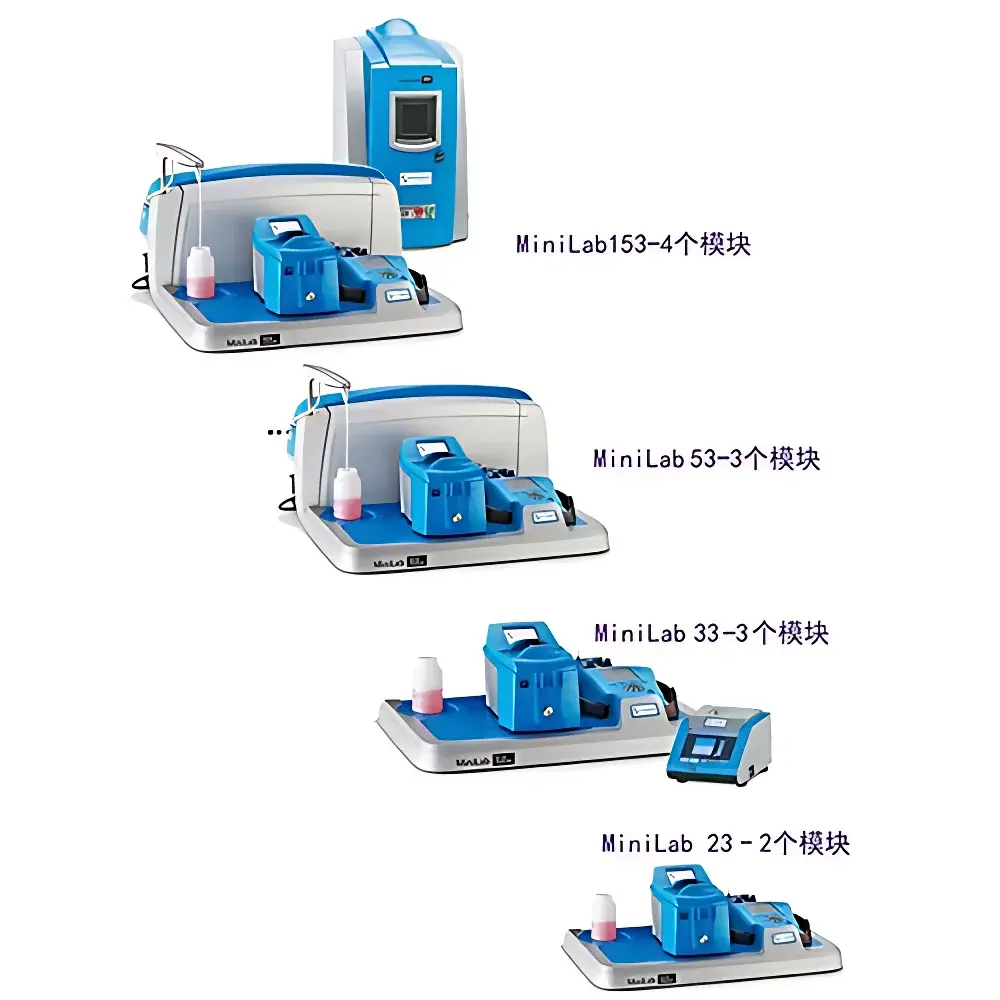
Spectro Scientific MiniLab 153 Industrial Oil Condition Monitoring System
| Brand | Spectro Scientific |
|---|---|
| Origin | USA |
| Manufacturer Status | Authorized Distributor |
| Origin Category | Imported |
| Model | MiniLab 153 |
| Product Type | Laboratory Instrument |
| Test Capabilities | Wear Debris Analysis, Contamination Monitoring, Oxidation & Degradation Assessment |
| Connectivity | Emerson AMS Machinery Health Manager Integration |
| Compliance Framework | Supports ISO 4406 (fluid cleanliness), ASTM D6595 (rotary piston pump wear debris analysis), ASTM D7690 (on-site oil analysis validation), GLP/GMP-aligned data audit trail |
Overview
The Spectro Scientific MiniLab 153 is a field-deployable, integrated oil condition monitoring system engineered for real-time assessment of industrial lubricants in mission-critical rotating equipment. It operates on a multi-technology platform combining quantitative ferrographic analysis (via the FluidScan® infrared spectrometer), particle counting and sizing (using laser obscuration per ISO 4406 and ISO 11171), elemental spectroscopy (with a high-sensitivity CCD-based Rotrode™ plasma emission analyzer), and viscosity measurement (capillary viscometry). Unlike single-parameter handheld testers, the MiniLab 153 delivers laboratory-grade data at the point of use—enabling predictive maintenance decisions grounded in statistically validated trends rather than isolated threshold alarms. Its architecture is purpose-built for integration into plant-wide reliability programs, particularly where rapid turnaround of oil health data directly informs maintenance scheduling, spare parts logistics, and root-cause failure analysis.
Key Features
- Fully automated, walk-away sample processing: single 5-mL oil sample yields full elemental composition (24+ elements), oxidation/nitration/sulfation indices, water content (% v/v), soot loading, glycol contamination, and ISO solid particle count across three size ranges (≥4 µm, ≥6 µm, ≥14 µm).
- Rotrode™ plasma excitation technology ensures detection limits down to 0.1 ppm for key wear metals (Fe, Cu, Al, Cr, Pb, Sn) with inter-laboratory reproducibility ≤5% RSD—validated against ASTM D6595 and ISO 17025-accredited reference labs.
- Embedded LIMS functionality enforces traceable sample chain-of-custody: each test record includes operator ID, timestamp, instrument calibration status, environmental conditions (ambient temperature/humidity), and digital signature—fully compliant with FDA 21 CFR Part 11 requirements for electronic records and signatures.
- “Three-Vector Risk Assessment” dashboard visualizes concurrent deterioration vectors—mechanical wear, fluid degradation, and contamination ingress—as color-coded trend trajectories aligned to OEM-recommended alarm bands (e.g., GEK 32568, Siemens TLV-001, Caterpillar SAE J183).
- Native Emerson AMS Machinery Health Manager integration via OPC UA protocol enables synchronized correlation of oil health metrics with vibration spectra, thermography logs, and process parameters—facilitating cross-domain fault pattern recognition.
Sample Compatibility & Compliance
The MiniLab 153 supports all mineral-, synthetic-, and bio-based industrial lubricants—including turbine oils (ISO VG 32–100), hydraulic fluids (HL, HM, HVLP), gear oils (CLP, EP), compressor oils, and circulating systems. It complies with ISO 4406:2017 (fluid cleanliness classification), ASTM D7690 (standard guide for validating field oil analyzers), and ASTM D7718 (practice for establishing oil analysis program quality control). All analytical methods are pre-validated against ASTM D6595 (ferrous density), ASTM D7889 (FTIR oxidation index), and ISO 12181-2 (particle counter calibration). The system meets IEC 61000-4-2 (ESD immunity) and UL 61010-1 safety certification for industrial environments.
Software & Data Management
MiniLab Software v5.x provides configurable reporting templates aligned with ISO 55001 asset management frameworks and API RP 546 oil analysis guidelines. Reports include dynamic trend charts (12-month rolling window), statistical process control (SPC) charts with Cpk/Ppk calculation, and automatic flagging of outliers using Grubbs’ test (α = 0.05). Audit logs retain full metadata for every data point—including raw spectral scans, calibration curves, and operator intervention timestamps—supporting GLP/GMP audits and third-party verification. Data export formats include CSV, PDF/A-2b (archival), and XML for ERP/MAXIMO integration.
Applications
The MiniLab 153 is deployed across industries requiring continuous uptime assurance: thermal and hydroelectric power generation (turbine lube oil, transformer insulating oil), pulp & paper mill gearboxes and hydraulic systems, steel mill rolling mill lubrication circuits, mining conveyor and crusher gearboxes, and automotive component manufacturing CNC spindles. It is especially effective in remote or offshore facilities where lab turnaround exceeds 72 hours—reducing mean time to diagnosis (MTTD) by >80% compared to off-site analysis.
FAQ
Does the MiniLab 153 require daily calibration?
No—calibration is performed automatically before each sample run using internal reference standards; full verification is required only every 30 days or after 100 tests, per ASTM D7690.
Can it analyze used diesel engine oil?
Yes, though optimized for industrial circulating systems; engine-specific interpretation rules (SAE J183) are available as optional software modules.
Is training required to operate the system?
Minimal—operators complete certified competency training in under 4 hours; no chemistry or spectroscopy background is necessary.
How does it handle emulsified or highly contaminated samples?
Integrated centrifugal separation and microfiltration ensure consistent sample presentation to all sensors, maintaining accuracy up to 2,000 ppm water and 15% soot loading.
What cybersecurity protocols are implemented?
Role-based access control (RBAC), TLS 1.2 encrypted data transmission, and local database encryption (AES-256) meet NIST SP 800-53 Rev. 4 requirements for industrial control systems.
Related Products






