
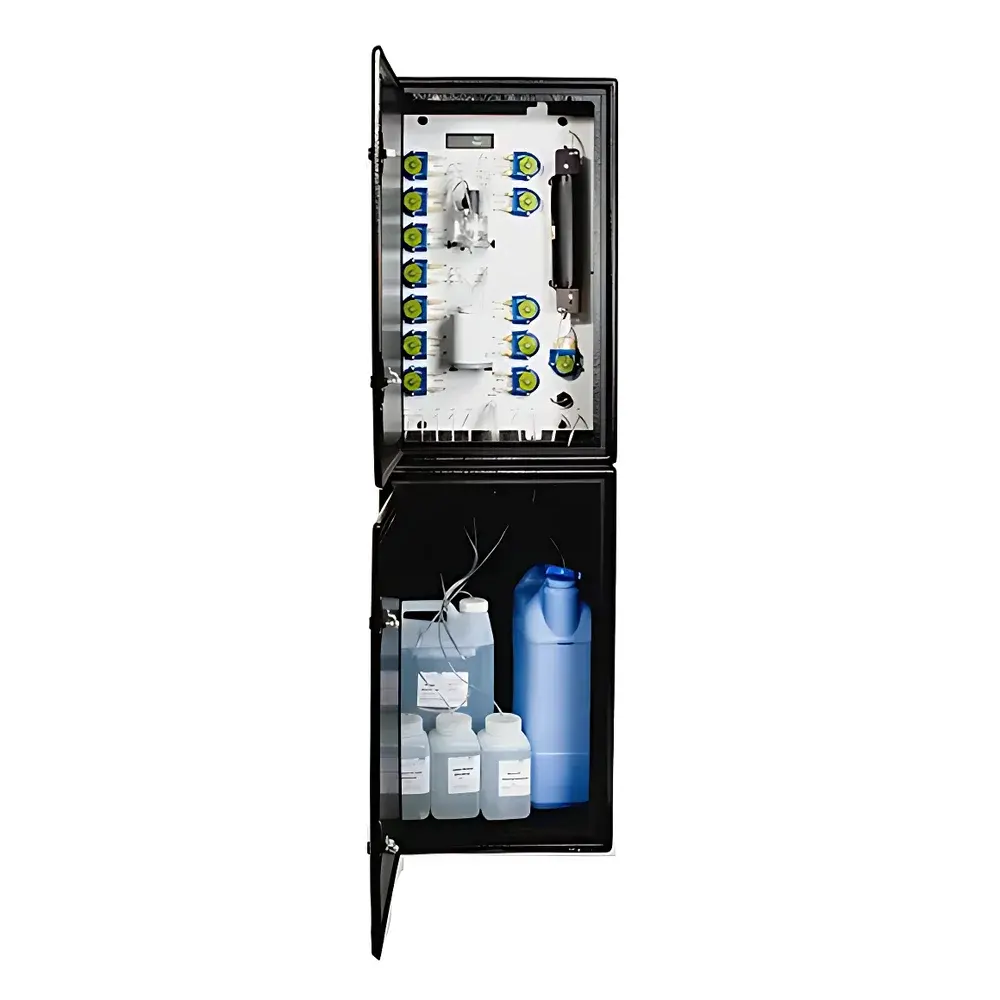
Modern Water MicroTrace™ OVA 7100 / OVA 7100Dualcell Online Heavy Metals Analyzer
| Brand | Modern Water |
|---|---|
| Origin | United Kingdom |
| Model | OVA 7100 / OVA 7100Dualcell |
| Detection Principle | Anodic Stripping Voltammetry (ASV) |
| Target Metals | Up to 23 heavy metals (e.g., As, Cd, Cr, Cu, Hg, Ni, Pb, Se, Tl, Zn) |
| Detection Range | 0.5–5 µg/L |
| Accuracy/Precision | ±5–10% RSD |
| Analysis Frequency | Continuous real-time monitoring |
| Sample Compatibility | Raw water, wastewater, groundwater, surface water, drinking water, industrial effluent |
| Pre-treatment Options | Acid digestion, UV digestion, filtration |
| Electrode Type | Solid-state mercury-free working electrode |
| Compliance | Designed for ASTM D3559, ISO 8692, USP <232>/<233>, and GLP/GMP-aligned data integrity requirements |
Overview
The Modern Water MicroTrace™ OVA 7100 and OVA 7100Dualcell are laboratory-grade online heavy metals analyzers engineered for continuous, unattended trace-metal quantification in aqueous matrices. Built upon the internationally validated principle of anodic stripping voltammetry (ASV), these instruments electrochemically pre-concentrate metal ions onto a solid-state working electrode under controlled potential, followed by oxidative stripping to generate analyte-specific current peaks. This technique delivers high selectivity and sensitivity without reliance on hazardous mercury-film electrodes—replacing legacy methods with a robust, maintenance-optimized architecture suitable for deployment in municipal, industrial, and environmental monitoring networks. Unlike optical or atomic absorption techniques, ASV is inherently insensitive to sample color, turbidity, and organic matrix interference, enabling direct analysis of minimally processed water streams—including raw surface water, treated effluent, and groundwater—without dilution or extensive pretreatment.
Key Features
- Simultaneous detection of up to 23 regulated heavy metals—including arsenic (As), cadmium (Cd), chromium (Cr), copper (Cu), mercury (Hg), nickel (Ni), lead (Pb), selenium (Se), thallium (Tl), and zinc (Zn)—via programmable multi-element ASV sequences
- Detection limits as low as 0.1 µg/L (method-dependent), with operational quantification range spanning 0.5–5 µg/L for routine compliance monitoring
- Real-time, high-frequency measurement capability: full multi-metal analysis completed in under 15 minutes, supporting sub-hourly reporting intervals to capture transient contamination events
- Integrated solid-state bismuth- or gold-based working electrodes—eliminating mercury handling, disposal liabilities, and regulatory constraints associated with traditional hanging mercury drop electrodes (HMDE)
- Automated system diagnostics: real-time monitoring of peristaltic pump status, reagent consumption, sample flow integrity, and electrode surface conditioning cycles
- Configurable alarm logic with relay outputs and Modbus TCP/RTU support for integration into SCADA, DCS, or PLC-based process control systems—enabling automated response actions such as chemical dosing adjustment or flow diversion
- Optional inline sample conditioning modules: programmable acid digestion (HNO₃/HCl), UV oxidation (185/254 nm), and 0.45 µm filtration to ensure complete dissolution of organometallic complexes and colloidal species
Sample Compatibility & Compliance
The OVA 7100 series accommodates a broad spectrum of water types without performance compromise: potable water (per WHO Guidelines and EU Drinking Water Directive 2020/2184), wastewater influent/effluent (aligned with EPA Method 200.8 and ISO 11885), industrial cooling water, mine drainage, and leachate from contaminated land remediation sites. All measurements adhere to metrological traceability principles outlined in ISO/IEC 17025. Data acquisition and storage comply with ALCOA+ (Attributable, Legible, Contemporaneous, Original, Accurate, Complete, Consistent, Enduring, Available) criteria. Audit trails, electronic signatures, and user-access controls satisfy FDA 21 CFR Part 11 and EU Annex 11 requirements when deployed in regulated environments requiring GxP documentation.
Software & Data Management
MicroTrace Control Software provides intuitive configuration of analytical methods, calibration schedules (including multi-point standard addition and spike recovery validation), and event-driven reporting. Raw voltammograms, peak integration parameters, and quality control metrics (e.g., electrode renewal efficiency, background current stability) are stored in encrypted SQLite databases with automatic daily backup to network shares or cloud endpoints via TLS 1.2–secured HTTPS. Remote access is enabled through role-based web interfaces (HTML5), supporting simultaneous viewing by operations, QA/QC, and regulatory affairs personnel. Export formats include CSV, PDF analytical reports, and XML-compatible datasets compatible with LIMS and enterprise environmental data platforms.
Applications
- Early-warning surveillance at drinking water intakes and distribution system nodes
- Compliance monitoring for industrial discharge permits (e.g., NPDES, IPPC)
- Long-term trend analysis in groundwater protection zones and landfill leachate collection systems
- Process optimization in metal finishing, electroplating, and battery recycling facilities
- Post-event forensic analysis following accidental spills or unauthorized releases
- Supporting circular economy initiatives through real-time tracking of metal recovery efficiency in wastewater reclamation plants
FAQ
What regulatory standards does the OVA 7100 meet for heavy metals monitoring?
It supports method equivalency to EPA Method 200.8, ISO 11885, and ASTM D3559 for dissolved metals; validation protocols align with ISO/IEC 17025 for accredited laboratories.
Can the instrument operate without sample pre-treatment?
Yes—ASV’s inherent matrix tolerance allows direct analysis of filtered samples; however, acid/UV digestion is recommended for total recoverable metal determination per regulatory definitions.
How is electrode fouling mitigated during long-term operation?
The system performs automated electrochemical cleaning cycles between analyses and monitors baseline current drift to trigger scheduled mechanical polishing or replacement alerts.
Is remote software update and troubleshooting supported?
Yes—secure over-the-air firmware updates and diagnostic session initiation are available via authenticated SSH or HTTPS, subject to customer-configured firewall policies.
What data security protocols are implemented?
All communications use TLS 1.2+, local storage employs AES-256 encryption, and audit logs record every user action—including method edits, calibration changes, and alarm acknowledgments—with immutable timestamps.







