
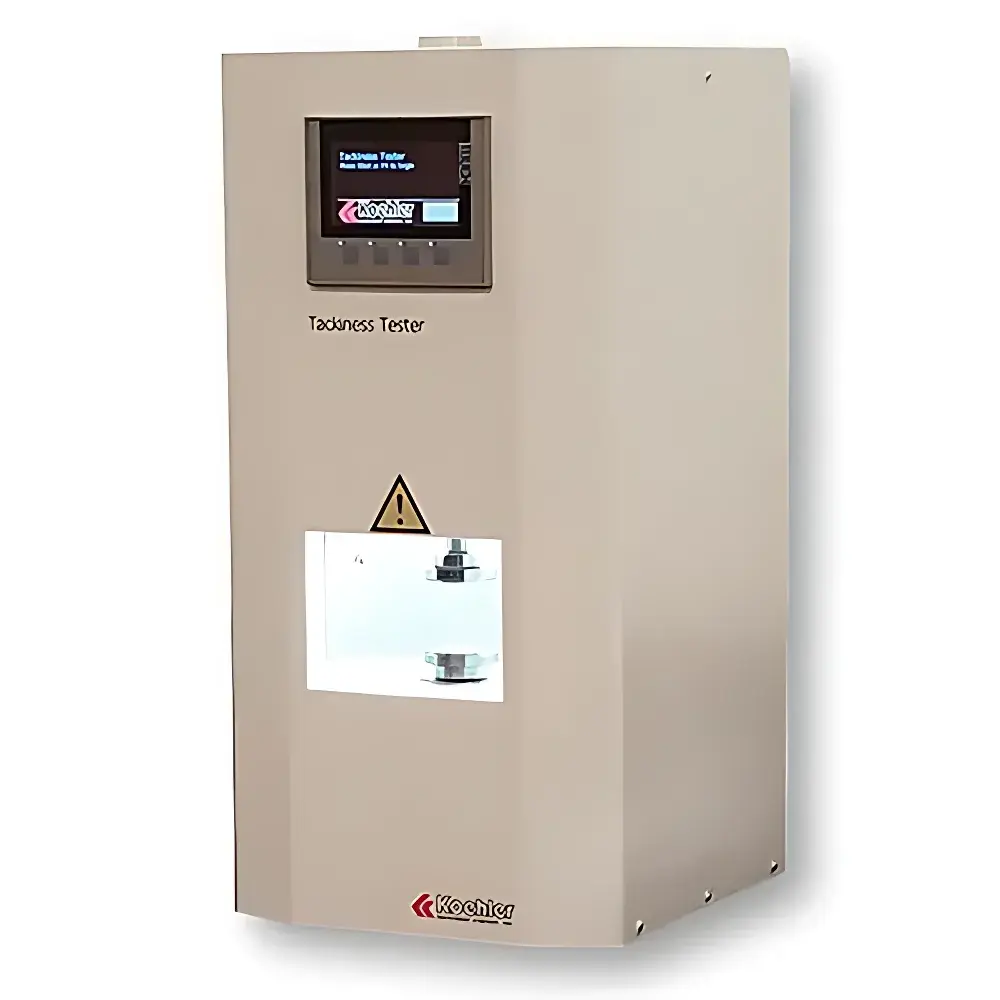
Koehler K95200 Grease Adhesion Tester
| Brand | Koehler |
|---|---|
| Origin | USA |
| Manufacturer Status | Authorized Distributor |
| Origin Category | Imported |
| Model | K95200 |
| Product Type | Laboratory Instrument |
| Test Parameter | Grease Adhesion Force |
| Accuracy | <0.1 N |
| Load System | Electromechanical Control |
| Sample Mass | 5 g |
| Test Duration | ~120 s |
| Result Units | N, N/mm², N/in² |
| Test Speed | 250 mm/s (standard) |
| PLC | Siemens S7-1200 + 7" HMI Touchscreen |
| Interface | Ethernet |
| Temperature Range | Ambient to 80 °C |
| Voltage | 110–230 V AC, 50–60 Hz |
| Dimensions (H×W×D) | 620 × 300 × 320 mm |
| Weight | 30 kg |
| Optional Accessory | K95200-1 Temperature-Controlled Test Chamber |
Overview
The Koehler K95200 Grease Adhesion Tester is an electromechanically driven laboratory instrument engineered for the quantitative, repeatable measurement of grease adhesion force — a critical interfacial property governing performance in rolling-element bearings, gear systems, and other high-load mechanical interfaces. Unlike empirical “tackiness” assessments, this system applies standardized shear separation under controlled normal load and displacement rate, quantifying the force required to separate two parallel metal surfaces coated with a defined mass (5 g) of grease. The measurement principle is grounded in tribological interface mechanics: adhesion reflects the cohesive strength of the grease’s thickener network, its affinity for metal substrates (wettability), and the contribution of polar additives at the solid–lubricant boundary. As such, the K95200 delivers objective, traceable data directly relevant to real-world lubrication failure modes including grease starvation, fling-off, and inadequate film retention under dynamic conditions.
Key Features
- Electromechanical actuation with Siemens S7-1200 PLC control ensures precise, programmable displacement velocity (standard 250 mm/s) and reproducible loading profiles.
- Integrated auto-calibration routine prior to each test sequence guarantees measurement integrity and reduces operator-dependent variability.
- 7-inch industrial touchscreen HMI guides users through a five-step workflow: cleaning verification → program selection → sample loading → test initiation → real-time result display.
- Temperature-controlled testing capability (ambient to 80 °C) via optional K95200-1 chamber enables evaluation of thermal effects on adhesion—critical for applications involving elevated operating temperatures.
- Multi-unit output (N, N/mm², N/in²) supports both SI and imperial reporting conventions without post-processing.
- Robust mechanical architecture includes hardened stainless steel test plates, precision-aligned coaxial disc geometry, and vibration-damped base construction for high signal-to-noise ratio measurements.
Sample Compatibility & Compliance
The K95200 accommodates all NLGI-grade greases—including lithium, calcium sulfonate, polyurea, and complex soap-based formulations—as well as specialty greases containing solid lubricants (e.g., MoS₂, PTFE). Sample preparation requires only 5 g per test, minimizing material consumption while maintaining statistical relevance. The instrument complies with ASTM D1403 (Standard Test Method for Cone Penetration of Lubricating Grease) for preparatory consistency checks and aligns with ISO 2137 methodology principles for interfacial force characterization. Its electromechanical architecture and digital audit trail (via Ethernet logging) support GLP and GMP environments; full electronic records—including timestamps, operator ID, calibration status, and raw force-vs.-time curves—are exportable for regulatory review under FDA 21 CFR Part 11-compliant data management protocols.
Software & Data Management
Data acquisition and visualization are handled locally via the embedded Siemens HMI, which stores up to 1,000 test records with metadata (date/time, temperature, operator, program ID). All results—including peak adhesion force, average separation stress, and time-to-failure—are exportable in CSV format over Ethernet to LIMS or QA databases. No proprietary software installation is required: the device operates as a standalone node with DHCP-enabled network configuration. For centralized fleet management, optional Koehler LabLink™ firmware (v3.2+) enables remote diagnostics, firmware updates, and aggregated trend analysis across multiple K95200 units within a single facility.
Applications
- Formulation development: Screening thickener types, base oil viscosity grades, and additive packages for optimal surface retention.
- Quality control: Batch-to-batch verification of adhesion consistency per internal specifications or OEM technical data sheets.
- Fatigue life correlation: Supporting predictive modeling of grease replenishment intervals in wind turbine pitch bearings and automotive wheel hubs.
- Competitive benchmarking: Objective comparison against industry reference greases (e.g., NLGI #2 lithium 12-hydroxystearate).
- Failure analysis: Diagnosing root causes of premature bearing wear linked to insufficient grease adhesion under shock loading or low-speed oscillation.
FAQ
What physical property does the K95200 actually measure?
It measures the maximum tensile separation force (in newtons) required to pull apart two parallel metal discs coated with a standardized 5 g grease sample at 250 mm/s, under controlled ambient or elevated temperature.
Is the test method standardized by any international body?
While no ISO or ASTM standard yet defines *adhesion* as a standalone parameter, the K95200’s mechanical configuration and data reporting protocol are aligned with the experimental frameworks described in ASTM D1403 Annex A3 (adhesive behavior assessment) and ISO 6743-9 Annex C (grease retention testing).
Can the instrument be integrated into an automated QC line?
Yes—via Ethernet interface and Modbus TCP support, the K95200 can accept external start triggers and transmit pass/fail flags to PLC-based manufacturing execution systems (MES).
Does the K95200-1 temperature chamber require external chillers or compressors?
No—the K95200-1 is a self-contained Peltier-based system with integrated heating and cooling; it operates from standard lab power without auxiliary utilities.
How often must the test plates be cleaned between measurements?
Cleaning is mandatory before every test using lint-free wipes and analytical-grade hexane or isopropanol; residual grease film introduces systematic bias exceeding ±5% in peak force values.
Related Products






