
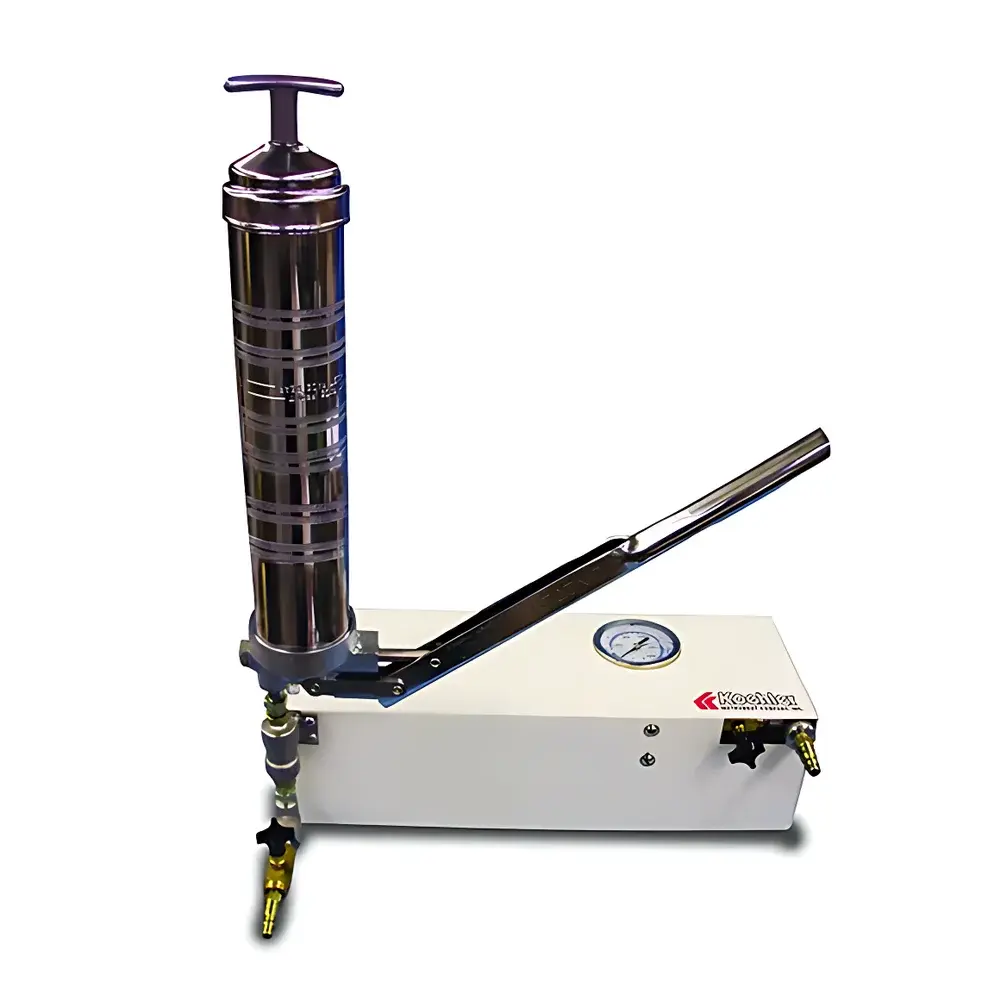
Koehler K95400 Lincoln Centralized Lubrication System Simulator
| Brand | Koehler |
|---|---|
| Origin | USA |
| Manufacturer Status | Authorized Distributor |
| Origin Category | Imported |
| Model | K95400 |
| Product Type | Laboratory Instrument |
| Test Parameter | Grease Bleedability (Penetrability under Pressure) |
| Operating Temperatures | 0 °F, 30 °F, 75 °F |
| Dimensions | 38 × 15 × 13 cm |
| Weight | 5.4 kg |
| Power Requirement | None |
Overview
The Koehler K95400 Lincoln Centralized Lubrication System Simulator is a precision-engineered mechanical test apparatus designed to evaluate the pressure-induced bleedability (also referred to as “forced grease bleed” or “pressure penetration”) of lubricating greases under controlled thermal and hydraulic conditions. Unlike conventional cone penetration tests (e.g., ASTM D217), this simulator replicates the functional stress experienced by greases within centralized lubrication systems—specifically, the resistance to forced flow through narrow-diameter feed lines and metering valves under high backpressure. The instrument operates on a defined pneumatic/hydraulic pressure cycle per the draft method referenced in industry working documents for grease compatibility and system design validation. It provides quantitative data critical for predicting grease pumpability, line plugging risk, and long-term reliability in industrial automatic lubrication networks.
Key Features
- Mechanically actuated, non-electric design ensures intrinsic safety and operational consistency in hazardous or electrically restricted environments.
- Three fixed-temperature testing configurations (0 °F, 30 °F, and 75 °F) enable comparative evaluation of low-temperature pumpability and thermal stability across formulation variants.
- Integrated calibrated pressure gauge with 0–2000 PSI range and ±10 PSI repeatability supports precise application and release of standardized 1800 PSI test pressure.
- Modular grease delivery interface compatible with standard Lincoln-style grease guns, facilitating reproducible sample loading without cross-contamination.
- Compact footprint (38 × 15 × 13 cm) and lightweight construction (5.4 kg) support benchtop deployment, field lab portability, and integration into QC workflows where space and mobility are constrained.
- Pressure decay measurement interval is strictly timed at 30 seconds post-release, aligning with procedural rigor required for inter-laboratory comparability.
Sample Compatibility & Compliance
The K95400 accepts NLGI-consistency-classified greases—including lithium, calcium-sulfonate, polyurea, and complex-soap formulations—without modification to the test cell geometry. Its mechanical architecture avoids thermal gradients or shear history artifacts common in motor-driven simulators, preserving native grease structure during pressurization. While not certified to a single published ASTM or ISO standard, the test protocol implemented by the K95400 corresponds to internal draft methodologies used by OEMs and lubricant suppliers for centralized system qualification. Data generated supports GLP-aligned documentation when paired with traceable pressure calibration records and temperature-controlled environmental logs. The absence of electrical components eliminates electromagnetic interference concerns and simplifies compliance with ATEX/IECEx zone classification requirements in refinery or offshore maintenance labs.
Software & Data Management
The K95400 is a fully manual, analog instrumentation platform with no embedded firmware, display, or digital output. All measurements—initial pressure attainment, decay timing, and final residual pressure—are recorded manually by the operator using calibrated external tools. This design intentionally excludes software dependencies, ensuring long-term operational continuity, audit-trail transparency, and full control over raw data entry into LIMS or ELN systems. Users maintain complete ownership of metadata annotation (e.g., batch ID, ambient RH, operator ID, calibration certificate number), supporting FDA 21 CFR Part 11-compliant workflows when documented per institutional SOPs. No proprietary drivers, cloud connectivity, or subscription services are involved.
Applications
- Evaluation of grease suitability for centralized systems with small-bore distribution tubing (e.g., ≤1/8″ OD stainless steel lines).
- Comparative screening of thickener type, base oil viscosity index, and additive package effects on high-pressure flow behavior.
- Root-cause analysis of field-reported blockages or inconsistent metering in automated lubrication installations.
- Pre-qualification testing prior to ASTM D1092 (Grease Bleed) or ASTM D6184 (Grease Oil Separation) correlation studies.
- Technical support for OEM equipment manufacturers specifying grease performance envelopes for new machinery platforms.
FAQ
Does the K95400 comply with ASTM D1092 or ISO 6743-9?
No—it implements a distinct pressure-decay protocol aligned with Lincoln-specific system validation practices, not a codified standard test method.
Can the instrument be used above 75 °F?
The mechanical design and pressure rating are validated only at the three specified temperatures; operation outside this range voids calibration traceability and may compromise seal integrity.
Is calibration certification included with purchase?
A NIST-traceable pressure gauge calibration certificate is provided with each unit; users must maintain periodic recalibration per internal QA schedule.
What maintenance is required?
Routine cleaning of the grease chamber and valve seat with solvent-compatible lint-free wipes; annual inspection of O-rings and pressure seal integrity is recommended.
Can results be exported directly to Excel or LIMS?
No—data entry is manual; however, structured templates for consistent transcription and electronic archiving are available upon request from Koehler Technical Support.




