
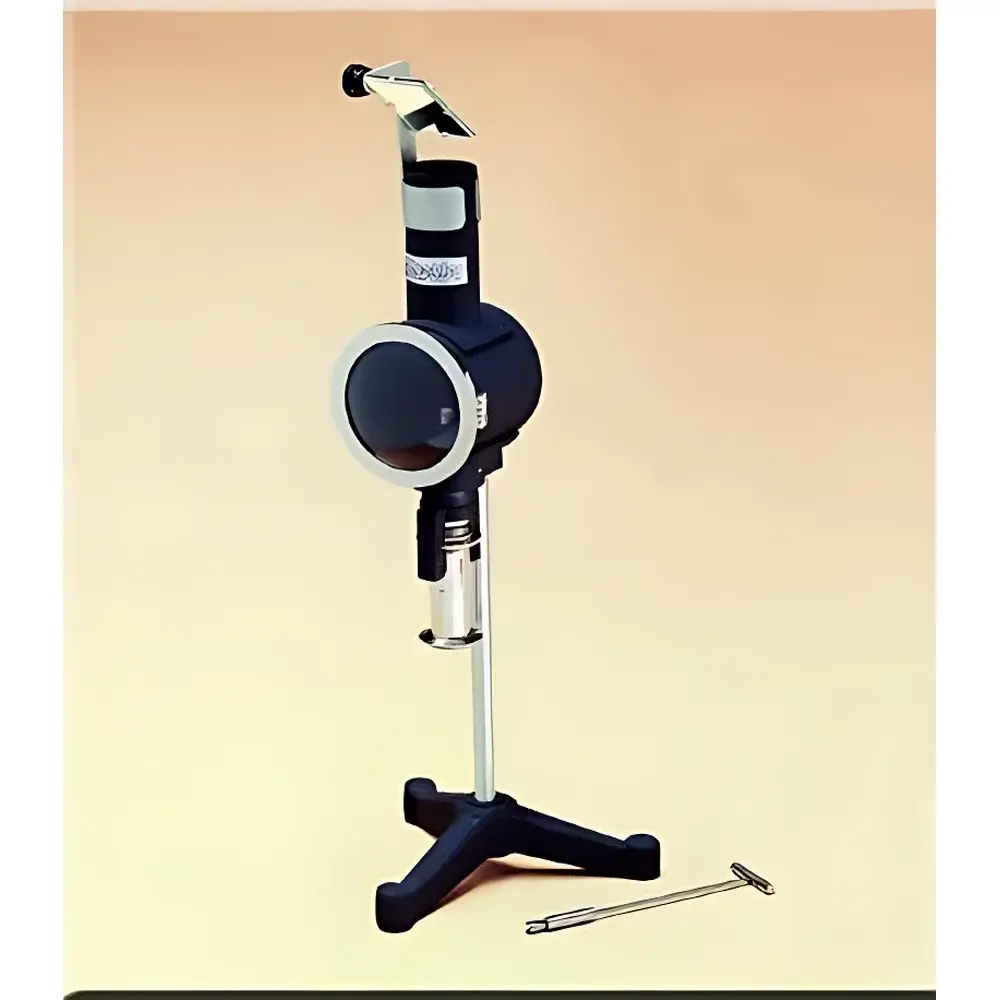
Koehler K27000 Smoke Point Tester (ASTM D1322 / ISO 3014)
| Brand | Koehler |
|---|---|
| Origin | USA |
| Model | K27000 |
| Standards Compliance | ASTM D1322, ISO 3014 |
| Dimensions | 18 cm Ø × 47 cm H |
| Net Weight | 4.5 kg |
| Construction | Brass lamp body, copper-plated viewing window, adjustable aluminum base, calibrated 0–50 mm black glass scale, cotton wick assembly with air vent, candle socket |
Overview
The Koehler K27000 Smoke Point Tester is a precision manual instrument engineered for the standardized determination of smoke point in aviation turbine fuels, kerosene, and related hydrocarbon distillates. Smoke point—defined as the maximum flame height, in millimeters, at which a fuel burns without producing visible smoke under controlled laboratory conditions—is a critical indicator of combustion cleanliness and hydrocarbon composition. The K27000 implements the classical wick-lamp method specified in ASTM D1322 and ISO 3014, where a standardized cotton wick draws fuel vertically by capillary action, and the flame is adjusted incrementally until the onset of smoke is visually detected against a calibrated black glass scale. This gravimetric–optical methodology remains the reference test for regulatory compliance, refinery quality control, and fuel specification validation across global aviation and military logistics supply chains.
Key Features
- Full compliance with ASTM D1322 “Standard Test Method for Smoke Point of Kerosine and Aviation Turbine Fuel” and ISO 3014 “Petroleum products — Determination of smoke point”
- Robust brass lamp body with corrosion-resistant copper-plated viewing window for consistent optical observation and long-term dimensional stability
- Precision-machined 0–50 mm black glass scale mounted in fixed vertical alignment, enabling repeatable flame-height measurement to ±0.5 mm resolution
- Adjustable aluminum base with fine-thread elevation mechanism for precise leveling and reproducible wick positioning relative to the burner orifice
- Dedicated cotton wick assembly featuring standardized porosity and integrated air venting to ensure uniform fuel vaporization and laminar flame geometry
- Compact benchtop footprint (18 cm diameter × 47 cm height) and lightweight design (4.5 kg net) for ease of transport between laboratories or field testing stations
Sample Compatibility & Compliance
The K27000 is validated for use with transparent, low-viscosity liquid hydrocarbon fuels including Jet A, Jet A-1, JP-5, JP-8, commercial kerosene, and synthetic paraffinic kerosene (SPK). It is not intended for use with fuels containing suspended particulates, high aromatic content beyond specification limits, or significant oxygenate blending (e.g., ethanol or fatty acid methyl esters), as these may interfere with wick performance or flame stability. All operational procedures align with Good Laboratory Practice (GLP) documentation requirements, and test records generated using the K27000 are admissible in audits supporting ISO/IEC 17025 accreditation, FAA Advisory Circular AC 20-129, and NATO AEP-69 fuel certification protocols.
Software & Data Management
As a manually operated, non-electronic instrument, the K27000 does not incorporate embedded firmware, digital interfaces, or data logging capabilities. Measurements are recorded directly by the analyst using the calibrated glass scale and documented in laboratory notebooks or LIMS-compatible electronic worksheets. This analog architecture ensures full traceability, eliminates software validation burdens under FDA 21 CFR Part 11, and supports audit-ready paper-based or hybrid recordkeeping systems compliant with ASTM E2500 and ISO/IEC 17025 clause 7.7 (result reporting). Users may integrate K27000-generated smoke point values into automated QA/QC dashboards via manual entry or CSV import workflows.
Applications
- Quality assurance testing of aviation turbine fuel prior to delivery to airports or military depots
- Refinery process monitoring during kerosene fractionation and hydrotreating operations
- Contractual verification of fuel conformance to DEF STAN 91-91, MIL-DTL-83133, and ASTM D1655 specifications
- Research into hydrocarbon composition effects on sooting tendency and combustion efficiency
- Training laboratories for ASTM method instruction and interlaboratory proficiency testing programs
- Third-party inspection agencies performing independent fuel certification per IATA Dangerous Goods Regulations Annex 18
FAQ
What standards does the K27000 support?
ASTM D1322 and ISO 3014 are fully supported; the instrument’s geometry, wick configuration, and scale calibration meet all physical requirements defined in both methods.
Is the K27000 suitable for biodiesel-blended fuels?
No—biodiesel blends (e.g., B5 or higher) alter wick saturation kinetics and flame luminosity, leading to non-representative smoke point readings; use only with conventional petroleum-derived kerosine-type fuels.
Does the K27000 require electrical power or gas supply?
No—it operates entirely without external utilities; ignition is performed using a standard laboratory match or spark igniter, and combustion is self-sustaining via capillary feed.
How often must the wick be replaced?
Per ASTM D1322 Section 7.3, a new wick must be used for each test to prevent carbon buildup and ensure consistent capillary rise; wicks are supplied as consumables (Koehler P/N K-27000-WICK).
Can the K27000 be used for flash point or fire point testing?
No—smoke point is a distinct physical parameter measured under different thermal and aerodynamic conditions; flash point requires a closed-cup apparatus (e.g., Pensky-Martens) per ASTM D93 or ISO 2719.







