
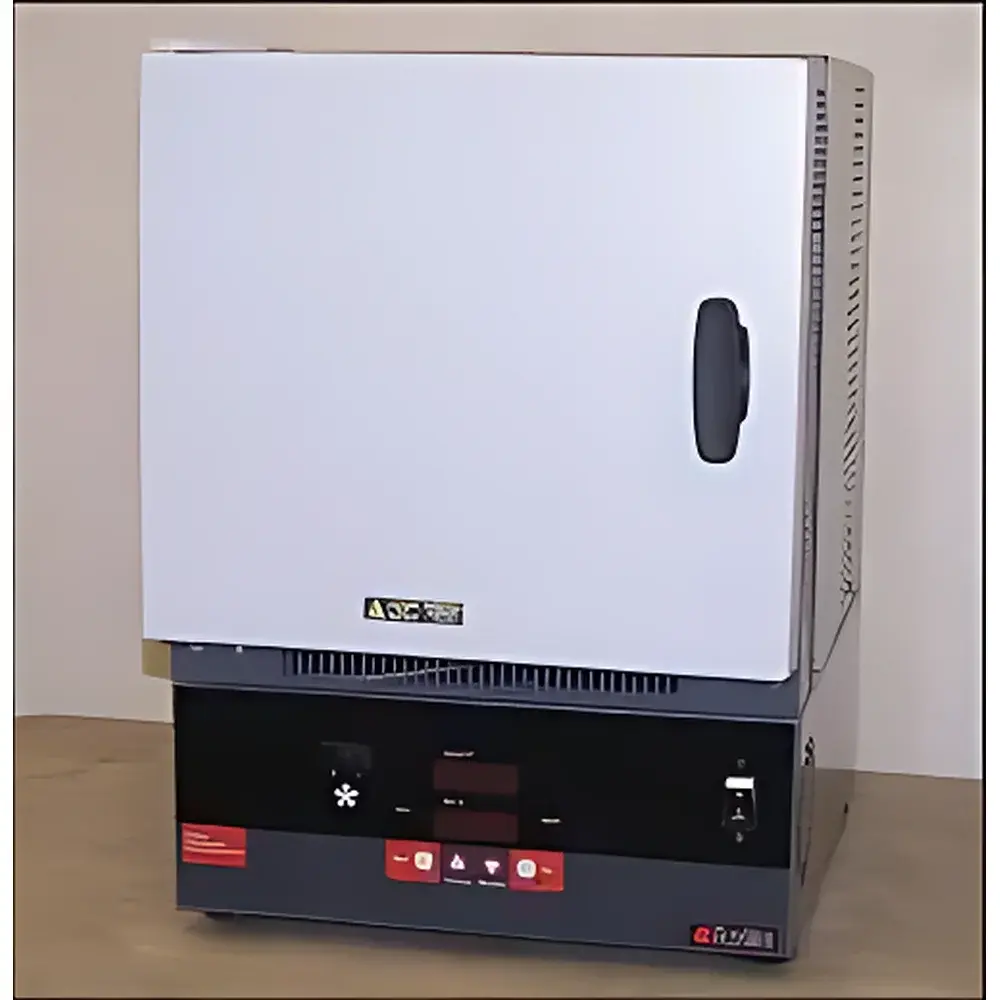
Koehler K24110 / K24120 / K24130 Programmable Muffle Furnace for Petroleum Ash Content Determination
| Brand | Koehler |
|---|---|
| Origin | USA |
| Model | K24110, K24120, K24130 |
| Temperature Range | Ambient to 1125°C |
| Setpoint Repeatability | ±1°C |
| Setpoint Accuracy | ±4°C |
| Temperature Uniformity (K24110/K24120/K24130) | ±5°C / ±8°C / ±10°C |
| Chamber Volume | 4 L / 16 L / 36 L |
| Air Exchange Rate | 2–4 complete exchanges per minute |
| Compliance | ASTM D482, D874, D1026, D3174, D4422 |
Overview
The Koehler K24110, K24120, and K24130 Programmable Muffle Furnaces are precision-engineered thermal instruments designed specifically for standardized ash content determination in petroleum products—including distillate fuels, residual fuels, gas turbine fuels, crude oil, lubricating oils, and paraffinic waxes—per ASTM, ISO, DIN, and NF methodologies. These furnaces operate on the principle of controlled high-temperature combustion in an oxidizing atmosphere, enabling quantitative residue (ash) measurement after volatile matter and carbonaceous matrix are fully volatilized. Unlike general-purpose ovens, each model integrates forced-air ventilation, programmable multi-step thermal profiles, and microprocessor-based temperature regulation to ensure reproducible ignition, calcination, and cooling cycles essential for regulatory compliance and inter-laboratory comparability.
Key Features
- Programmable thermal sequencing with up to 12 independent heating/cooling segments or hold steps per method—enabling full automation of ASTM D482 (ash in petroleum products), D874 (sulfated ash), D1026 (ash in coal and coke), D3174 (ash in coal and coke by ultimate analysis), and D4422 (ash in used lubricating oils)
- Forced-air convection system delivering 2–4 complete air exchanges per minute—critical for consistent oxidation kinetics and elimination of localized reducing zones during ash formation
- Microprocessor-controlled PID temperature regulation with ±1°C setpoint repeatability and ±4°C absolute accuracy across the full 25–1125°C operating range
- Three chamber volume options (4 L, 16 L, 36 L) optimized for sample throughput and thermal mass requirements—each validated for temperature uniformity (±5°C, ±8°C, ±10°C respectively) per ASTM E1142 and ISO/IEC 17025 calibration guidelines
- Rugged ceramic-fiber insulation and corrosion-resistant stainless-steel interior construction—designed for long-term exposure to sulfur-rich combustion byproducts and halogenated residues
- Integrated safety interlocks including overtemperature cutoff, door-open shutdown, and real-time fault logging compliant with IEC 61000-6-2/6-4 EMC standards
Sample Compatibility & Compliance
These furnaces accommodate a broad spectrum of sample forms: crucibles (porcelain, platinum, silica), filter papers, petri dishes, and pre-weighed ash pans—compatible with both gravimetric and sulfated ash protocols. They meet the physical and procedural requirements of multiple international standards bodies: ASTM International (D482, D874, D1026, D3174, D4422), ISO (3987 for petroleum ash, 6245 for solid mineral fuels), DIN (51352 for lubricants, 51575 for coal), and French standard NF M 07-045. The design satisfies IP4 and IP163 ingress protection ratings for dust resistance and limited liquid exposure, supporting GLP-compliant operation in QC laboratories. All models support audit-ready documentation when paired with Koehler’s optional data acquisition module (K-DAQ), fulfilling traceability requirements under FDA 21 CFR Part 11 and ISO/IEC 17025 clause 7.7.
Software & Data Management
While the base units operate via intuitive front-panel interface with tactile keypad and LCD display, optional integration with Koehler K-DAQ software enables PC-based method programming, real-time temperature profiling, automated data export (CSV, PDF), and electronic signature capture. All thermal events—including ramp rates, dwell times, ambient compensation, and alarm triggers—are timestamped and stored locally with non-volatile memory retention (>10,000 cycles). The system supports configurable audit trails, user access levels (administrator/operator), and exportable calibration certificates aligned with ISO/IEC 17025 Annex A.2 requirements for measurement uncertainty estimation.
Applications
Beyond petroleum ash testing, these furnaces serve as versatile high-temperature platforms for diverse analytical and preparatory workflows: quantitative residue analysis in pharmaceutical excipients (USP ), inorganic ash evaluation in food matrices (AOAC 942.05), ceramic sintering (ASTM C20), glass annealing (ASTM C142), rock/mineral fusion (ASTM D3682), moisture-free drying of hygroscopic solids, and heat-treatment of metallurgical samples. Their stable thermal architecture and programmable cooling profiles make them suitable for controlled thermal decomposition studies requiring precise kinetic control.
FAQ
Which ASTM methods are directly supported by the K241xx series?
ASTM D482, D874, D1026, D3174, and D4422—all specifying muffle furnace parameters for ash content determination in hydrocarbon-based materials.
Can the K24120 be used for sulfated ash testing per USP ?
Yes—its programmable multi-stage heating profile, forced-air ventilation, and temperature stability meet USP requirements for sulfate ash quantification in drug substances and excipients.
Is temperature uniformity validated across the entire chamber volume?
Yes—each model undergoes factory validation using 9-point thermocouple mapping per ASTM E1142, with uniformity specifications published in the Certificate of Conformance (±5°C for K24110, ±8°C for K24120, ±10°C for K24130).
What electrical configurations are available for global deployment?
All models support dual-voltage input (208/240 V AC) and dual-frequency operation (50/60 Hz), with current draw ranging from 7.1 A (K24110) to 19.2 A (K24140); CE, UKCA, and RoHS declarations are provided upon request.
Does the furnace include GLP/GMP-compliant data integrity features?
With optional K-DAQ software, the system delivers electronic records, audit trails, role-based access control, and 21 CFR Part 11–compliant electronic signatures—fully aligned with laboratory quality management systems.





