Koehler K72000 Cleveland Open Cup Flash Point Tester
| Brand | Koehler |
|---|---|
| Origin | USA |
| Manufacturer Status | Authorized Distributor |
| Origin Category | Imported |
| Model | K72000 |
| Detection Method | Cleveland Open Cup (COC) |
| Operation Mode | Fully Automated |
| Temperature Range | Ambient to 405°C |
| Ignition Sources | Electric Spark and Gas Flame |
| Repeatability | ±1°C |
| Compliant Standards | ASTM D92, GB/T 3536, IP 36/403, ISO 2592, AFNOR T60-118, EN 22592, DIN 51376 |
Overview
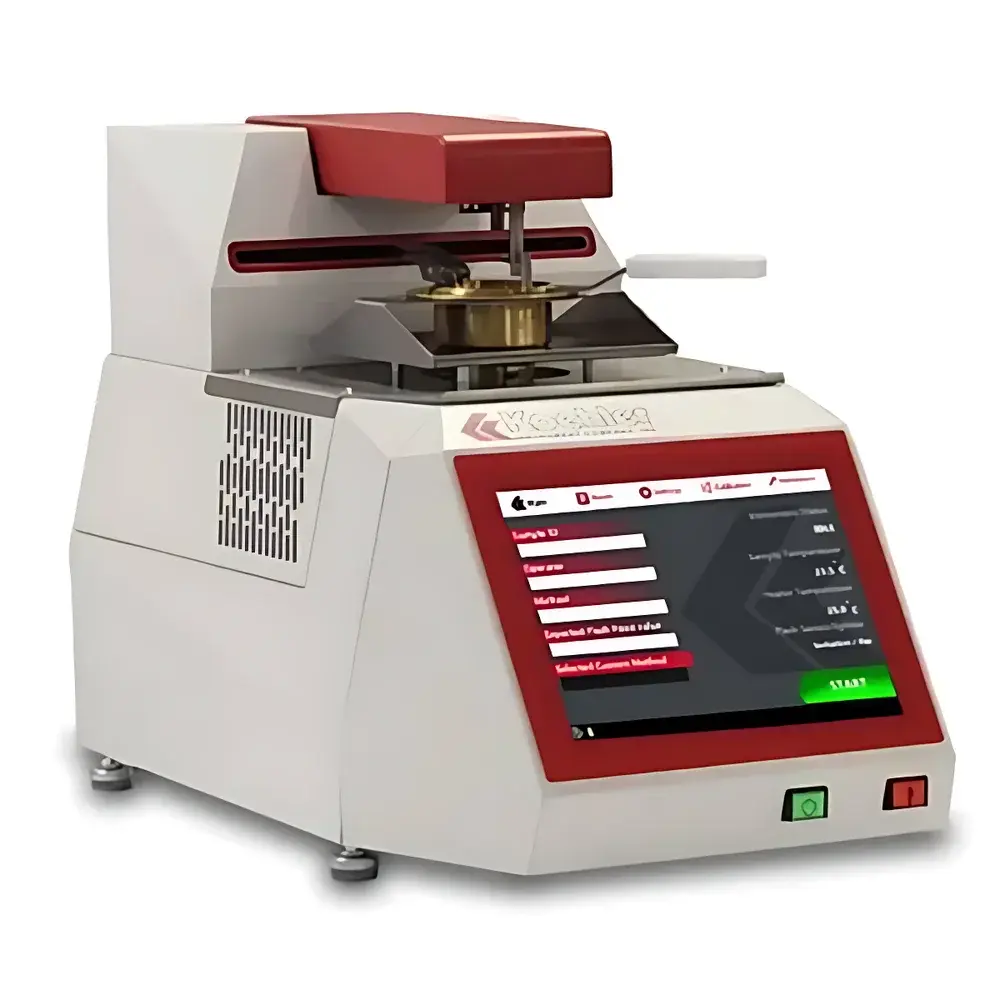
The Koehler K72000 Cleveland Open Cup Flash Point Tester is a fully automated, microprocessor-controlled instrument engineered for precise determination of flash point and fire point of petroleum products—including lubricating oils, residual fuels, bituminous materials, and other viscous or high-boiling hydrocarbons—according to the Cleveland Open Cup (COC) method. Based on the fundamental principle of thermal equilibrium and vapor-phase ignition detection, the instrument heats a standardized test cup under controlled conditions while periodically introducing an ignition source across the specimen surface. Flash point is identified as the lowest temperature at which vapors above the sample ignite momentarily upon exposure to the flame or spark; fire point is recorded when sustained combustion occurs for at least 5 seconds. Designed to meet the stringent procedural requirements of ASTM D92 and its internationally harmonized equivalents (e.g., ISO 2592, GB/T 3536), the K72000 delivers metrologically traceable results with high reproducibility and minimal operator intervention.
Key Features
- Fully automated test execution—from cup loading and heating ramp to ignition scanning and endpoint detection—reducing human error and improving inter-laboratory consistency.
- 10.4-inch high-resolution LCD touchscreen interface with intuitive graphical user interface (GUI), enabling real-time monitoring of temperature profile, ignition events, atmospheric pressure correction, and pass/fail status—all displayed on a single screen.
- Dual ignition system: integrated electric spark igniter and adjustable gas flame igniter, both compliant with ASTM D92 geometry and positioning tolerances.
- Two-position mechanical lift arm for precise vertical movement of the igniter and smoke extinguisher, controlled via software-driven actuation for repeatable alignment.
- Integrated dual-fan cooling system for rapid post-test cooldown of the test cup and surrounding chamber, minimizing turnaround time between analyses.
- Automatic barometric pressure compensation using a built-in digital pressure sensor, ensuring accurate flash point correction per ASTM D92 Annex A1 without manual input.
- Active flame suppression system: inert gas (typically nitrogen or CO₂) is automatically discharged over the test cup upon detection of uncontrolled combustion, meeting OSHA and laboratory safety protocols.
- Robust thermal architecture with PID-controlled heating element and calibrated platinum RTD sensor (Class A tolerance), maintaining temperature stability within ±0.5°C during critical ramp phases.
Sample Compatibility & Compliance
The K72000 accommodates standard Cleveland open cup specimens (65–70 mL volume) across a broad viscosity range—from low-volatility base oils to heavy residual fuels (e.g., No. 6 fuel oil). It is validated for use with samples having initial flash points ≥79°C, in accordance with ASTM D92 scope limitations. Instrument compliance extends beyond basic method adherence: it supports GLP/GMP documentation workflows through audit-trail-enabled software logging (user actions, calibration events, test parameters, raw temperature/time data). All firmware and control logic are designed to support FDA 21 CFR Part 11 readiness when deployed with appropriate network authentication and electronic signature configurations. Routine verification follows ASTM D6117 and Koehler’s internal IQ/OQ protocols.
Software & Data Management
Embedded Linux-based operating system powers the onboard controller, delivering deterministic real-time response during critical ignition cycles. Test methods are preloaded—including ASTM D92 standard program (2°C scan interval), fast-scan mode (5°C), and customizable ramp profiles (1–5°C increments). Results—including flash point, fire point, atmospheric pressure, ambient temperature, and test duration—are timestamped and stored locally on a secure 32 GB industrial-grade SSD. Data export options include CSV via USB 2.0 ports (2×), RS-232 serial output for legacy LIMS integration, and Ethernet (10/100BASE-T) for TCP/IP communication with centralized laboratory informatics platforms. Optional Koehler LabLink™ software enables remote monitoring, batch reporting, and trend analysis across multiple instruments.
Applications
- Quality control of lubricants, cylinder oils, and marine distillate fuels in refinery QC labs.
- Specification conformance testing for ASTM D975 (diesel fuel), D396 (fuel oils), and D2880 (gas turbine fuels).
- Research and development of alternative fuels, including bio-oils and pyrolysis liquids, where thermal stability and volatility profiling are critical.
- Regulatory submission testing for EPA, IMO MARPOL Annex VI, and national petroleum product registration programs.
- Third-party certification laboratories requiring ISO/IEC 17025-compliant instrumentation with documented uncertainty budgets and traceable calibration records.
FAQ
What standards does the K72000 explicitly support?
ASTM D92, GB/T 3536, ISO 2592, IP 36 and IP 403, EN 22592, AFNOR T60-118, and DIN 51376.
Is manual ignition adjustment required during testing?
No—the instrument performs automatic igniter positioning and timing per ASTM D92 specifications; no manual calibration or repositioning is needed between tests.
How is atmospheric pressure measured and applied?
An integrated digital barometric sensor continuously monitors ambient pressure and applies real-time correction to flash point values using the algorithm defined in ASTM D92 Annex A1.
Can test data be exported to LIMS without third-party middleware?
Yes—via native RS-232 ASCII output or Ethernet TCP socket streaming, supporting direct ingestion into most modern LIMS architectures.
What safety certifications does the instrument carry?
CE marking (EMC and Low Voltage Directive), UL/cUL listed for electrical safety, and compliance with IEC 61010-1 for laboratory equipment.