
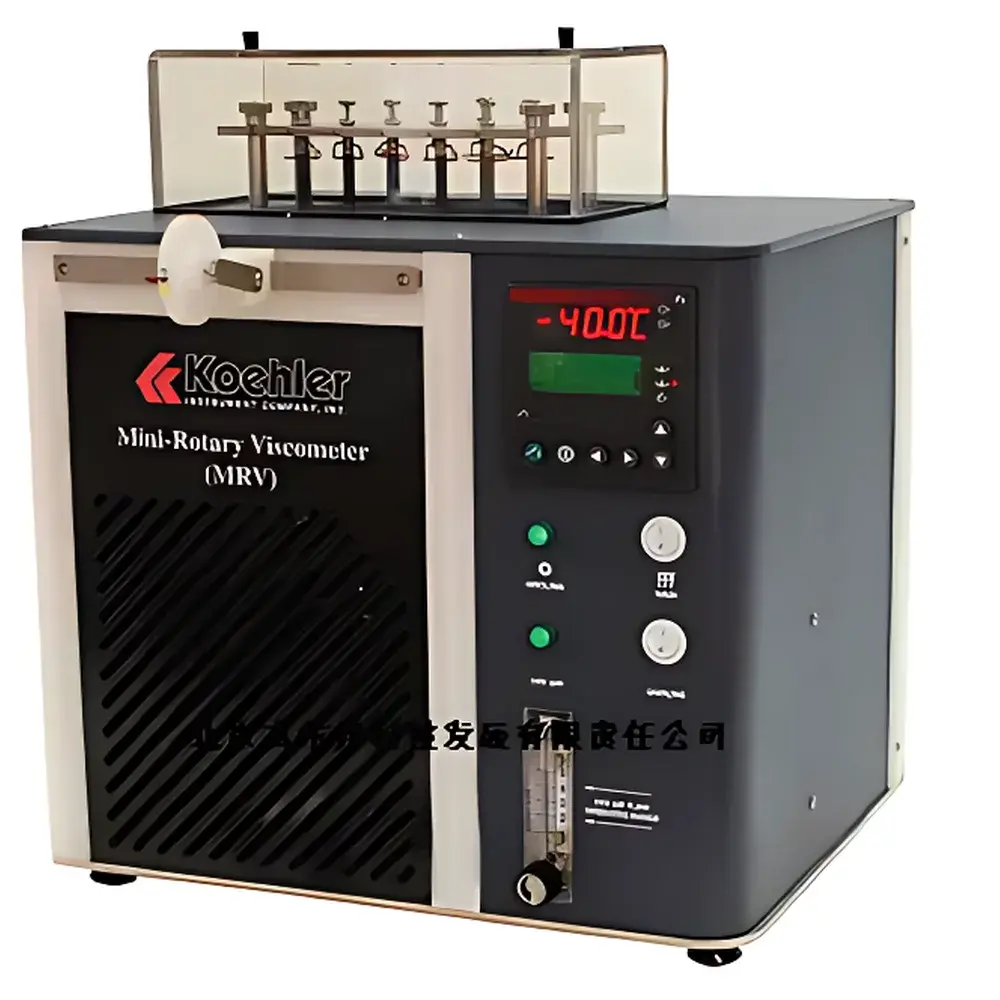
Koehler K38590 Engine Oil Borderline Pumping Temperature (BPT) Yield Stress and Apparent Viscosity Tester
| Brand | Koehler |
|---|---|
| Origin | USA |
| Manufacturer Authorization | Authorized Distributor |
| Product Origin | Imported |
| Model | K38590 |
| Pricing | Upon Request |
Overview
The Koehler K38590 Engine Oil Borderline Pumping Temperature (BPT) Yield Stress and Apparent Viscosity Tester is an engineered solution for determining the low-temperature flow behavior of engine oils under simulated crankcase pumping conditions. It operates on the principle of controlled shear rheometry in a defined geometry—specifically, a concentric cylinder (Couette-type) configuration—under precisely regulated thermal gradients. The instrument measures both yield stress (the minimum stress required to initiate flow) and apparent viscosity at temperatures approaching the borderline pumping temperature, where oil transitions from a pumpable fluid to a quasi-solid state. This measurement directly correlates with an engine’s ability to circulate oil during cold-start conditions, thereby informing compliance with OEM specifications and industry standards such as SAE J300 and ASTM D4684.
Key Features
- Integrated thermoelectric cooling system eliminates reliance on hazardous liquid cryogens (e.g., methanol or ethanol baths), ensuring operational safety and reducing maintenance overhead.
- Self-contained heating and cooling architecture—no external chillers, compressors, or auxiliary refrigeration units required.
- 10-position sample carousel enables unattended sequential testing of multiple specimens, improving throughput in QC and R&D laboratories.
- Dedicated rotor design minimizes interference from ice nucleation and water condensation, critical for reproducible low-temperature rheological assessment.
- Modular test cup assembly with quick-release mechanism facilitates rapid cleaning, solvent rinsing, and sample loading—reducing cross-contamination risk and turnaround time.
- Microprocessor-based temperature controller stores full test protocols—including ramp rates, dwell times, shear rate profiles, and target setpoints—for traceable method execution.
- Internal dry gas purge system maintains a moisture-free environment within the test chamber, preventing frost formation and ensuring stable thermal boundary conditions.
- Intelligent power recovery logic allows resumption of interrupted tests following brief power loss (<30 seconds), preserving data continuity and regulatory compliance.
- Multi-layer safety interlocks monitor pressure, temperature, and motor current; automatic shutdown occurs upon detection of overpressure, thermal runaway, or mechanical stall.
Sample Compatibility & Compliance
The K38590 is validated for use with conventional, synthetic, and high-performance engine oils—including those formulated with viscosity index improvers (VIIs) and low-SAPS additives. It supports testing per ASTM D4684 (Standard Test Method for Determination of Yield Stress and Apparent Viscosity of Engine Oils at Low Temperature), ASTM D3829 (Standard Test Method for Predicting the Borderline Pumping Temperature of Engine Oils), ASTM D6896 (Standard Test Method for Determination of Low-Temperature Viscosity of Engine Oils by Cold-Cranking Simulator), and ASTM D6821 (Standard Test Method for Determination of Borderline Pumping Temperature Using a Rotational Viscometer). Note: ASTM D6821 implementation requires optional drive module (K38590-D6821). The system also aligns with SAE J300 viscosity classification requirements and supports GLP-compliant documentation when paired with Koehler’s optional data software package.
Software & Data Management
An optional Koehler Data Acquisition and Analysis Software Suite is available for comprehensive test management. The software provides audit-trail functionality compliant with FDA 21 CFR Part 11 requirements—including electronic signatures, user access levels, and immutable record storage. It supports automated report generation in PDF and CSV formats, trend analysis across batches, and direct integration with LIMS environments via standard OPC UA or CSV export. All raw torque, rotational speed, temperature, and time-stamped data points are retained with metadata (operator ID, method version, calibration status), satisfying ISO/IEC 17025 documentation expectations for accredited testing laboratories.
Applications
- Formulation development of low-temperature engine oils for passenger car and heavy-duty applications.
- Quality control verification of finished lubricants prior to release.
- Regulatory submission support for OEM approval processes (e.g., GM dexos®, Ford WSS-M2C945-A, MB 229.5).
- Root-cause analysis of cold-cranking failures and oil gelling incidents.
- Stability evaluation of VIIs and pour point depressants under extended low-temperature exposure.
- Interlaboratory round-robin studies requiring high inter-operator reproducibility (RSD <3% per ASTM D4684 repeatability criteria).
FAQ
Does the K38590 require external refrigeration equipment?
No. Its integrated thermoelectric cooling system delivers precise sub-zero temperature control without liquid cryogens or external chillers.
What is the lowest temperature achievable during BPT testing?
The system achieves stable operation down to –40 °C, with programmable ramping and isothermal holds per ASTM D4684 protocol requirements.
Can the instrument be used for both yield stress and apparent viscosity measurements in a single run?
Yes. The K38590 executes sequential yield stress determination followed by apparent viscosity sweep at the same temperature, fully automating the D4684 workflow.
Is calibration traceable to NIST standards?
All torque and temperature sensors are supplied with NIST-traceable calibration certificates; periodic recalibration services are available through Koehler-authorized service centers.
How does the dry gas purge system enhance measurement reliability?
By maintaining a dew-point-controlled inert atmosphere inside the test chamber, it prevents surface icing on the rotor and cup—eliminating spurious torque spikes and ensuring consistent shear history.






