
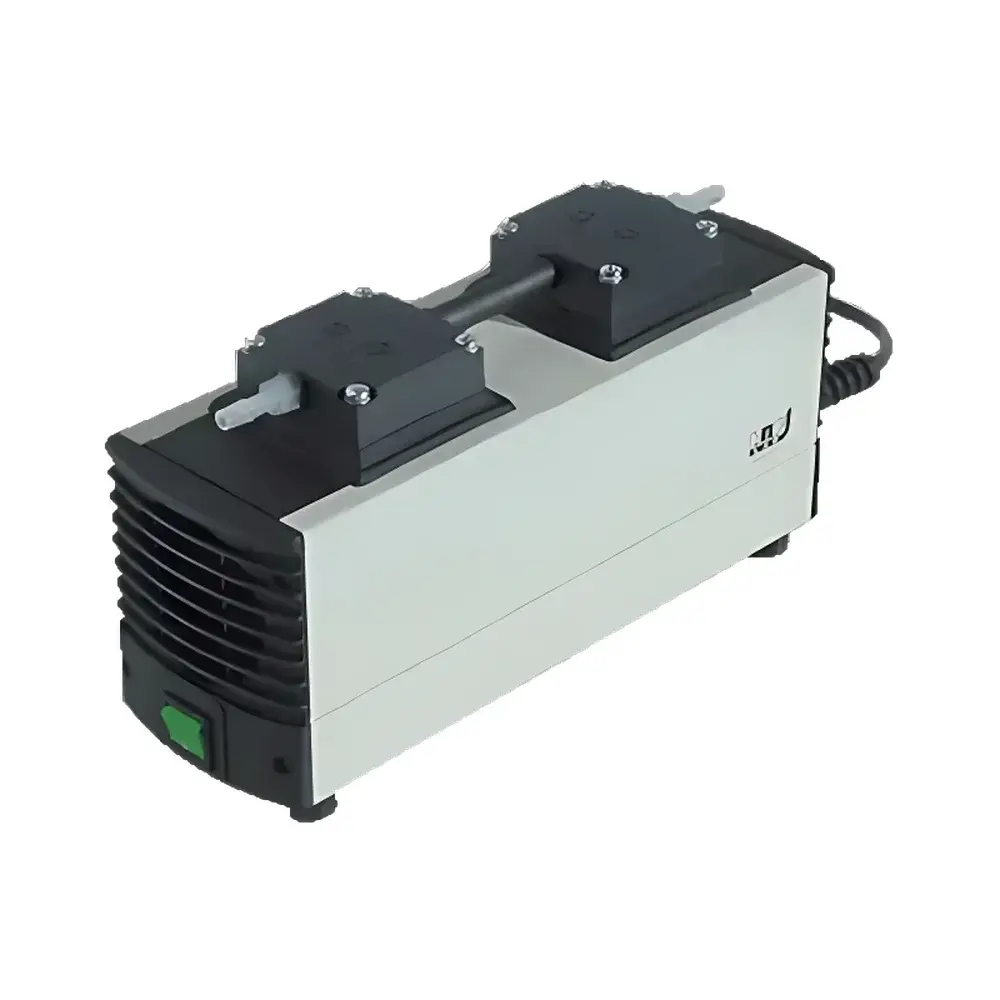
KNF N816.3KT.18 Diaphragm Vacuum Pump
| Brand | KNF |
|---|---|
| Origin | Germany |
| Pump Type | Oil-Free Diaphragm Vacuum Pump |
| Model | N816.3KT.18 |
| Ultimate Vacuum | 20 mbar |
| Flow Rate | 16 L/min |
| Motor Power | 100 W |
| Dimensions (L×W×H) | 361 × 90 × 141 mm |
| Weight | 3.95 kg |
| Diaphragm Material | PTFE-Coated |
| Valve Material | FFPM |
| Housing Material | PPS |
| Inlet/Outlet Port Size | 6 mm (G¼") |
| Continuous Duty Rating | Yes |
| Vacuum Gauge Option | Integrated (indicated by ".45" suffix in variant nomenclature) |
Overview
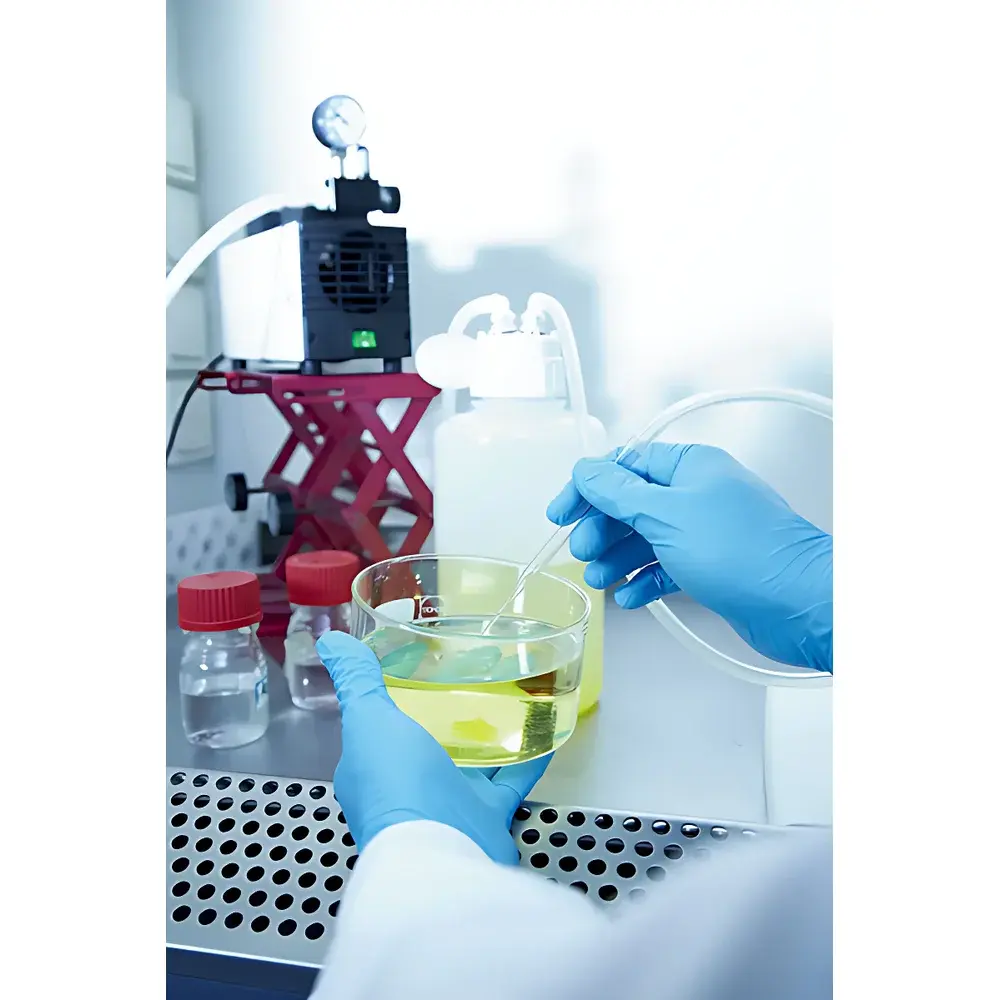
The KNF N816.3KT.18 is a compact, oil-free diaphragm vacuum pump engineered for precision and reliability in demanding laboratory environments. Based on positive displacement principle using elastomeric diaphragms actuated by an eccentric cam mechanism, it generates vacuum through cyclic expansion and contraction of the pumping chamber—eliminating lubricants, hydrocarbon contamination, and maintenance associated with rotary vane or water aspirator systems. Designed specifically for applications requiring clean, chemically resistant vacuum generation—including rotary evaporation, solvent recovery, vacuum filtration, degassing, and controlled-pressure drying—the N816.3KT.18 delivers stable ultimate vacuum down to 20 mbar with a nominal flow rate of 16 L/min at atmospheric inlet pressure. Its robust polyphenylsulfone (PPS) housing, PTFE-coated diaphragm, and perfluoroelastomer (FFPM) valves ensure compatibility with a broad spectrum of organic solvents, weak acids, and alkaline vapors without degradation or permeation.
Key Features
- Oil-free operation ensures zero risk of sample contamination and eliminates routine oil changes or disposal concerns.
- PTFE-coated diaphragm and FFPM valve materials provide exceptional chemical resistance to common laboratory solvents (e.g., acetone, ethanol, ethyl acetate), dilute acids (e.g., acetic, phosphoric), and mild bases.
- Compact footprint (361 × 90 × 141 mm) and low mass (3.95 kg) enable seamless integration beneath fume hoods, inside gloveboxes, or adjacent to rotary evaporators and filtration manifolds.
- Thermally optimized 100 W brushless motor supports uninterrupted 24/7 operation without thermal cut-out—critical for unattended overnight solvent recovery or long-duration degassing protocols.
- Integrated analog vacuum gauge (denoted by “.45” in KNF’s optional configuration nomenclature) enables real-time pressure monitoring and manual regulation via built-in needle valve or external controller interface.
- Vibration-damped mounting and acoustic enclosure design achieve sound pressure levels <45 dB(A) at 1 m—suitable for shared lab spaces and noise-sensitive analytical workflows.
Sample Compatibility & Compliance
The N816.3KT.18 is validated for use with non-explosive, non-corrosive-to-FFPM/PTFE vapors under ambient temperature conditions (5–40 °C). It complies with IEC 61000-6-3 (EMC emission standards) and IEC 61000-6-2 (immunity), and meets CE marking requirements for laboratory equipment within the EU Machinery Directive 2006/42/EC. While not intrinsically safe for ATEX Zone 1 environments, its oil-free architecture aligns with GLP-compliant vacuum system design principles where trace hydrocarbon interference must be excluded—particularly relevant in pharmaceutical residual solvent analysis (ICH Q3C), environmental VOC sampling preparation, and polymer solution degassing prior to rheological characterization. KNF provides full material declarations (RoHS, REACH SVHC) and test reports upon request for audit readiness.
Software & Data Management
As a standalone analog vacuum source, the N816.3KT.18 does not incorporate digital control firmware or native USB/Ethernet connectivity. However, it is fully compatible with third-party vacuum controllers (e.g., Vacuubrand VACUU·SELECT, KNF’s own EC-100 series) that support 0–10 V or 4–20 mA analog input/output for closed-loop pressure regulation and data logging. When integrated into automated systems, its stable flow and repeatable vacuum setpoints support compliance with FDA 21 CFR Part 11 requirements when paired with validated electronic record systems—enabling audit trails for pressure profiles during lyophilization cycle development or solvent removal validation studies.
Applications
- Vacuum-assisted rotary evaporation of heat-sensitive compounds (e.g., natural product isolates, oligonucleotides) where oil backstreaming could compromise purity.
- Gravity or pressure-driven filtration of aqueous and organic suspensions using PTFE or nylon membranes—common in HPLC mobile phase preparation and cell culture supernatant clarification.
- Solvent recovery from distillates via condensation traps, minimizing waste generation and supporting green chemistry objectives (ACS GCI Principles).
- Deaeration of adhesives, coatings, and composite resins prior to casting or curing—reducing void formation and improving mechanical consistency.
- Evacuation of desiccators and vacuum ovens operating below 100 mbar, especially where moisture or solvent vapor load exceeds the capacity of sorption-based systems.
FAQ
Is the N816.3KT.18 suitable for continuous-duty operation?
Yes—its thermally managed motor and high-cycle-life diaphragm assembly are rated for indefinite continuous service at ambient temperatures up to 40 °C without duty-cycle limitation.
Can this pump handle chlorinated solvents such as dichloromethane or chloroform?
No—while PTFE and FFPM offer broad resistance, prolonged exposure to chlorinated hydrocarbons may cause swelling or accelerated aging; consult KNF’s Chemical Compatibility Guide (Ref: KNF-CCG-2023) before deployment.
What is the expected service life of the diaphragm under typical lab usage?
Under standard operating conditions (≤80% of max vacuum, ambient temperature, non-aggressive media), KNF specifies ≥10,000 hours or ~3 years of continuous operation before scheduled replacement.
Does the pump include inlet filtration or exhaust silencing by default?
A particulate inlet filter (KNF part # F-01) and exhaust muffler (KNF part # M-01) are available as optional accessories—not supplied standard—but strongly recommended for extended diaphragm longevity and noise reduction.
How does the N816.3KT.18 compare to water aspirators in terms of sustainability?
It eliminates consumable water use (~1–2 L/min per aspirator), reduces lab wastewater load, avoids freeze-thaw damage risks, and lowers total cost of ownership over 3+ years despite higher initial CAPEX.



