
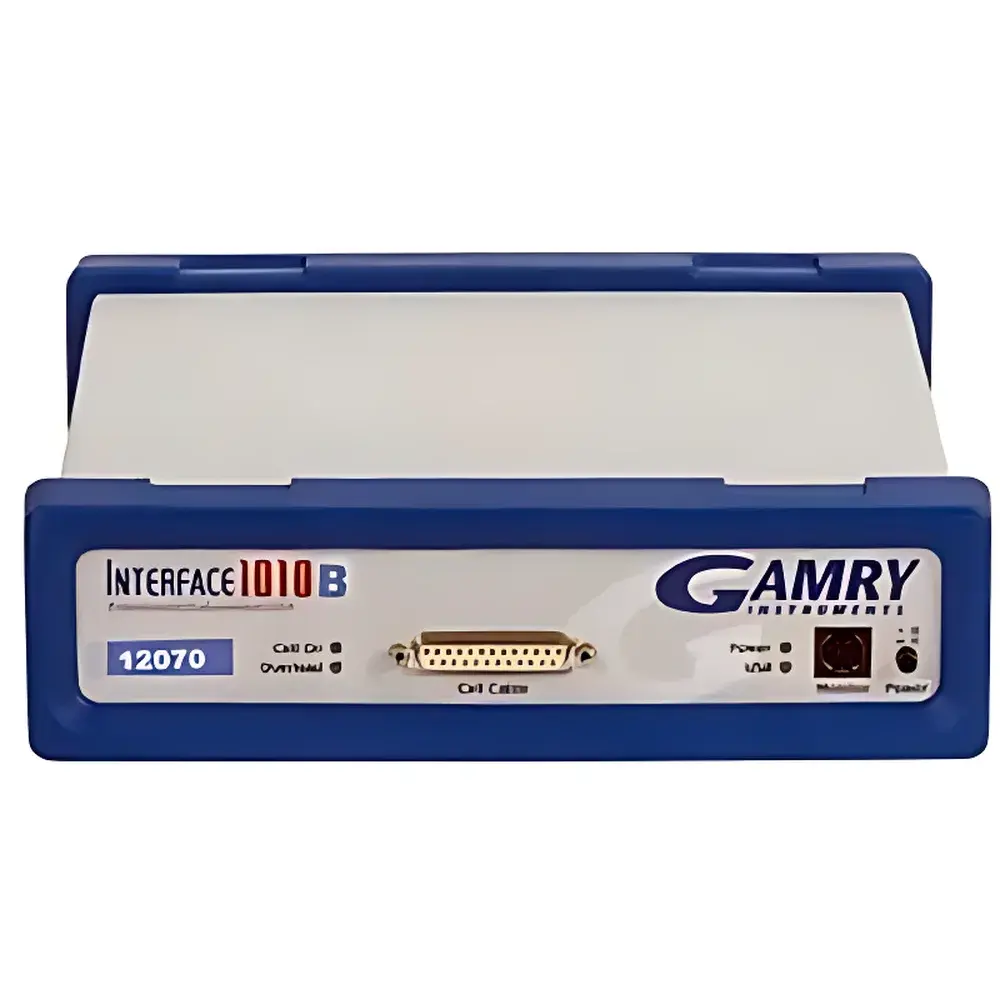
Gamry Interface 1010B Portable Potentiostat/Galvanostat
| Brand | Gamry |
|---|---|
| Origin | USA |
| Model | Interface 1010B |
| Instrument Type | Portable Electrochemical Workstation |
| Current Range | ±1 A |
| Current Accuracy | ±0.2% of reading |
| Potential Accuracy | ±4 mV |
| Potentiostatic Range | ±12 V |
| EIS Frequency Range | 10 µHz – 20 kHz |
| Electrode Configuration | 2-, 3-, and 4-electrode systems |
| Isolation | Galvanically isolated floating ground |
| Weight | 3 kg (6.6 lbs) |
| Connectivity | USB 2.0 (Windows-compatible) |
| Signal Processing | DSP-based oversampling for enhanced SNR and capacitance resolution |
| iR Compensation | Current-interrupt method with auxiliary I/O support |
| Expansion I/O | Analog voltage output, analog current output, external trigger input, digital I/O |
Overview
The Gamry Interface 1010B is a compact, high-fidelity portable potentiostat/galvanostat engineered for rigorous electrochemical characterization in laboratory, field, and educational environments. Built upon Gamry’s proven analog front-end architecture and real-time digital signal processing (DSP), the Interface 1010B implements controlled-potential and controlled-current techniques using classic three-electrode cell configurations—working, reference, and counter—with full galvanic isolation to eliminate ground-loop interference. Its floating-ground design enables stable operation in electrically noisy or high-voltage contexts, including integration with autoclaves, mechanical stress rigs, corrosion probes in pipelines, and battery test fixtures. The instrument supports both DC and AC electrochemical methods, with its core functionality centered on voltammetry, chronoamperometry, chronopotentiometry, and electrochemical impedance spectroscopy (EIS) across a wide dynamic range—from ultra-low frequencies (10 µHz) up to 20 kHz—making it suitable for interfacial kinetic analysis, double-layer capacitance quantification, charge-transfer resistance mapping, and solid-electrolyte interface (SEI) evolution studies.
Key Features
- True bipolar ±1 A current compliance with ±0.2% accuracy—enabling high-current applications such as battery electrode screening and corrosion rate quantification under aggressive polarization conditions.
- ±12 V potentiostatic range with ±4 mV absolute potential accuracy—ensuring reliable control during oxide formation, passivation, and anodic dissolution experiments.
- DSP-driven oversampling architecture that improves signal-to-noise ratio (SNR) by >20 dB and enhances resolution in low-capacitance measurements (e.g., ultramicroelectrodes or thin-film electrodes).
- Integrated current-interrupt iR compensation with auxiliary I/O channels—allowing real-time ohmic drop correction without interrupting data acquisition or requiring external hardware.
- Galvanically isolated floating ground—critical for safe and artifact-free measurements in grounded industrial systems (e.g., pipeline corrosion monitoring, fuel cell stack testing, or high-voltage electrolyzer cells).
- USB 2.0 interface with native Windows driver support—enabling plug-and-play connectivity and deterministic timing for time-critical protocols like pulse voltammetry and fast-scan cyclic voltammetry.
- Expandable I/O subsystem—including analog voltage/current outputs, TTL-compatible digital I/O, and external trigger inputs—for synchronized control of auxiliary equipment (e.g., peristaltic pumps, temperature controllers, or optical spectrometers).
Sample Compatibility & Compliance
The Interface 1010B accommodates standard electrochemical cell geometries (e.g., conventional three-neck flasks, rotating disk electrodes, screen-printed electrodes, and microfluidic chips) and supports all common electrode materials (Pt, Au, GC, carbon paste, Ag/AgCl, SCE). Its hardware and firmware comply with ISO/IEC 17025 traceability requirements for measurement uncertainty reporting, and its software architecture meets essential elements of FDA 21 CFR Part 11 for electronic records and signatures when deployed with appropriate audit trail configuration. Experimental protocols—including ASTM G5, G59, G102, and G106 for corrosion testing; ASTM D1148 for accelerated aging of coatings; and IEC 62660-1 for lithium-ion cell characterization—are natively implemented in Framework software. The system supports GLP-compliant workflows through user-defined method templates, electronic signature enforcement, and immutable raw-data archiving.
Software & Data Management
Controlled via Gamry’s Framework™ software suite (v7.x or later), the Interface 1010B provides a modular, scriptable environment for experiment design, real-time visualization, and post-acquisition analysis. Framework includes pre-validated method libraries for cyclic voltammetry, linear sweep voltammetry, electrochemical impedance spectroscopy (EIS), Mott-Schottky analysis, galvanostatic intermittent titration technique (GITT), and hybrid potentiostatic-galvanostatic cycling. All raw data are stored in open-format .DTA files containing metadata (timestamp, instrument ID, calibration history, operator ID), enabling third-party interoperability with Python (via gamry-parser), MATLAB, or OriginLab. For developers, eChemBasic—a lightweight SDK—provides C# and Python APIs to implement custom waveforms, closed-loop feedback routines, and automated sequence execution—ideal for teaching labs, OEM integrations, or proprietary algorithm validation. Audit trails, user access levels, and electronic signature capture are configurable to meet regulated QC/QA environments.
Applications
- Battery & Energy Storage Research: Charge/discharge profiling, capacity retention tracking, SEI growth kinetics, self-discharge rate quantification, and impedance evolution during cycling.
- Corrosion Science: Polarization resistance (LPR), Tafel analysis, cyclic polarization for pitting susceptibility, galvanic coupling assessment, and electrochemical noise monitoring.
- Sensor Development: Amperometric biosensor calibration, redox mediator optimization, and surface-confined electron transfer kinetics on functionalized electrodes.
- Electrocatalysis: Oxygen reduction reaction (ORR), hydrogen evolution reaction (HER), and CO₂ reduction activity mapping via rotating ring-disk electrode (RRDE) compatible protocols.
- Materials Characterization: Conductive polymer doping/dedoping, metal oxide semiconductor band-edge determination (Mott-Schottky), and porous electrode tortuosity estimation from transmission-line modeling of EIS data.
- Education & Training: Portable platform for undergraduate electrochemistry labs—supporting hands-on instruction in fundamental techniques without requiring dedicated benchtop infrastructure.
FAQ
Is the Interface 1010B suitable for battery cycling tests?
Yes—it supports galvanostatic charge/discharge, potentiostatic hold, and hybrid current/voltage-controlled protocols with programmable rest periods, coulombic efficiency calculation, and voltage cutoff enforcement.
Can it perform EIS on high-impedance samples such as coated metals or biological membranes?
Yes—the 10 µHz lower frequency limit, combined with DSP oversampling and floating-ground isolation, enables robust low-current EIS acquisition on samples with impedances exceeding 100 MΩ.
Does it support four-electrode (Kelvin) measurements?
Yes—its independent sense leads allow true four-terminal potential measurement, eliminating lead resistance artifacts in low-ohmic systems like aqueous electrolytes or conductive composites.
What operating systems are supported?
Windows 10 or 11 (64-bit); no macOS or Linux native drivers are provided, though virtualized Windows environments may be used with performance caveats.
Is calibration traceable to NIST standards?
Yes—each unit ships with a factory calibration certificate referencing NIST-traceable voltage and current standards, and users can perform in-house verification using Gamry’s CalCheck utility.




