
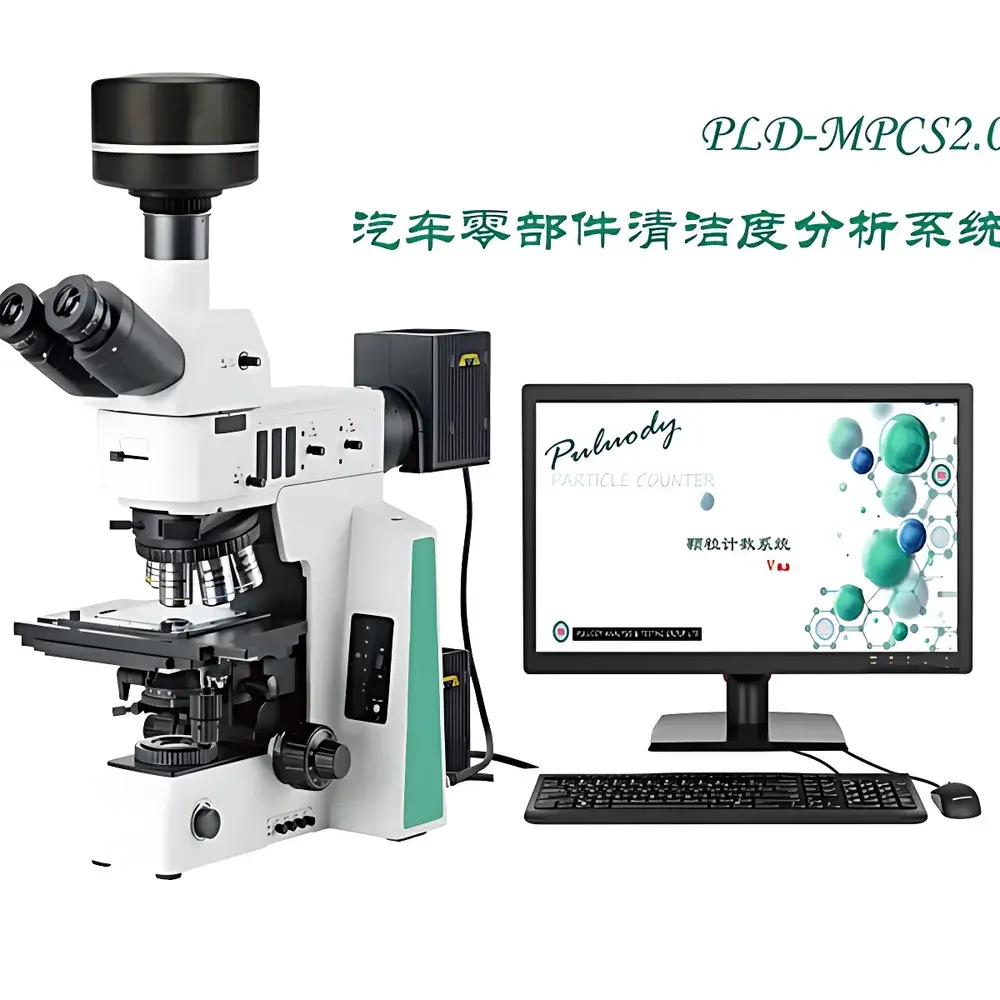
PULUODY PLD-MPCS2.0-1 Microscopic Particle Analysis System
| Brand | PULUODY |
|---|---|
| Origin | Shaanxi, China |
| Manufacturer Type | Authorized Distributor |
| Product Category | Domestic |
| Model | PLD-MPCS2.0-1 |
| Instrument Type | Optical Particle Counter |
| Measurement Principle | Digital Image-Based Microscopy with Polarized Light |
| Detection Range | 1–500 µm |
| Magnification | 40×–1000× |
| Maximum Resolution | 0.1 µm |
| Microscope Accuracy | ±0.02 µm (excluding sample preparation variability) |
| Repeatability Error | < 5% (excluding sample preparation variability) |
| Camera | ≥5 MP CCD sensor |
| Calibration Scale | 0.1 µm per pixel |
| Particle Segmentation Speed | < 1 s per image |
| Segmentation Success Rate | > 93% |
| Software Platform | Windows 2000/XP |
| Interface | RS-232 or USB |
| Compliance | ISO 16232, ISO 4406, VDA 19, GME 7061, GMW 16037, JB/T 7858, GB/T 3821, DL 432 |
Overview
The PULUODY PLD-MPCS2.0-1 Microscopic Particle Analysis System is a research-grade, image-based particle characterization platform engineered for quantitative morphological and dimensional analysis of solid contaminants in fluid-borne and surface-mounted samples. Unlike laser diffraction or light obscuration methods, this system employs high-magnification optical microscopy coupled with polarized illumination and digital image acquisition to resolve individual particles down to 1 µm—enabling direct visualization, material discrimination, and metrological traceability. It implements the ISO 16232-compliant microscopical analysis method for particle size distribution, shape descriptors (e.g., aspect ratio, circularity), and compositional classification (metallic vs. non-metallic) via birefringence under crossed polarizers. Designed for technical cleanliness validation in mission-critical mechanical systems, the PLD-MPCS2.0-1 delivers calibrated, auditable data required for compliance with automotive OEM standards (e.g., GMW 16037, VDA 19), aerospace component qualification, and hydraulic fluid certification per ISO 4406.
Key Features
- Motorized XYZ stage with 0.1 µm step resolution and auto-focus capability for repeatable, multi-field scanning across filter membranes or component surfaces
- Upright polarized-light microscope with 40×–1000× magnification range and calibrated 0.1 µm scale bar embedded in real-time imaging
- ≥5 megapixel monochrome CCD camera optimized for high-contrast particle segmentation under variable lighting conditions
- Automated workflow: auto-exposure control, multi-location field stitching, real-time image capture via RS-232 or USB, and batch processing of filter scans
- Material discrimination module leveraging birefringence response under orthogonal polarizers to classify metallic, ceramic, polymeric, and organic particulates
- Traceable measurement architecture compliant with ISO/IEC 17025 principles—each result includes metadata on magnification, calibration timestamp, operator ID, and instrument configuration
Sample Compatibility & Compliance
The PLD-MPCS2.0-1 supports standardized sampling protocols defined in ISO 16232 Annex B and VDA 19 Section 5. It accommodates membrane filters (e.g., polycarbonate, mixed cellulose ester) ranging from 25 mm to 47 mm diameter, as well as direct imaging of component surfaces (valve bodies, gear housings, fuel injector nozzles) using optional stage adapters. All measurements adhere to the “particle-by-particle” counting paradigm mandated by ISO 4406:2017 and GMW 16037-2017. The system’s software embeds configurable reporting templates aligned with OEM-specific coding schemes (e.g., NAS 1638, ISO 4406 code assignment, VDA 19 cleanliness classes). Audit trails—including raw image archives, parameter logs, and user action timestamps—are retained for GLP/GMP-aligned environments where 21 CFR Part 11 electronic record integrity is required.
Software & Data Management
The proprietary MPCS Analysis Suite runs natively on Windows 2000/XP platforms and provides full control over image acquisition, threshold-based segmentation, feature extraction, and statistical reporting. Algorithms implement ISO 16232-defined particle detection logic—including minimum bounding rectangle, convex hull, and Feret diameter calculation—with customizable noise rejection filters. The software exports ANSI-standard CSV files containing per-particle coordinates, area, perimeter, major/minor axis lengths, aspect ratio, circularity, and birefringence classification flags. Reports comply with ISO 16232-7 requirements for data presentation: cumulative and differential histograms, tabular summaries by size bin (e.g., >4 µm, >6 µm, >14 µm, >25 µm, >50 µm), and maximum particle identification with spatial coordinates. Firmware and application updates are provided free-of-charge for the lifetime of the instrument, with version-controlled release notes and validation documentation available upon request.
Applications
This system is deployed across Tier-1 automotive suppliers and OEM engineering labs for component cleanliness verification of powertrain assemblies (camshafts, crankshafts, transmission valve bodies), hydraulic subsystems (ABS actuators, EPS steering racks, brake caliper bores), and fuel delivery components (injectors, high-pressure pumps, rail manifolds). In aerospace, it supports EASA Part 21G and FAA AC 20-152A compliance testing for turbine engine oil systems and landing gear hydraulic reservoirs. Additional use cases include contamination monitoring in semiconductor slurry filtration, pharmaceutical excipient powder morphology screening, and wear debris analysis in wind turbine gearboxes per IEC 61400-25. Its ability to distinguish fatigue-generated metallic wear particles from environmental dust or sealing elastomer fragments makes it indispensable for root-cause failure analysis.
FAQ
What particle size range can the PLD-MPCS2.0-1 reliably quantify?
It detects and measures particles from 1 µm to 500 µm in equivalent spherical diameter (ESD), with optimal accuracy between 3 µm and 200 µm under 200×–400× magnification.
Does the system support automated ISO 4406 code generation?
Yes—the software calculates particle counts per ISO 4406 size thresholds (≥4 µm(c), ≥6 µm(c), ≥14 µm(c)) and outputs coded contamination levels directly in report headers.
Can it differentiate between ferrous and non-ferrous metallic particles?
While not magnetic sorting, the polarized-light module identifies crystalline anisotropy typical of forged steel, cast iron, and aluminum alloys versus isotropic polymers or oxides—supporting metallurgical inference when correlated with SEM-EDS.
Is the hardware compatible with modern Windows OS versions?
The core imaging engine requires Windows 2000/XP for driver stability; however, exported CSV and PDF reports are fully interoperable with Windows 10/11 and enterprise LIMS platforms via standard file ingestion protocols.
How is measurement uncertainty quantified and documented?
Each analysis session generates a calibration certificate referencing NIST-traceable stage encoders and certified graticules; repeatability is validated per ISO 16232-5 Annex C using reference microsphere standards.



