
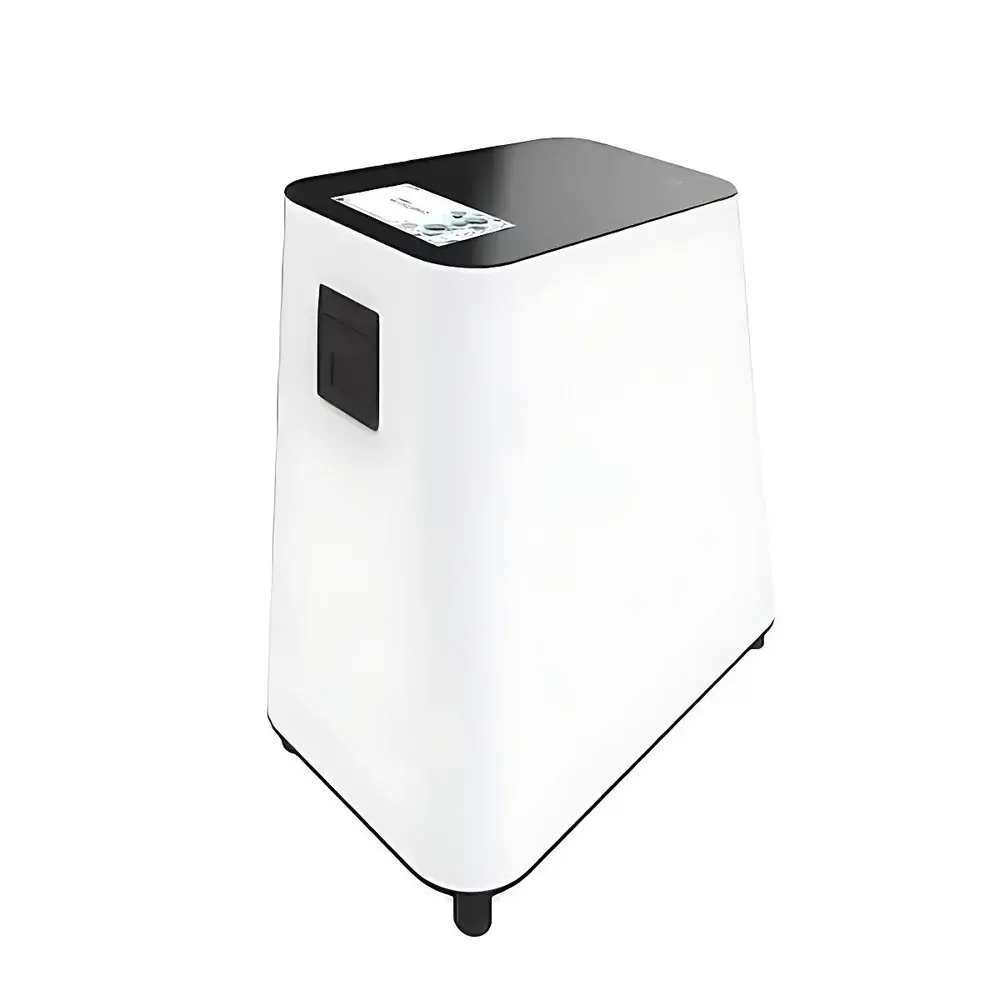

PULUODY TQ-01A Online Membrane Degassing System
| Brand | PULUODY |
|---|---|
| Origin | Shaanxi, China |
| Model | TQ-01A |
| Display | High-resolution LCD touchscreen interface |
| Pre-heating capability | Yes, prior to degassing |
| Fluid delivery accuracy | ±1% of set volume (≥2 L) |
| Volume resolution | 0.1 L |
| Operating temperature range | 35–42 °C (heating optional) |
| Media compatibility | Deionized water, distilled water, aqueous buffers (pH 1–14, non-surfactant) |
| Degassing efficiency | 3.0–5.0 mg/L dissolved oxygen (DO) |
| Flow rate | 1.6 L/min |
| Dimensions (L×H×W) | 500 × 340 × 295 mm |
| Rated power | 1700 W |
| Heating accuracy | ±2 °C |
| Inlet filtration | Optional 40/25/20 µm stainless-steel mesh pre-filter |
| Minimum inlet fluid temperature | ≥18 °C |
| Maintenance design | Modular, tool-free component replacement |
Overview
The PULUODY TQ-01A Online Membrane Degassing System is an engineered solution for continuous, low-oxygen solubilization media preparation in dissolution testing laboratories. It employs hydrophobic hollow-fiber membrane contactor technology to selectively remove dissolved oxygen (DO) from aqueous media—such as purified water, distilled water, and pH-adjusted buffers—without introducing volatile organic contaminants or altering ionic composition. Unlike vacuum-based or sparging methods, membrane degassing operates at ambient pressure and avoids foaming, oxidation of labile analytes, or CO₂ loss in buffered systems. The TQ-01A integrates inline pre-heating (35–42 °C), precision volumetric dispensing, and real-time process monitoring via a high-resolution capacitive touchscreen. Designed for direct integration with USP Apparatus I (basket) and II (paddle) dissolution testers, it eliminates manual media transfer and reduces operator-induced variability in DO-sensitive assays—critical for method robustness in pharmaceutical QC and regulatory submissions.
Key Features
- Integrated pre-heating module: Solvent is heated to target temperature before entering the membrane contactor, significantly enhancing mass transfer kinetics and reducing residual DO concentration.
- Volumetric dispensing with ±1% accuracy (≥2 L): Programmable delivery volumes from 0.1 L increments; validated per ASTM E2500-13 for volumetric system qualification.
- Modular membrane cartridge design: Hydrophobic polypropylene hollow-fiber bundle with defined surface area and residence time; compatible with standard ISO 8536-4 port configurations.
- Tool-free service architecture: All fluid-path components—including inlet filter housings, temperature sensors, and flow control valves—are accessible without disassembly tools, supporting rapid changeout during GLP-compliant maintenance intervals.
- Configurable thermal management: Heating function can be disabled for ambient-temperature operation; heating accuracy maintained at ±2 °C across full setpoint range.
- Robust inlet filtration: Interchangeable stainless-steel mesh pre-filters (20/25/40 µm) protect membrane integrity against particulate fouling; compliant with USP particulate matter requirements for solvent preparation equipment.
Sample Compatibility & Compliance
The TQ-01A processes aqueous dissolution media within pH 1–14 and free of surfactants, emulsifiers, or high-viscosity co-solvents—ensuring compatibility with compendial monographs (USP , Ph. Eur. 2.9.3). Its non-invasive degassing mechanism preserves buffer capacity and avoids pH drift. The system meets mechanical and electrical safety requirements per IEC 61010-1:2010 and supports audit-ready documentation for FDA 21 CFR Part 11 compliance when paired with validated LIMS or ELN platforms. All wetted materials—316L stainless steel, PTFE, and medical-grade silicone tubing—comply with USP Class VI and ISO 10993-5 cytotoxicity standards.
Software & Data Management
The embedded firmware provides password-protected user roles (Operator, Supervisor, Administrator), event logging with timestamp and operator ID, and exportable CSV records for volume dispensed, inlet/outlet temperature, and run duration. Audit trails are retained for ≥36 months and support electronic signature workflows per ALCOA+ principles. Optional RS-485 Modbus RTU or Ethernet TCP/IP interface enables integration with laboratory automation systems (e.g., LabVantage, STARLIMS) for centralized calibration tracking and preventive maintenance scheduling.
Applications
- Pharmaceutical dissolution testing per USP , JP 6.03, and ChP 0931—especially for oxygen-labile APIs (e.g., nitroimidazoles, catecholamines, and peroxide-sensitive formulations).
- Preparation of low-DO mobile phases for HPLC and UHPLC systems where dissolved oxygen contributes to column oxidation or baseline noise.
- Cell culture media conditioning in bioprocess development labs requiring sub-3 mg/L DO to minimize oxidative stress in sensitive monoclonal antibody production steps.
- Calibration standard preparation for electrochemical DO sensors used in environmental and process analytical technology (PAT) applications.
FAQ
What is the minimum inlet fluid temperature required for optimal degassing performance?
The system requires inlet media at ≥18 °C to ensure consistent membrane permeability and avoid condensation-induced flow restriction.
Can the TQ-01A be validated for GMP environments?
Yes—its modular construction, traceable calibration points, and electronic audit trail support IQ/OQ/PQ execution per ASTM E2500 and Annex 15 guidelines.
Is the degassing efficiency verified per pharmacopeial standards?
DO concentration is measured using calibrated luminescent dissolved oxygen probes traceable to NIST SRM 2820; results meet USP acceptance criteria for degassed media (<5 mg/L, target ≤2.8 mg/L with upgraded membrane configuration).
Does the system support non-aqueous solvents?
No—the membrane contactor is optimized exclusively for aqueous media; organic solvents may degrade hydrophobic fiber integrity and invalidate performance specifications.
How often must the pre-filter be replaced?
Replacement frequency depends on feed water quality; under typical purified water conditions (≤1 NTU turbidity), filters are inspected weekly and replaced every 3–6 months or after 500 L throughput—whichever occurs first.



