
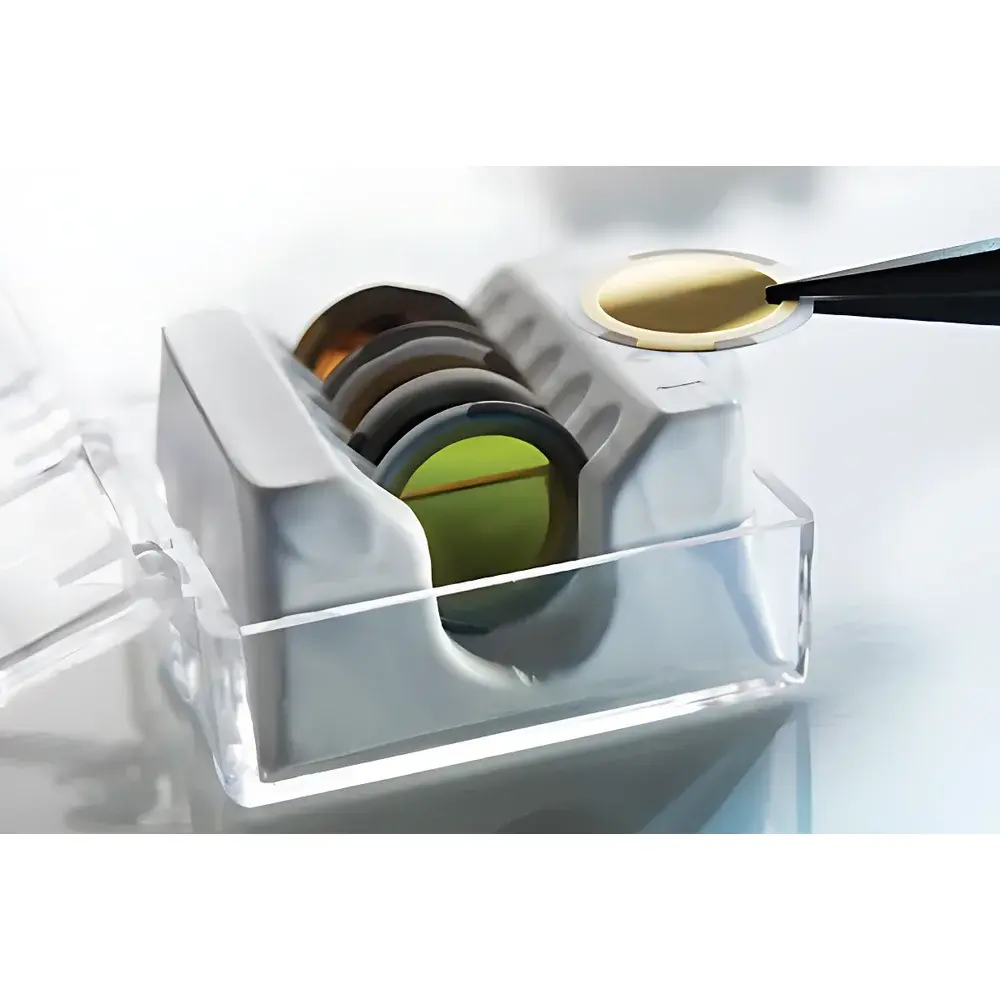
QSense QSensors Biochip for QCM-D Systems
| Brand | QSense |
|---|---|
| Origin | Sweden |
| Model | QSensors |
| Instrument Type | Microfluidic Chip System |
| Chip Surface Types | 18 Standard Coatings (e.g., Au, SiO₂, TiO₂, Al₂O₃, Cr, Ni, PMMA, PEI, NHS, Biotin, Hydroxyapatite, etc.) |
| Manufacturing Site | Gothenburg, Sweden |
| Compliance | Designed for ISO/IEC 17025-aligned QCM-D workflows |
| Application Domain | Surface science, biomolecular interaction analysis, electrochemistry, environmental interfaces, energy materials, and pharmaceutical formulation studies |
Overview
The QSense QSensors Biochip is a precision-engineered consumable platform designed exclusively for use with QCM-D (Quartz Crystal Microbalance with Dissipation monitoring) instruments. Based on the piezoelectric resonance principle, QCM-D measures real-time mass changes—down to sub-nanogram levels—on sensor surfaces, while simultaneously quantifying viscoelastic properties of adsorbed layers via energy dissipation (D) signals. Unlike optical techniques, QCM-D operates label-free in liquid environments and provides direct insight into interfacial processes including protein adsorption, polymer layer formation, cell adhesion, lipid bilayer assembly, and nanoparticle binding kinetics. The QSensors series comprises 18 rigorously validated surface chemistries, each fabricated under controlled cleanroom conditions at QSense’s Gothenburg headquarters to ensure batch-to-batch reproducibility and long-term baseline stability—critical for longitudinal studies and regulatory-compliant data generation.
Key Features
- 18 Standardized Surface Chemistries: Including Au (with Ti adhesion layer), SiO₂, Al₂O₃, TiO₂, Cr, Ni, Pt, Ta, W, ZnO, ZrO₂, Si₃N₄, carbon-based coatings (SiC, SiOC), polymers (PMMA, PS, PVDF, PEI, Nylon 6.6), functionalized surfaces (NHS, Biotin, Hydroxyapatite), and mineral substrates (CaCO₃, Cellulose, Kaolinite).
- Traceable Manufacturing & QC: All chips are produced in an ISO 9001-certified facility; each lot undergoes rigorous electrical impedance validation, surface roughness profiling (AFM-verified ≤0.4 nm RMS), and contamination screening (XPS/EDS) prior to release.
- Microfluidic Compatibility: Optimized for integration with standard QSense flow modules (e.g., E4, I4, L4), supporting laminar flow control, low dead-volume injection (<5 µL), and temperature-regulated operation (4–45 °C).
- Surface-Specific Functionalization Readiness: Pre-cleaned and plasma-activated where appropriate; many coatings support direct covalent coupling (e.g., NHS-amine), thiol-gold self-assembly, or affinity capture (e.g., biotin-streptavidin) without additional priming steps.
- Regulatory-Ready Documentation: Lot-specific certificates of analysis (CoA) include resonance frequency (f₀), dissipation factor (D), and surface wettability (contact angle) data—supporting GLP/GMP-aligned method validation and audit trails.
Sample Compatibility & Compliance
QSensors chips accommodate diverse sample classes: proteins (IgG, fibrinogen, lysozyme), nucleic acids, polysaccharides, synthetic polymers, liposomes, exosomes, bacterial cells, and colloidal nanoparticles (e.g., Au, Fe₃O₄, SiO₂). Surface selection follows physicochemical matching principles—e.g., hydrophobic PS for membrane protein reconstitution, charged PEI for DNA condensation studies, or biocompatible hydroxyapatite for osteoblast adhesion assays. All chips comply with material safety requirements per REACH Annex XIV and are free of SVHCs. For regulated environments, the system supports 21 CFR Part 11-compliant software logging when used with QTools™ v5.5+ and validated instrument configurations.
Software & Data Management
QSensors chips are fully integrated into QSense’s QTools™ software ecosystem. Raw f/D time-series data are acquired at up to 10 Hz sampling resolution and processed using built-in Voigt-based viscoelastic modeling. Batch analysis workflows enable automated comparison across multiple surface types under identical buffer conditions. Export formats include CSV, HDF5, and MIA-compliant metadata tagging (Minimum Information for QCM-D Assays). Audit trail functionality records chip lot number, operator ID, calibration timestamp, and environmental parameters (T, flow rate, pressure)—essential for ISO 13485 or FDA submission packages.
Applications
- Biomolecular Interaction Kinetics: Real-time quantification of antibody-antigen binding affinities (KD), His-tagged protein capture on Ni-NTA chips, or lectin-carbohydrate multivalency studies on mannose-functionalized surfaces.
- Drug Delivery & Formulation Science: Monitoring micelle disassembly on hydrophobic PMMA, liposome fusion on supported lipid bilayers (SLBs), or polymer-drug complexation on PEI-coated sensors.
- Corrosion & Electrochemical Interfaces: In-situ tracking of passivation layer growth on Cr or stainless steel chips under simulated coolant or seawater conditions.
- Environmental Interface Chemistry: Adsorption hysteresis of surfactants on Al₂O₃ or kaolinite chips; microplastic fouling on PVDF in wastewater matrices.
- Energy Materials Development: Solid-electrolyte interphase (SEI) formation on Li-ion battery anode analogs (e.g., graphite, SiOₓ) or catalyst layer hydration dynamics on Pt/TiO₂ fuel cell interfaces.
FAQ
Are QSensors chips compatible with non-QSense QCM-D instruments?
Yes—mechanically and electrically standardized to 14 mm diameter, 5 MHz fundamental frequency, and AT-cut quartz geometry. However, optimal dissipation sensitivity and software integration require QSense hardware and QTools™ firmware.
Can I reuse a QSensors chip after cleaning?
Reuse is not recommended. Surface regeneration may compromise coating integrity, introduce trace contaminants, or alter interfacial energetics—impacting quantitative reproducibility. Single-use protocols are validated for regulatory submissions.
Do you offer custom surface synthesis beyond the 18 standard options?
Yes. QSense provides GMP-grade custom coating development (e.g., peptide-terminated SAMs, PEGylated gold, enzyme-immobilized silica) with full characterization reports and scalability to pilot-lot production.
How are shelf life and storage conditions specified?
All chips are vacuum-sealed with desiccant and carry a 24-month shelf life from manufacturing date. Storage at 4–25 °C, protected from UV light and ambient humidity, is required to preserve surface functionality.
Is there application support for method development?
QSense’s Application Scientists provide protocol optimization services—including surface blocking strategies, buffer compatibility screening, and kinetic model selection—complementing the publicly available QCM-D Best Practices Guide (v3.2, 2023).
Related Products



