
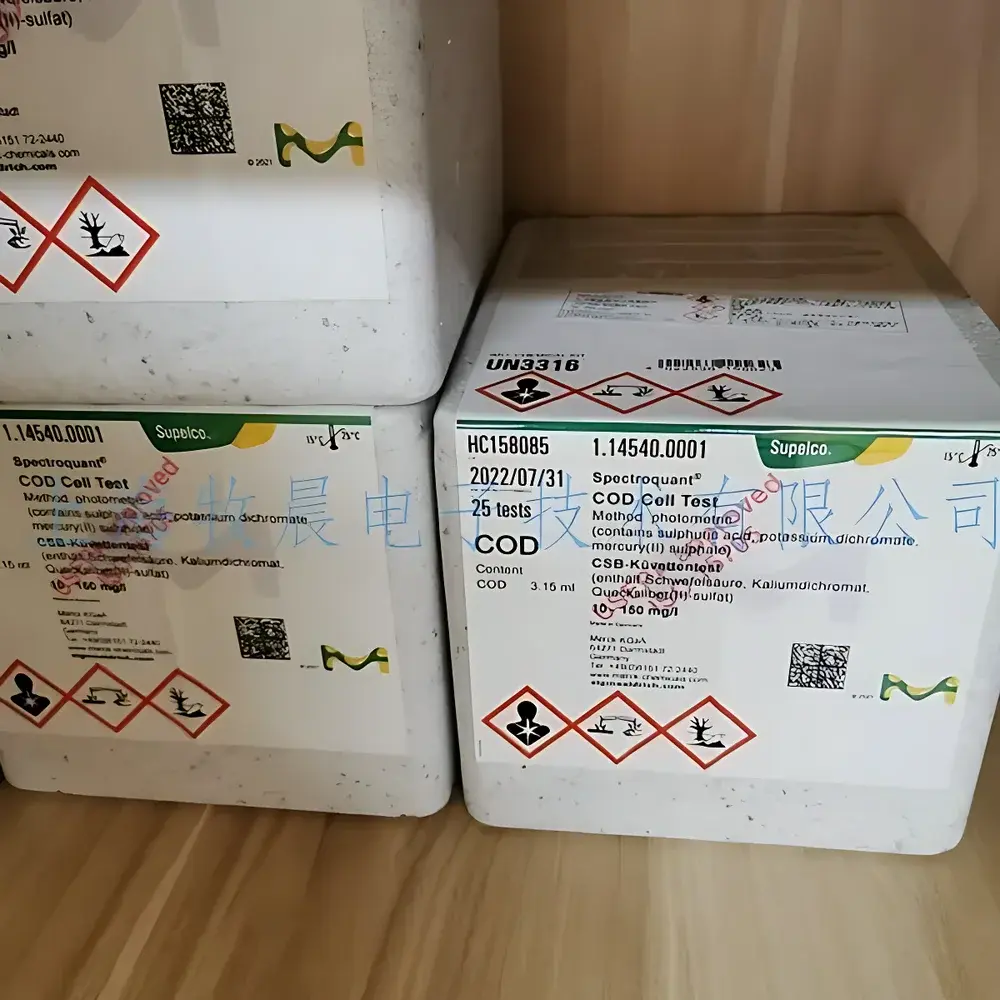
WTW C3/25 COD Pre-filled Reagent Vials (Cat. No. 14541)
| Brand | WTW |
|---|---|
| Origin | Germany |
| Model | C3/25 14541 |
| Certification | DIN 38409-41, EPA 410.4 compliant |
| Packaging | 25 vials per kit |
| COD Range | 25–1500 mg/L |
Overview
The WTW C3/25 COD Pre-filled Reagent Vials (Catalog No. 14541) are precision-engineered, factory-calibrated reagent kits designed for accurate, traceable, and operator-independent Chemical Oxygen Demand (COD) determination in accordance with standardized wet-chemical oxidation protocols. These vials implement the dichromate-based closed-reflux colorimetric method—fully compliant with DIN 38409-41 (German standard for water analysis) and U.S. EPA Method 410.4—enabling reliable quantification of oxidizable organic and inorganic substances in aqueous samples. Each vial contains a pre-weighed, homogenized mixture of potassium dichromate, sulfuric acid, silver sulfate catalyst, and mercury sulfate masking agent, sealed under inert atmosphere to ensure long-term stability and minimal batch-to-batch variability. The system is optimized for use with WTW’s photometric platforms—including photoLab® 6100/6600/7100/7600, NOVA 30/60, Prove®, Move 100, and photoFlex®—leveraging integrated barcode recognition to auto-select the correct calibration curve, wavelength, and measurement protocol without manual configuration.
Key Features
- Barcode-activated assay selection: Eliminates method selection errors by automatically loading the validated COD method (including wavelength, blank correction, and calibration slope) upon vial insertion into compatible WTW photometers.
- Traceable quality assurance: Every production lot is accompanied by a Certificate of Analysis (CoA) and Certificate of Quality (CoQ), documenting raw material sourcing, purity verification, stability testing (≥18 months shelf life at 15–25 °C), and inter-lot consistency data.
- Multi-range compatibility: This specific kit (14541) supports the 25–1500 mg/L COD range—ideal for municipal wastewater influent/effluent, industrial process streams, and bioreactor monitoring—while maintaining linearity (R² ≥ 0.999) and repeatability (RSD < 2.5% at mid-range).
- Ready-to-use formulation: No reagent preparation, weighing, or dilution required; reduces analyst exposure to hazardous chemicals and minimizes procedural drift in routine QC/QA workflows.
- Robust packaging: Vials are housed in UV-protected, tamper-evident, recyclable polypropylene trays with individual aluminum foil seals—ensuring integrity during transit and storage under ambient laboratory conditions.
Sample Compatibility & Compliance
The C3/25 14541 reagents are validated for use with clarified, filtered, or centrifuged aqueous matrices including municipal sewage, anaerobic digester supernatant, food processing effluents, cooling tower water, and surface/groundwater subject to moderate turbidity ( 2000 mg/L) require prior dilution or use of chloride-tolerant variants (e.g., 14540 with HgSO₄ enhancement). All methods comply with ISO 6060 (water quality — determination of chemical oxygen demand), ASTM D1252-12 (Standard Test Methods for Chemical Oxygen Demand), and support GLP/GMP audit readiness through full electronic record retention (when used with photoLab® instruments equipped with FDA 21 CFR Part 11-compliant software modules).
Software & Data Management
When paired with WTW’s photoLab® instrument firmware (v5.2+), the 14541 vials trigger automated data capture: instrument serial number, vial lot ID, operator ID (if logged), measurement timestamp, absorbance values at 600 nm and 436 nm (for turbidity correction), and final COD concentration with uncertainty estimation. Raw spectral data and method parameters are exportable in CSV or PDF format. Optional connectivity via USB or Ethernet enables integration into LIMS environments using ASTM E1384 or HL7-compliant data exchange protocols.
Applications
- Municipal wastewater treatment: Influent characterization, biological process control (e.g., nitrification/denitrification balance), and discharge compliance reporting.
- Industrial effluent monitoring: Electroplating rinse waters, pharmaceutical fermentation broths, brewery spent wash, and pulp/paper mill liquors.
- Environmental field studies: Seasonal COD profiling in rivers, lakes, and estuaries—particularly where rapid on-site screening replaces off-site lab analysis.
- Drinking water safety: Detection of organic contamination events (e.g., algal bloom decay, pipe biofilm sloughing) in distribution networks.
- Research & education: Standardized COD training modules in environmental engineering labs, method validation studies, and inter-laboratory comparison exercises.
FAQ
What instruments are compatible with the C3/25 14541 reagent vials?
photoLab® 6100, 6600, 7100, 7600; NOVA 30, NOVA 60; Prove®; Move 100; photoFlex®; and all WTW photometers supporting C3-series barcode protocols.
Is digestion required before measurement?
Yes—vials must undergo thermal digestion at 148 °C for 2 hours in a certified COD reactor block (e.g., WTW Reactor Block RB 09) prior to photometric reading.
Can these vials be used for chloride-rich samples?
Samples with chloride concentrations exceeding 2000 mg/L require dilution or alternative reagent formulations (e.g., Cat. No. 14540 with enhanced HgSO₄ content) to prevent interference.
How is metrological traceability maintained across batches?
Each lot is calibrated against NIST-traceable COD reference standards (SRM 2687b), and CoA reports include gravimetric verification, spectrophotometric linearity checks, and stability validation under accelerated aging conditions.
Are CoA and CoQ documents supplied with every shipment?
Yes—both certificates are provided digitally (PDF) and physically (printed copy included in the kit box), with lot-specific identifiers linked to WTW’s global quality management system (ISO 9001:2015 certified).







