
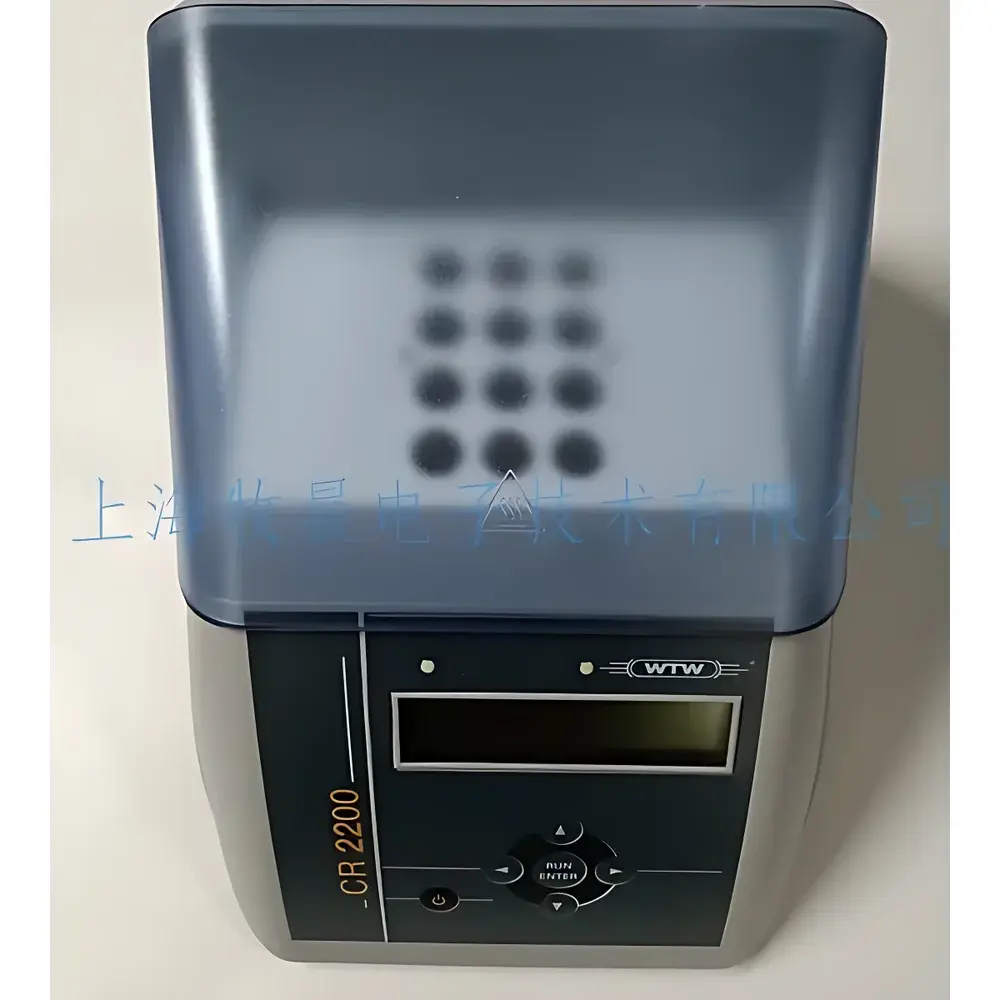
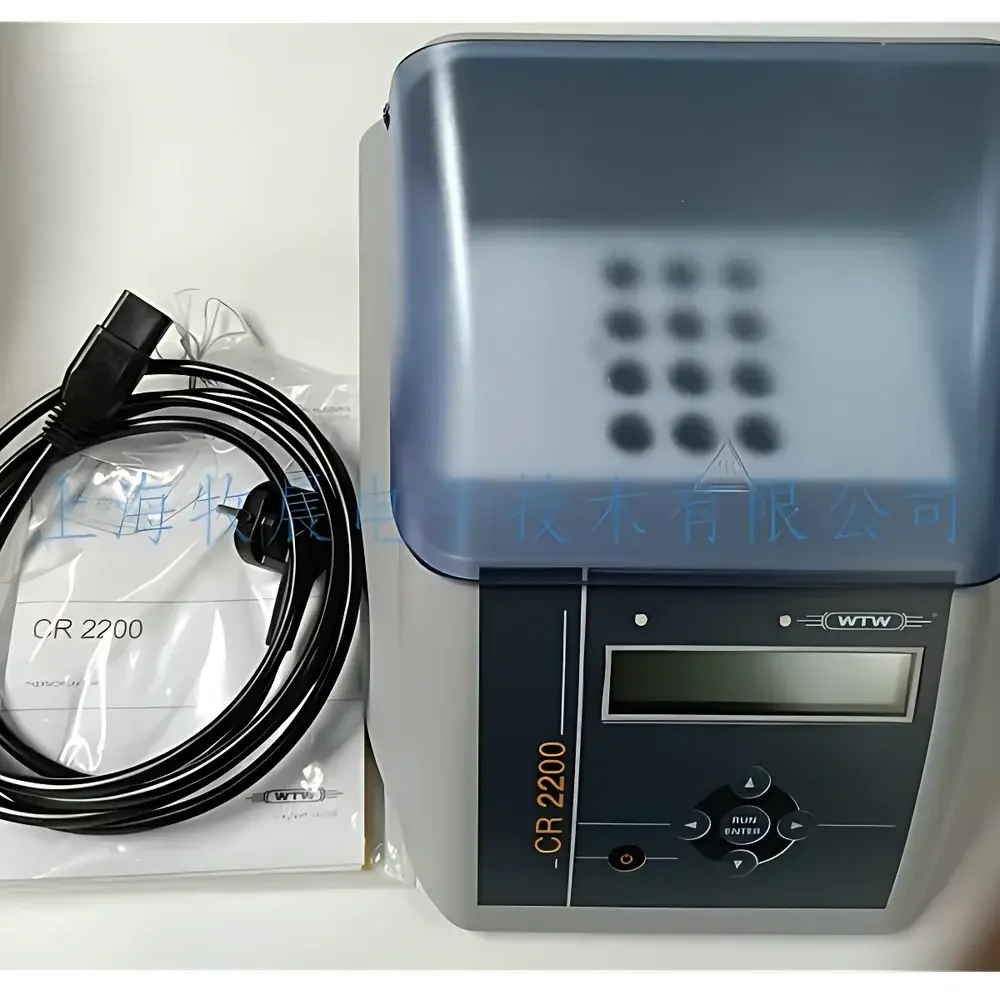
WTW CR2200 COD Digestion Block (1×12, ø16 mm)
| Brand | WTW |
|---|---|
| Origin | Germany |
| Model | CR2200 1P21- |
| Digestion Method | Rapid Digestion |
| Heating Module | Single Heating Block |
| Batch Capacity | 12 × 16 mm Tubes |
| Temperature Range | Ambient to 170 °C |
| Fixed Programs | 5 pre-set (100 °C/60 min |
| Temperature Stability | ±0.5 K |
| Control Accuracy | ±1 °C |
| Overtemperature Protection | 190 °C ±5 °C |
| Heating Time | 25 °C → 100 °C in 5 min |
| Power Supply | 230 V AC / 50 Hz or 115 V AC / 60 Hz |
| Power Consumption | 280 W |
| Dimensions (W×D×H) | 292 × 245 × 180 mm |
| Weight | 2.9 kg |
| Safety Certifications | GS, CE, cETLus |
| Operating Temperature | +5 °C to +40 °C |
| Storage Temperature | −25 °C to +65 °C |
Overview
The WTW CR2200 COD Digestion Block is a precision-engineered thermal reaction system designed for standardized oxidative digestion of water and wastewater samples prior to chemical oxygen demand (COD), total nitrogen (TN), and total phosphorus (TP) analysis. Based on the principle of controlled conductive heating within a calibrated aluminum heating block, the CR2200 delivers reproducible thermal profiles essential for compliance with international standard methods—including DIN EN ISO 6060 (COD), DIN 38405-27 (TN), and DIN 38405-30 (TP). Its single-zone 12-position heating module maintains uniform temperature distribution across all 16 mm diameter reaction tubes, minimizing inter-sample variance and ensuring method fidelity. Unlike open-heating or oil-bath systems, the CR2200’s solid-state aluminum block provides rapid thermal response, low thermal inertia, and high long-term stability—critical attributes for laboratories performing routine regulatory testing under ISO/IEC 17025 or EPA-aligned quality systems.
Key Features
- Single aluminum heating block with 12 precisely spaced 16 mm tube wells, optimized for standard COD vials (e.g., Hach, Lovibond, Merck)
- Five factory-programmed digestion protocols aligned with common regulatory requirements: 100 °C/60 min (low-temperature TP), 120 °C/30–120 min (TN and moderate COD), and 148 °C/120 min (high-efficiency COD per ISO 6060)
- Integrated overtemperature safety cutoff at 190 °C ±5 °C—mechanically independent of main control logic—to prevent thermal runaway under fault conditions
- GS-, CE-, and cETLus-certified enclosure with hinged polycarbonate safety shield, engineered to contain splashes from ruptured vials and limit operator contact with hot surfaces (surface temp <50 °C during operation)
- LED status indicators for power, heating, and completion; digital LCD display showing real-time setpoint and actual block temperature
- Auto-start and auto-shutdown functionality eliminates manual timing errors and reduces energy consumption during unattended operation
- Robust mechanical design: anodized aluminum housing, stainless steel fasteners, and IP20-rated electronics for laboratory durability
Sample Compatibility & Compliance
The CR2200 accommodates standard 16 mm outer-diameter digestion vials used across major reagent kits (e.g., WTW Spectroquant®, Hach LCK, Merck Spectroquant®). Its fixed geometry ensures consistent heat transfer coefficients across all positions—validated per ASTM D1250 Annex A4 for thermal uniformity (±1.2 °C max deviation across 12 wells at 148 °C). The instrument meets essential safety and electromagnetic compatibility requirements for use in accredited environmental testing labs, including conformity with IEC 61010-1 (Safety of Electrical Equipment for Measurement, Control, and Laboratory Use) and IEC 61326-1 (EMC for Laboratory Instruments). While not equipped with data logging hardware, its thermal performance supports GLP-compliant workflows when paired with external temperature validation probes (e.g., NIST-traceable Pt100 sensors) and documented calibration procedures performed at least annually.
Software & Data Management
The CR2200 operates as a standalone hardware platform without embedded software or network connectivity. All parameter selection and execution occur via front-panel push-button interface and real-time LCD feedback—ensuring deterministic behavior, immunity to firmware corruption, and full auditability of user actions (no hidden background processes). For laboratories requiring electronic records, integration is achieved through external validation tools: a calibrated external probe (e.g., WTW TFK CR-compatible Pt100 sensor) may be inserted into a designated well to log temperature vs. time profiles using third-party DAQ software compliant with FDA 21 CFR Part 11 (e.g., LabVIEW with electronic signature modules or validated LIMS interfaces). No proprietary drivers or cloud dependencies are required, preserving data sovereignty and simplifying 21 CFR Part 11 validation efforts.
Applications
- Routine COD determination in municipal wastewater, industrial effluents, and surface water per ISO 6060 and EPA Method 410.4
- Oxidative digestion for total nitrogen quantification using alkaline persulfate digestion (DIN 38405-27)
- Acid hydrolysis of orthophosphate esters in total phosphorus analysis (DIN 38405-30)
- Preparation of digested samples for subsequent spectrophotometric, ion chromatographic, or ICP-OES analysis
- Method development and validation studies requiring precise, repeatable thermal ramping and hold profiles
- Training and teaching laboratories where operational simplicity, safety, and regulatory alignment are prioritized
FAQ
Does the CR2200 support custom temperature/time programs?
No—the CR2200 offers five fixed digestion protocols only. For programmable ramp/soak capability, consider the CR3200 or CR4200 models with RS-232 interface and editable program memory.
Is the heating block compatible with 20 mm or 25 mm vials?
No—it is dimensionally optimized for 16 mm OD glass or quartz digestion tubes. Use of larger vials compromises thermal contact and violates safety certification conditions.
Can the CR2200 be used for chloride interference correction protocols?
Yes—its 120 °C/30 min program is suitable for mercury sulfate-based chloride masking steps as specified in ISO 6060 Annex B.
What maintenance is required to ensure long-term accuracy?
Annual verification of block temperature uniformity and setpoint accuracy using a NIST-traceable reference thermometer is recommended. No routine lubrication or internal servicing is required.
Is the CR2200 suitable for GMP-regulated pharmaceutical wastewater testing?
It may be deployed in GMP environments when integrated into a validated analytical method, supported by documented IQ/OQ/PQ protocols, and operated under controlled change management—but it does not provide electronic audit trails or user access controls out-of-the-box.
Related Products







