
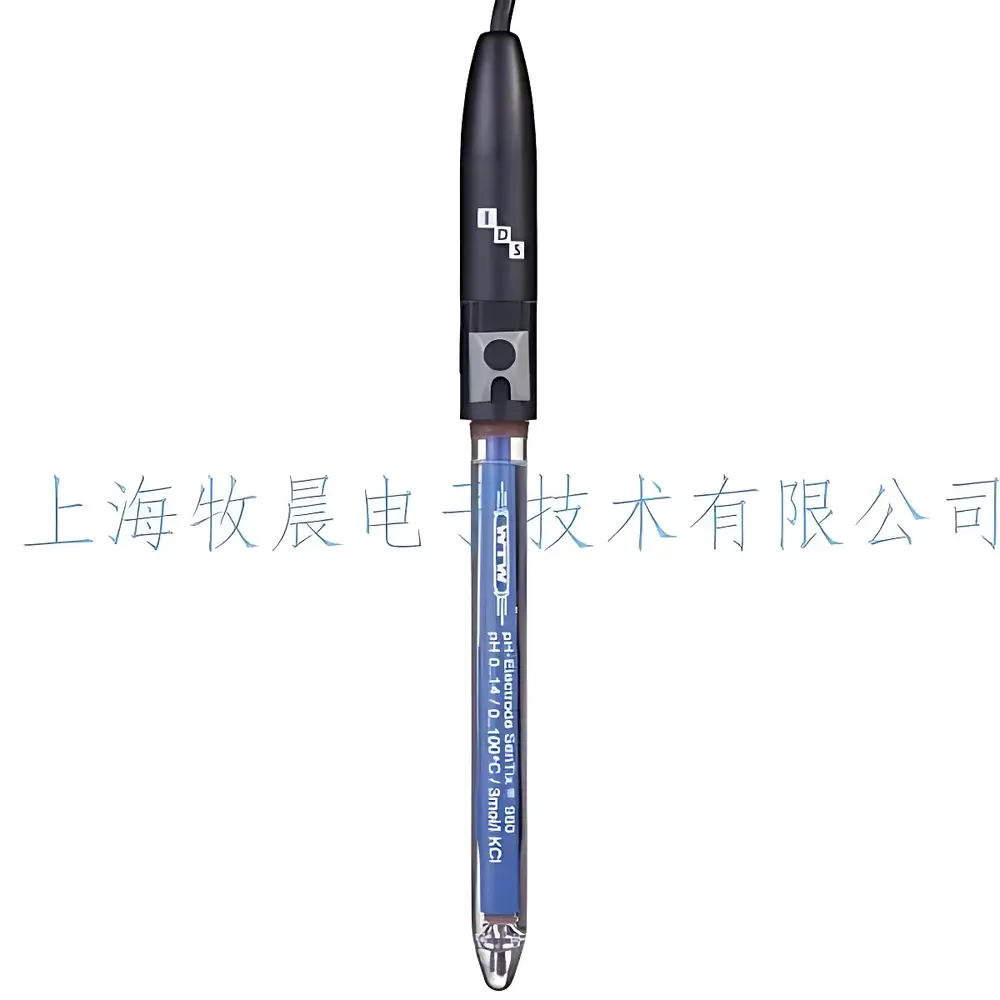
WTW SenTix® 980 IDS Digital pH Electrode
| Brand | WTW |
|---|---|
| Origin | Germany |
| Model | SenTix® 980 |
| Measurement Range | 0–14.00 pH |
| Accuracy | ±0.004 pH |
| Temperature Sensor | NTC 30 kΩ |
| Reference Electrolyte | 3 mol/L KCl |
| Membrane Resistance | < 600 MΩ |
| Shaft Length | 120 mm |
| Shaft Diameter | 12 mm |
| Connection | Integrated 1.5 m waterproof digital cable with IDS connector |
| Tip Geometry | Conical glass membrane |
| Electrolyte System | Liquid-filled |
| Internal Signal Processing | Yes |
| QSC (Quality Sensor Control) | Yes |
| Calibration Data Storage | On-board memory |
Overview
The WTW SenTix® 980 IDS Digital pH Electrode is an advanced, intelligent sensor engineered for high-precision laboratory pH measurement in demanding analytical environments. Built upon WTW’s Intelligent Digital Sensor (IDS) platform, it integrates analog-to-digital conversion and signal conditioning directly within the electrode housing—eliminating analog signal degradation, noise susceptibility, and cable-length limitations common in conventional analog electrodes. The electrode operates on the fundamental principle of potentiometric measurement: the potential difference between a pH-sensitive glass membrane and a stable internal reference system (Ag/AgCl in 3 mol/L KCl) is measured against a defined reference electrode, yielding a voltage proportional to the logarithm of hydrogen ion activity (Nernst equation). Its conical glass membrane ensures rapid response, mechanical robustness, and optimal contact with small-volume or heterogeneous samples—including suspensions, gels, and viscous media—while the platinum-wire junction enhances electrolyte flow stability and prevents clogging during extended use.
Key Features
- Integrated digital signal processing: All measurement data (pH, mV, temperature) are digitized at the sensor head, ensuring immunity to electromagnetic interference and enabling plug-and-play compatibility with all WTW IDS-compatible meters (e.g., pH 3310, Multi 3630, inoLab®系列).
- On-board calibration memory: Stores up to three-point calibration history—including date, time, buffer values, slope, and offset—enabling seamless electrode replacement without reconfiguration or manual parameter transfer.
- QSC (Quality Sensor Control): Continuously monitors junction potential, membrane resistance (< 600 MΩ), and thermal drift to provide real-time diagnostic feedback on sensor health and measurement reliability.
- Liquid-filled reference system with 3 mol/L KCl electrolyte: Ensures stable, low-resistance junction potential and long-term reproducibility across wide pH and temperature ranges (0–100 °C).
- Conical glass sensing tip (12 mm diameter × 120 mm shaft): Optimized for immersion depth control, reduced sample volume requirements, and minimized surface adhesion in routine lab workflows.
- NTC 30 kΩ integrated temperature sensor: Enables automatic temperature compensation (ATC) with ±0.1 °C accuracy—critical for compliance with ISO 7888, ASTM D1293, and USP .
Sample Compatibility & Compliance
The SenTix® 980 is validated for aqueous and mildly aggressive matrices including buffers, biological fluids, wastewater, food extracts, and pharmaceutical formulations. Its liquid-junction design supports reliable performance in low-ionic-strength samples where gel-junction electrodes may exhibit unstable potentials. The electrode meets IEC 61000-4 electromagnetic compatibility standards and conforms to CE marking requirements for laboratory instrumentation. When used with WTW IDS meters configured for audit trail and user access control, the system supports GLP/GMP-aligned workflows—including 21 CFR Part 11-compliant data integrity when paired with appropriate software (e.g., LabX® or WTW LabManager™). Calibration traceability aligns with ISO/IEC 17025-accredited reference buffers (e.g., DIN 19266, NIST SRM 186).
Software & Data Management
All IDS sensors communicate via a standardized digital protocol that enables automatic recognition, firmware updates, and metadata-rich data logging. When connected to WTW’s LabManager™ or third-party LIMS platforms via RS232/USB/Ethernet gateways, the electrode transmits timestamped pH, mV, temperature, QSC status, and calibration parameters as structured CSV or XML records. Each measurement includes embedded sensor ID, serial number, and calibration validity flags—supporting full chain-of-custody documentation required in regulated QC/QA labs. Firmware updates preserve backward compatibility and may introduce enhanced diagnostics or expanded temperature compensation algorithms per latest WTW service bulletins.
Applications
- Standardization of pH calibration protocols in central analytical laboratories (e.g., environmental testing, clinical chemistry, raw material QC).
- Long-term stability monitoring in bioreactor media and fermentation broth analysis.
- High-accuracy titration endpoint detection where drift-free baseline stability is essential.
- Educational labs requiring robust, maintenance-minimized electrodes for undergraduate electrochemistry instruction.
- Regulatory submissions requiring documented sensor performance history and calibration traceability.
FAQ
Does the SenTix® 980 require special cleaning or storage procedures?
Yes—store upright in 3 mol/L KCl solution or WTW Storage Solution (Art. No. 100102); avoid prolonged dry storage or immersion in deionized water. Clean the conical tip with mild detergent or ethanol for organic residues; rinse thoroughly before reuse.
Can the electrode be used with non-WTW meters?
No—it is exclusively compatible with WTW IDS-enabled instruments due to proprietary digital communication protocol and power delivery architecture.
What does QSC status “Warning” indicate?
A QSC warning signals elevated membrane resistance (>400 MΩ) or junction instability—typically resolved by soaking in KCl solution for 2–4 hours; persistent warnings suggest membrane aging or contamination requiring replacement.
Is the 1.5 m cable field-replaceable?
No—the cable is permanently sealed and potted into the electrode body; replacement requires factory service or new sensor unit (Order No. 103780).
How often should calibration be performed?
Daily calibration is recommended for critical applications; interval may extend to weekly under stable conditions—always verify with two-point check (pH 4.01 + 7.00 or 10.01) prior to sample measurement.




